謝謝你,親愛的,《日本骷髏》:一幅可怕的二戰紀念品的肖像
Thank You, Sweetheart, for the ‘Jap Skull’: Portrait of a Grisly WWII Memento
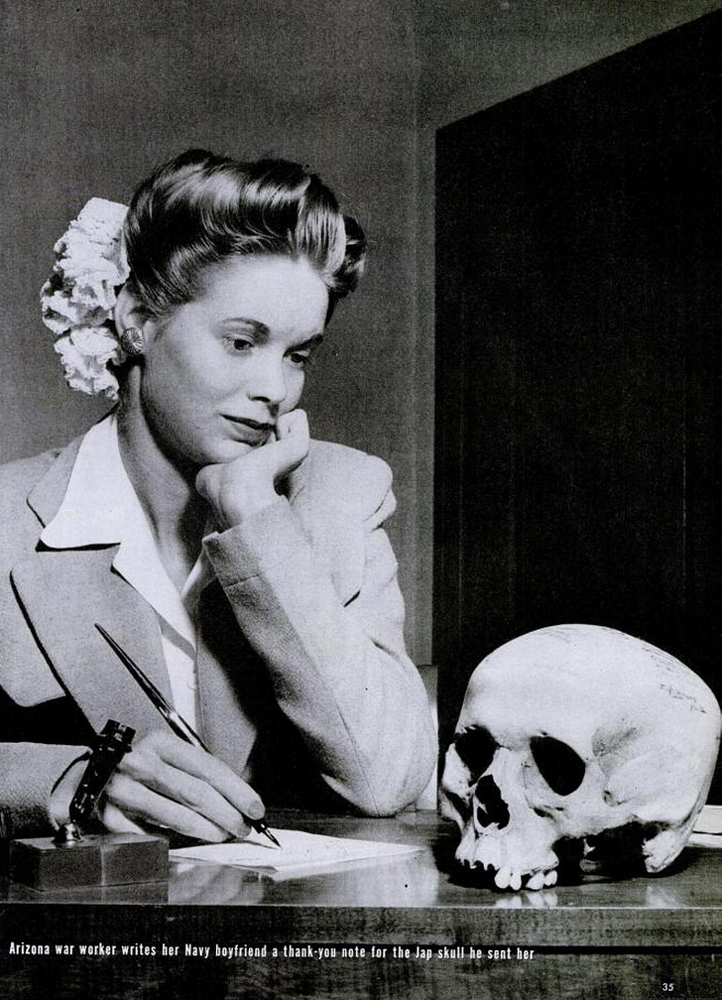
So much about this picture is a mystery. We don’t know what the young women in it was thinking. We don’t know what became of the skull—or, indeed, what became of the young woman herself, or the man who sent it to her as a “gift” from the Pacific in the midst of World War II.
We only know what LIFE magazine’s editors wrote about the photo, taken by Ralph Crane (later a staff photographer for LIFE) when they featured it as a Picture of the Week in the May 22, 1944, issue:
When he said goodbye two years ago to Natalie Nickerson, 20, a war worker of Phoenix, Ariz., a big, handsome Navy lieutenant promised her a Jap. Last week Natalie received a human skull, autographed by her lieutenant and 13 friends, and inscribed: “This is a good Jap—a dead one picked up on the New Guinea beach.” Natalie, surprised at the gift, named it Tojo. The armed forces [LIFE pointedly noted] disapprove strongly of this sort of thing.
Battlefield atrocities have of course been a part of warfare since humans began killing one another in a concerted, relatively organized fashion several thousand years ago, and no army in history has been wholly innocent of the charge. As Niall Ferguson pointed out in his 2006 book, The War of the World: Twentieth-Century Conflict and the Descent of the West, while discussing this very photograph of young Natalie Nickerson and the Japanese skull: “Allied troops often regarded the Japanese in the same way that Germans regarded Russians—as Untermenschen. Boiling the flesh off enemy skulls to make souvenirs was a not uncommon practice. Ears, bones and teeth were also collected.”
That Japanese troops committed stomach-churning atrocities of their own in the 1930s and 1940s—burying prisoners of war alive or using them for bayonet practice; the mass slaughter and rape of civilians; torturing and executing captured Allied airmen; and on and on—is well documented. In light of those brutal excesses, mailing a single skull to a stateside sweetheart might seem an almost innocent, if rather grisly, undertaking.

And yet, all these years later, as the visual landscape of warfare grows, improbably, more gruesome than ever—with beheadings and other savageries videotaped and posted online for any and all to see—there remains something oddly unsettling about the sight of an attractive young woman gazing at an “enemy skull” and penning a thank-you note to the (unnamed) beau who sent it.
MORE MUST-READS FROM TIME
- What Student Photojournalists Saw at the Campus Protests
- How Far Trump Would Go
- Why Maternity Care Is Underpaid
- Saving Seconds Is Better Than Hours
- Welcome to the Golden Age of Ryan Gosling
- Scientists Are Finding Out Just How Toxic Your Stuff Is
- The 100 Most Influential People of 2024
- Want Weekly Recs on What to Watch, Read, and More? Sign Up for Worth Your Time
CONTACT US AT LETTERS@TIME.COM
TIME may receive compensation for some links to products and services on this website. Offers may be subject to change without notice.

留言
張貼留言