中村輝夫、李光輝:最後的落後者:比小野田廣夫活得更久的日本士兵
A BLAST FROM THE PAST
by Mike Dash
曾經叱吒風雲的
透過邁克·達什
最後的落後者:比小野田廣夫活得更久的日本士兵

二戰結束後,日本帝國陸軍的一名士兵中村照夫 (Teruo Nakamura) 在摩羅泰島的叢林深處生存了 29 年,成為印尼和太平洋各島嶼上被圍捕的 120 多名散兵游勇中的最後一個。 1947 年和1974 年。
四十年前,日本的過去與現在在盧邦島熱帶雨林中的一條河邊相遇。這次相遇發生在 1974 年 2 月 20 日的熱帶黃昏,當時微風已停,空氣中飛蟲密密麻麻。代表嘉賓是一位大學輟學生,名叫鈴木紀男,24 歲,身穿 T 卹、深藍色長褲、襪子和一雙橡膠涼鞋。他彎下腰,用一堆樹枝生火,完全沒有意識到有人在監視他。同時,過去從叢林的掩護中向外張望,想知道這個年輕人是否是某種陷阱。站在森林邊緣凝視的男人穿著一套殘破的軍裝,手裡拿著一把步槍。這場遭遇時,他已在盧邦內地躲藏了近 30 年,堅定不移地繼續發動一場戰爭,這場戰爭最終以 1945 年 9 月 2 日日本在東京灣投降而告終。
過去的名字叫小野田寬郎。他是大日本帝國陸軍的情報官,當時他才五十二歲生日,即將成名。

小野田寬郎從 1945 年一直在菲律賓盧邦島堅守,直到 1974 年投降。他的智慧、決心和拒絕投降使他成為名人,儘管他在日本以外比在日本國內更被視為英雄。
小野田自 1944 年起就一直在盧邦,幾個月後,美國入侵並奪回了菲律賓。他從頂頭上司收到的最後指示命令他撤退到該島的內部——該島很小,實際上並不重要——並騷擾盟軍佔領軍,直到以色列軍隊最終返回。「絕對禁止你親手死去,」他被告知。「可能需要三年,也可能需要五年,但無論發生什麼,我們都會回來找你。在那之前,只要你還有一名士兵,你就必須繼續領導他。
「你可能得靠椰子為生。如果是這樣的話,就靠椰子過活吧!在任何情況下你都不能自願放棄自己的生命。”
小野田遵從了這樣的決心,他無視一再勸降的努力——透過散發傳單、透過擴音器和實地巡邏——並繼續將戰爭帶給當地人民。在三十年的時間裡,他和數量不斷減少的同伴在一場零星的遊擊戰中殺死了30 名盧邦島民,並打傷了100 多人,曾經強大的帝國軍隊淪落到暗殺一些牛,偶爾還焚燒成堆收穫的農作物的地步。靠近叢林邊緣種植的水稻。在與當地警察的交火中,他的四名手下中的最後一人喪生後,小野田獨自一人繼續前進。

29 年後,小野田離開了叢林。左邊是找到他的冒險家鈴木法夫。
那場槍戰被證明是小野田一生中的一個變革時刻。當然,當地的菲律賓人非常清楚,日本舊佔領軍的倖存者就住在他們島上的某個地方。他們的政府和日本政府也是如此。但在此之前,這個故事從未如此真實地引起了世界媒體的興趣。直到現在——隨著小野田的同伴、二等兵小塚金七的屍體發現了無可爭議的散兵游勇的存在證據 ——記者們才開始廣泛報道盧邦的頑固分子。他們的故事也越來越多地集中在小野田身上,以及他在小衝突中倖存下來並在叢林中的某個地方生活的可能性。
正是這篇新聞報道引起了鈴木法夫的注意,鈴木法夫剛從幾年的亞洲流浪中歸來,正在尋找另一次冒險。當他宣布打算去尋找「按順序尋找小野田中尉、熊貓和可惡的雪人」時,很少有人認真對待他;畢竟,幾次大規模的探險已經試圖將小野田從他的藏身之處哄出來,但都以失敗告終。但鈴木比他之前的人有一個顯著的優勢:他的一個人搜索隊是如此不言而喻的古怪和荒謬,以至於小野田在叢林中偶然發現這個年輕人時並沒有感到受到威脅。相反,經過仔細的偵察,他確信附近沒有其他人潛伏後,他出現並與入侵者對峙。
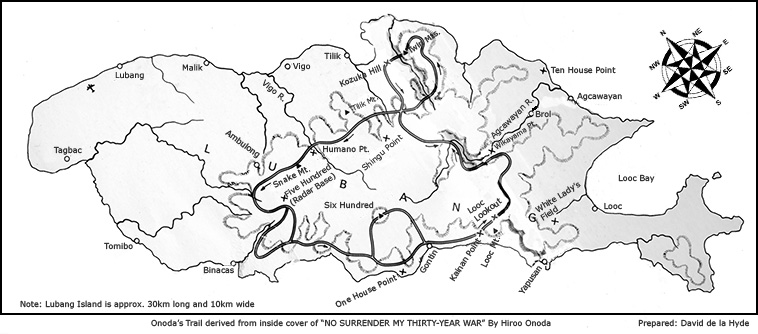
盧邦島長近 19 英里,寬 6 英里(30 公里 x 10 公里)。小野田和其他三名散兵游勇的日本人定期圍繞一系列臨時基地盤旋,如大衛·德拉·海德繪製的這張地圖所示。點擊以更高解析度查看。
「如果他沒有穿襪子,」小野田後來寫道,「我可能會開槍打死他。但他雖然穿著涼鞋,卻穿著厚厚的羊毛襪。島民絕對不會做出如此不協調的事。
他站起來,轉身。他的眼睛睜得圓圓的……他面向我敬禮。然後他再次行禮。他的雙手在顫抖,我發誓他的膝蓋也在顫抖。
他問道:“你是小野田先生嗎?”
“是的,我是小野田。”
“真的嗎,小野田中尉?”
我點點頭,他繼續說。
「我知道你已經度過了一段漫長而艱難的時光。戰爭結束了。你不跟我一起回日本嗎?”
他用禮貌的日文表達讓我相信他一定是在日本長大的,但他做事太匆忙了。他是否認為他可以簡單地說戰爭已經結束,我會和他一起跑回日本?這麼多年過去了,這讓我很生氣。
「不,我不會回去!對我來說,戰爭還沒結束!”
在小野田當天所說的所有話中——或者說,在鈴木幾週後帶著日本要求中尉放下武器的正式命令返回後,他用相當長的篇幅說——最後這句話引起了最強烈的共鳴。老戰士的前敵人更熱烈地接受了這種情感,他們發現他的堅定和無私比在他的祖國更值得欽佩,當時他的祖國仍在努力接受戰時軍國主義,並對那些人深表懷疑。他們代表對舊政權的忠誠。(比阿特麗斯·特雷法爾特指出,對於大多數日本人來說,小野田「只是以一種最令人不舒服的方式令人欽佩。」)不過,最終他贏得了所有人的支持。這位前叢林居民能言善辯,是天生的演員,在聚光燈下出奇地自在,他毫不費力地把自己塑造成一個主張簡單和自力更生、而不是侵略和帝國主義的人。就連他懷疑的同胞也開始在他身上看到他們失去的東西——重要的東西。
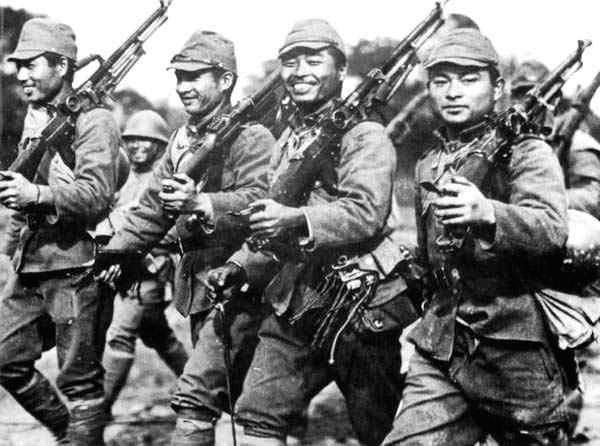
二戰時期的日本士兵。
可以肯定地說,1974 年的日本幾乎沒有人對那些對1937 年南京大屠殺或1941 年珍珠港襲擊負有責任的政府、武裝部隊或意識形態表示同情— — 甚至在那些了解這些事件的人中也是如此。本島缺乏自然資源,導致該國走上戰爭之路,或支持表面上為之奮鬥的公開反殖民目標。但自 1945 年以來已經過去了很長一段時間。該國一半的人口是在戰爭結束後出生的,他們對戰爭事件、戰時宣傳或結束戰爭的可怕方式沒有個人記憶。由蘑菇雲。對他們中的許多人來說,戰後時期的軍隊散兵游勇不僅讓人們想起了日本近代的侵略行為,而且還是一個共同價值觀時代的旗手。在 70 年代中期的日本,怨恨的退伍軍人並不是唯一認為年輕一代被寵壞了、沉迷於消費品、並受到西方時尚和西方音樂的影響的人。
人們還記得日本是如何進行戰爭的——不斷擴大其帝國的疆域,直到它涵蓋了中國的大部分地區、整個東南亞和印度尼西亞,以及太平洋的一半,然後眼睜睜地看著這個帝國淪陷。一系列自殺性最後一戰的碎片,戰鬥範圍達數萬平方英里,通常幾乎沒有留下任何倖存的目擊者——毫不奇怪,該國在確定最後一場戰鬥中誰還活著、誰已經死亡方面經歷了難以置信的困難衝突的日子。投降後,350 萬倖存的日本士兵、水手和飛行員被困在海外,其中超過 100 萬駐紮在菲律賓、印尼和太平洋島嶼上。他們花了三年時間才完成遣返,即便如此,仍有數千名不幸被困在鐵幕或竹幕後面的人直到多年後才回家。現代日本每年仍然有大約 100 名左右的「戰爭嬰兒」源源不斷地回歸日本,他們是在戰爭年代出生在中國,並在一個飽受內戰和革命蹂躪的國家長大成人的成年人。
 在這種混亂的環境中,有多少日本人的命運仍然不明,令人震驚。1946 年,僅海軍就公佈了 72 萬名「失蹤」人員的姓名,儘管戰後遣返福利局的成立不僅是為了將駐紮在海外的人員送回祖國,也是為了追查死者的下落,但在通過梳理記錄和訪談倖存者,1950 年這一數字仍為561 人,這一年所有下落不明的人均被官方推定死亡。
因此,派往太平洋搜尋可以歸還給家人的遺骸的所謂「骨頭收集團」偶爾會偶然發現一小群掉隊者,也就不足為奇了。第一個報導的是一群住在新幾內亞內陸的八名士兵,告訴救援人員,自戰爭結束以來,他們已經靠著「老鼠和馬鈴薯」生活了四年。迄今為止,最臭名昭著的是1951 年在阿納塔漢小島上被圍捕的21 名帝國臣民。與其他幾個此類團體一樣,他們有幸駐紮在一個被美國搶先的島嶼上,並在接下來的六次圍捕中倖存下來。多年來幾乎完全不受干擾。關於他們,最有趣的事情是——至少在好色的媒體眼中——是這群人中出現了一位孤獨的女性,比嘉和子,人們普遍認為,她曾多次成為爭奪感情的暴力鬥爭的對象 。根據阿納塔漢號故事更色彩繽紛的描述,滯留在島上的 30 名海軍水手中有 11 人因此死亡——其中四人曾一度認為自己是和子的「丈夫」。

1945 年至 1951 年間,30 名日本水手和一名平民婦女留在阿納塔罕島上的經歷已被改編成三部電影。兩部日本作品中的第一部是 1956 年由前田美智子主演的《珍珠女王的復仇》,它是如何美化島上不尋常情況並使其性感化的一個很好的例子。
然而,總體而言,直到 20 世紀 60 年代,關於在太平洋發現日本落後者的故事還沒有引起太多關注。造成這種情況的原因有幾個。最重要的是,首先當然是許多日本人或多或少有意識地希望將他們的戰時經歷拋在腦後。特雷哈夫特指出:「戰爭死難者,由於他們的犧牲和缺席,可以在一定程度上得到原諒和紀念,但那些回來的人,即使是在很久以後,他們的態度也要模糊得多。 」他們不僅參與了錯誤的戰爭,而且沒能贏得戰爭;而且 他們也沒有死。隨著時間的推移,這種態度確實軟化了。1955 年在新幾內亞發現的另外五名落後者曾短暫被譽為「戰死者的活人靈魂」。但直到 1972 年,也就是小野田的同伴和子被殺的那一年,日本頑固分子的回歸才首次引起了全世界的關注。

橫井昭一在美國關島躲藏了近 30 年,直到 1972 年初才被重新發現。
在這起案件中,情況確實非同尋常,這很有幫助。橫井昭一士官在美國關島的叢林中倖存下來,他整天躲在一個精心建造的地洞裡。儘管他的存在可能有失尊嚴,但他無疑是聰明才智和堅韌的,他最終回到日本時受到了熱烈歡迎。事實上,事實證明,橫井除了簡單地活下去之外幾乎沒有做任何事情,而且他的被捕遠非英雄式的尷尬境地——他是在半飢餓狀態下被一群跌跌撞撞的村民帶走的。當他在小溪裡抓蝦時,他從他身邊走過。橫井被稱讚為一個不言而喻的「特別」人。戰前他曾是一名裁縫,人們對他為自己製作紐扣和鞋子的能力以及使他避免吃任何有毒的當地植物和野生動物的自學技能給予了高度讚揚。這對兩個早期同伴來說是致命的。作為日本戰時領導階層(包括不可觸碰的裕仁天皇)的公開批評者,橫井從叢林中崛起,也可以令人信服地被描繪成受害者——他自己受教育程度不足,軍事訓練不足,對時事的故意無知這是 IJA 宣傳以及戰時審查和鎮壓的一個顯著特徵。

橫井中士的洞穴是手工挖掘的,並用竹子精心支撐,多年來在距美國主要空軍基地僅幾英里的地方庇護和隱藏了他,使其不被發現。
橫井中士還有另一堂課要教。他多年前不自首的動機——儘管他早在 1952 年就清楚戰爭已經結束——與為皇帝繼續戰鬥的願望無關。他知道他的軍隊的 武士道準則禁止自我犧牲或自殺,而不是自我保護,他坦率地承認,他擔心自己會被視為逃兵,接受軍事法庭審判,如果被遣返,可能會被處決。
橫井和小野田這樣兩個完全不同的散兵游勇在幾個月內從兩個不同的叢林、兩個不同的島嶼上相繼出現,現在看來很引人注目,就像當時看起來很奇怪一樣。橫井是一名應徵入伍的士兵,一名士官,一名和平主義者,他躲在地洞裡,多年來以蝸牛和蜥蜴為食,從叢林中出來時又髒又病,帶著一把腐蝕得毫無用處的步槍,他非常願意承認整個戰爭是個錯誤。小野田是一名軍官,曾在日本陸軍精英中野突擊隊學校就讀,他在盧邦內陸地區隨心所欲地生活,他的步槍始終閃閃發亮,只要有可能,他仍然向敵人發動戰爭。小野田三十多年來一直保持巔峰狀態。當他遇到鈴木典夫時,他比同齡的日本人平均健康得多。很容易得出結論(正如許多人所做的那樣),小野田和橫井之間的區別是「武士和平民之間的區別」。
然而,在思考盧邦和關島的頑抗者之間的有趣對比時,人們幾乎總是忘記的是,在小野田投降後僅幾個月,第三個落後者就從叢林中出現了——事實上,這是大規模爆發的直接後果。隨之而來的宣傳。他的名字叫中村輝雄,他是 1945 年之後所有奮戰的落後者中「最後一個」返回家鄉的人——他與小野田和橫井的不同,就像他們彼此之間的不同一樣。事實上,中村已經被如此嚴重地遺忘,並且如此與眾不同,以至於非常值得詳細考慮他的奇怪問題案例。

點擊地圖以清晰的全解析度查看
中村在福爾摩沙(台灣)長大,當時台灣是日本的屬地,1894-95 年中日戰爭結束時從中國手中奪取了台灣。他出生於 1923 年,是當地原住民的一員,當時原住民只佔島上人口的一小部分。他的真名似乎是阿頓·帕拉林(Attun Palalin),但他在應徵入伍(或自願;這裡似乎沒有達成共識)並於1943 年參戰時採用了日本名字。在完成基礎訓練後,他被被派往幾個月前,他的部隊抵達印尼摩羅泰島,遭到美軍的攻擊。
那麼,中村並不是日本人,他和他的戰友在帝國軍的戰鬥序列中充其量只是處於邊緣位置。他參軍的首要動機之一——參加一場只有大約8,500名台灣人直接參與的戰爭——可能是為了提升自己的地位;在島上管理者的眼中,加入帝國軍隊的土著男子的地位高於當地華人。但這個決定也將他置於相當危險的境地。台灣的「特種志願兵」被日本上級指派去執行危險任務,並在一些最血腥的戰爭中充當砲灰。正如特雷法爾特指出的那樣,中村的倖存「因此不可避免地將日本帝國主義的遺產帶入了公共領域」。

道格拉斯·麥克阿瑟將軍抵達摩羅泰島。1944 年 9 月美國登陸後,該島發生了激烈的戰鬥。
中村部隊被迫做出的戰時選擇與許多其他日本陸軍部隊面對盟軍在小島上登陸時所做的選擇類似。他們被迫充分利用有限的補給,面對壓倒性的數量,並且缺乏適當的空中支援,他們要么在無望的防禦嘗試中犧牲自己,要么撤退到內陸地區。莫羅泰島——一個面積約700 平方英里的島嶼,是小野田的盧邦島的五倍——足夠大,使後一種選擇成為現實,而中村很幸運,他的部隊在入侵後不久就被命令分散並開始遊擊戰發生了。11個月後,當戰爭真正結束時,他已經是一支日漸減少的士兵隊伍中的一員,這支隊伍似乎反覆分散和合併,分成越來越小的隊伍,在叢林深處尋找食物,並經常因飢餓而失去成員和疾病。據這些小團體之一的倖存者(1956 年被發現並遣返的九名男子)稱,中村擁有高度的自給自足能力。1946年至1947年間,他獨自前往叢林生活,1950年回到大群,幾年後再次失蹤。

「中村市」-加羅卡山脈中的一塊空地,是台灣流浪者近四分之一個世紀以來的家。
其他部隊普遍認為中村死在叢林的某個地方。事實上,他倖存下來並獨自生活,在河裡捕魚,維護他的步槍(但沒有用它來狩獵,因為擔心被當地人聽到和發現),並最終在莫羅泰南部山區的一個偏遠裂縫中定居下來。在那裡,他逐漸在雨林中開闢了一塊空地,在那裡他可以種植紅辣椒、香蕉、芋頭和木瓜。
很難確切知道這些年來中村是多麼孤獨。當地的一些證詞表明,他繼續漫遊尋找食物來補充飲食,並且不時在叢林中被發現——一個遙遠的身影,幾乎赤身裸體地站在山坡上。來自摩羅泰島印尼空軍基地的飛機有時也會飛越叢林,多年來,飛行員在一些奇怪的偏遠地區記錄了人類活動的證據。但是,關於島上可能存在日軍落伍者的消息仍然僅限於基地內部,直到 1974 年小野田投降的全球宣傳喚起了一些記憶,飛行員目擊事件的消息最終傳到了遣返福利局的成員那裡。-同年晚些時候訪問摩羅泰的收集任務。
消息被傳遞到日本駐雅加達大使館,然後又傳遞到東京,後者正式請求印尼政府提供協助。事實證明,從空中確定中村的位置並不困難,但實際上步行到達他的空地卻是另一回事。印尼軍隊的士兵花了三天時間從最近的道路長途跋涉穿過叢林,面對一個很可能攜帶武器的未知對手,他們在接近他時選擇了一些非正統的戰術。

中村藏身之處的大概位置,在摩羅泰島的南側。點擊以更高解析度查看。
1974年12月18日上午,到達被稱為「中村市」的11名士兵為與這位孤獨的士兵的相遇做好了仔細的準備。他們記住了日本國歌的歌詞——走出叢林時齊聲唱著——此外,他們還為自己配備了一張藝妓的照片。(他們並不是唯一認為一個在叢林裡獨自生活了數年的男人會對女人感興趣的人;鈴木典夫帶著一小部分軟色情色情作品去了盧邦,他試圖與小野田分享——然而,事實證明,沒有必要進行此類接觸。中村——「瘦得令人痛苦,明顯感到害怕」——沒有做出任何抵抗,不過,和橫井一樣,他似乎連續幾天都堅信自己從叢林中撤離後將面臨處決。
中村被送往雅加達住院。與此同時,印尼人從報紙上的報道中醒來,這些報道充分讚揚了他在這麼長時間的生存中所表現出的聰明才智。他為自己建造了一座堅固的棚屋,並在一塊石頭上刻下了周圍環境的粗略地圖。他曾試圖馴服一頭野豬和一隻莫雷烏鳥作為陪伴。根據距離他的基地最近的叢林村莊德赫吉拉(Dehegila)的人們說,他甚至和當地的一位獵人交了朋友,獵人偶爾會給他帶來鹽和糖的禮物。隨著時間的推移,村民們會豎立一座雕像來紀念中村在莫羅泰島的一生,並銘記他是“善良的日本人”,他在叢林的頭幾週救了一名當地女孩,當時她遭到了他所在部隊其他成員的襲擊。 。

日本報紙上描繪的中村小屋的草圖,他在內陸山區獨自居住了 20 多年。
然而,對於世界其他大部分國家來說,日本最後的落後者有些令人失望。中村堅強的自給自足以自己的方式令人欽佩,但與小野田近30年的現役生涯相比,它顯得黯然失色,而且他完全不具備日本中尉的戲劇天賦,也沒有他在世界媒體面前的輕鬆自如。甚至很難確定中村到底是誰。當他走出叢林時,歷史已經使他實際上成為無國籍者。他所服務的日本帝國早已不復存在。台灣已成為中國民族主義政府所在地。儘管他自己表達了「遣返」日本的願望,但他從未去過那裡,而且——事實證明——也沒有權利在那裡生活。
1945年至1974年間,在所有從避難所搖搖晃晃地穿越太平洋的掉隊者中,中村輝夫是最邊緣、最難歸類的一個。但如果說小野田寬郎的有趣之處主要在於他對 20 世紀 40 年代消失的一種國家、一種心態和一種生活方式的頑強堅持,那麼中村則是他的鏡像。他的故事之所以值得講述,與其說是因為他在叢林中度過了漫長的歲月,不如說是因為他的出現對 20 世紀 70 年代的日本意味著什麼。

是時候反思了。中村回到雅加達後不久,就在鏡子裡。
當然,對於像日本這樣決心擺脫帝國過去的國家來說,台灣本土士兵的出現是相當尷尬的。許多日本人認為,中村先生多年來對國家的忠誠應該得到某種補償,當人們發現他因三十年的服務而欠下的工資僅為68,000 日元(當時約為230 美元)時,人們感到驚愕。現在 1,110 美元)。1956 年從叢林中帶出的中村摩羅泰退伍軍人同伴也被要求提供證詞。這讓人們對橫井和小野田幫助提升的獨創性和自給自足的聲譽產生了懷疑——「我們在那裡對日本士兵來說確實有好處。當他們沒有食物時,我們一次又一次地幫助他們。” 這些退伍軍人也暴露了國家對待台灣士兵的醜陋面。中村本人憤怒地暗示,他逃進叢林是因為他擔心他的團隊中的日本倖存者正在密謀謀殺他,雖然他的前戰友被允許在日本定居,但事實證明他們必須付出代價他們自己在抵達東京時支付了醫院帳單,並且在過去的幾十年裡一直在道路幫派中賺取低薪:「每個人都非常不友善。我們真的完蛋了,不是嗎?”
所有這些啟示確實帶來了一些好處。中村輝雄熱情歡迎協會成立,其成員不僅組織了向政府和日本人民募集的425 萬日元(當時約為14,000 美元,現在約為62,000 美元),而且敦促通過一項法律,該法律於2007 年姍姍來遲地通過。1987年,要求國家向每名倖存的台灣退伍軍人支付200萬日元,並向戰爭中陣亡者的家屬支付相同的金額。

中村從摩羅泰叢林出現時,一臉困惑,戴著花環。
中村自己的和平經歷是有問題的。當一名記者問他對在摩羅泰「浪費」三十年生命有何感想時,他憤怒地回答說,這些年並沒有浪費——他一直在為國家服務。但他返回的國家是台灣,當他於 1975 年 1 月初在台北下船時,發現他的妻子有一個他從未見過的兒子,而且他對自己永遠無法回到她身邊感到絕望,在他被正式宣布死亡十年後,她再婚了。
中村和女兒一起生活,但他確實享受了某種幸福的結局。他的妻子重新考慮了自己的立場,拋棄了第二任丈夫,與他和解。這對夫婦重新宣誓結婚,並前往另一個城鎮開始新的生活。中村又活了四年,於 1979 年死於肺癌。
也許可以讓橫井莊一來總結一下身為日本散兵游勇、在敵方領土上獨自生存多年的意義。他說,他對最終獲救仍保有一定的信心。儘管他知道日本已經輸掉了他所參與的戰爭,但他仍然相信它會再次戰鬥,並且最終會重新入侵關島。為了迎接那一天——他最初估計這一天不會超過十年——他保留了一種日曆,記錄月亮的盈虧。而且,為了讓自己在等待的時候有事可做,他還回憶起往事。他說,每天晚上在小溪裡沐浴後,他都會躺下來享受竹林間的涼風,想著他的家人。
當一個年輕的侄子問他是如何在一個小島上堅持這麼久的,而他的藏身之處距離一個巨大的美國空軍基地只有一兩英里時,橫井的回答非常簡單。「我真的很擅長捉迷藏,」他說。
然後
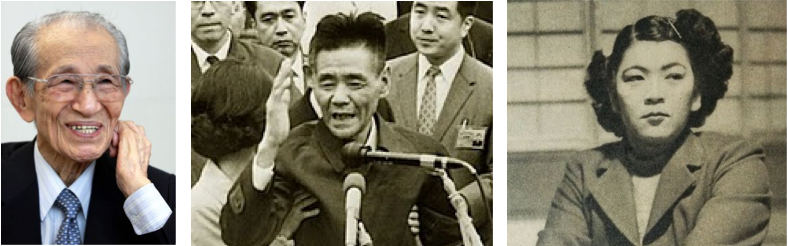
三位倖存者:年老的小野田廣郎;橫井翔一從關島返回時;還有比嘉和子,Anatahan 中所謂的蛇蠍美人。
小野田廣夫的發現者鈴木典夫享受了 15 分鐘的成名,然後實現了他的第二個抱負,在中國的野外找到了一隻大熊貓。儘管他聲稱在探索喜馬拉雅山時從遠處看到了至少五個可惡的雪人,但他繼續他的探索,希望能夠更近距離地遭遇。1986年,他在一次雪崩中死於高山。
阿納塔罕上的孤獨女性比嘉和子回到沖繩的家鄉,成為一位受人尊敬的高中校長。
橫井昭一 1972 年返回日本後結婚,並在名古屋市過著平靜的生活。1974年,他競選日本眾議員失利。1997 年,他在被診斷出患有帕金森氏症後不久去世。人們普遍認為,他是故意餓死自己,而不是成為妻子的負擔。
小野田寬郎成了名人。當他返回日本時,在機場,他年邁的父母被一隊急於將名片塞到他手中的警察推到一邊。他出版了一本代筆回憶錄,並在巴西養牛一段時間,但最終回到日本,在那裡他建立了一所成功的生存學校。
小野田在海外廣受讚譽和欽佩,但在他的祖國仍然是一個引起爭議的人物。有一次,他的長期伴侶小塚金七的父親與他對質,指責他對兒子的死負有責任。他的代筆作家池田伸後來發表了他自己的事件版本,題為《幻想英雄》,其中他表示,他認為小野田既不是英雄,也不是勇敢的人。
他於 2014 年 1 月去世,享年 91 歲。
附錄:關於後來堅持的一些註釋

新聞報導,哈爾康山是菲律賓民都洛島的最高峰,海拔近 8,500 英尺(2,582 m),直到 1980 年,這裡還是一名倖存的日本士兵的家園。這座山地勢崎嶇,雖然在海岸的景色很難到達,攀登也很困難。
中村輝雄是二戰中最後一位在不知道戰爭已經結束的情況下堅持戰鬥並倖存回家的人。但他可能不是最後一個堅持不懈的日本人。自從他被發現以來的這些年裡,媒體和該地區旅行者撰寫的個人記錄中出現了許多關於其他可能倖存者的表面可信的報導。其中至少有一個似乎是個騙局。其他人可能指中村投降後倖存的士兵。如果他們真的死了,那麼這些人現在肯定都死了,但有些人在日本投降後存活了長達50 甚至60 年之久似乎也並非完全不可能——很可能不是絕對孤立,而是透過融入當地社會社團。以下是他們案例的簡要摘要。

Vella Lavella 內部的雨林。
1960 年代至 1970 年代。維拉拉維拉,所羅門群島。維拉拉維拉 (Vella Lavella) 是新喬治亞群島最北端的島嶼,位於所羅門群島中部。同一組還包括科隆班加拉(Kolombangara)(見下文)。該島由兩個帝國陸軍團和支援部隊嚴密駐守,是 1943 年 7 月和 8 月激烈戰鬥的場所。
可能有多達 300 名日本人逃入內陸地區,1959 年有傳言稱,該組織的幾名成員「留著長鬍子,穿著腰布」繼續在島上堅守。大約1965年,試圖迫使他們投降。儘管偶爾有報道稱一名男子被找到並被遣返,但事實是當時或之後沒有人從叢林中出來。史丹利《南太平洋手冊》第 6 版中發表的 1978 年遣返記錄似乎是對 1965 年搜尋的訥誤重述。
1980 年。菲律賓民都洛島。法新社4月初報道稱,一名日本士兵中原文雄中士仍在菲律賓南部民都洛島上的哈爾康山堅守,該山位於馬尼拉以南約100英里處。和小野田一樣,中原據說也是日本海軍情報部門的成員。
關於中原所謂的活動的報導早在 1957 年就傳到了日本,一位名叫 Isao Mayazawa 的前同志多次嘗試尋找他。法新社的一篇報導稱,1980 年春天,他幾乎成功了,當時,在徒步一周「穿過茂密的森林、穿過河流和深谷,尋找並帶回掉隊者」之後,他和他的同伴們發現了他認為一定是的東西。中原的小屋。他們在現場等了幾天,但沒有看到任何人,所以他們留下了紙條,敦促頑固分子投降。
在現有的報告中,尚不清楚 Mayazawa 和他的團隊如何得出他們找到了 Nakahara 基地的結論;我懷疑,這一識別可能是由當地導遊做出的,而不是由於發現了任何明顯的日本文物而造成的。如果是這樣,我們應該對這個建議持相當大的懷疑態度,而且當然沒有確鑿的證據表明中原本人直到 1980 年仍然倖存,更不用說超過這個日期了。

橋本茂之(左)和田中清明在 1989 年底投降後。這張照片的糟糕質量,甚至很難找到它(它發表在當代報紙——《科科莫論壇報》上)很有像徵意義。男人的極限地位-夾在馬來西亞和泰國、合法衝突與失敗的遊擊戰、家庭與責任、戰爭與和平之間。
1989. 馬來西亞. 完全有可能證明,橋本茂之和田中清明,而不是中本輝夫,是二戰中最後的真正的日本堅守者。1989 年12 月2 日,這兩個人在馬來西亞和泰國邊境的一個叢林基地遲來地放下武器,並於1990 年初返回日本。從那時起,他們首先與英國軍隊作戰,然後與馬來西亞政府軍隊作戰。1945年8月,日軍在馬來半島投降。
中本聰——當時已經 71 歲——和田中——77 歲——很少被記住,也很少與橫井、小野田和中村等人一起被考慮,這似乎有幾個原因。一是兩人都不是 IJA 的士兵;他們是平民,被派往馬來西亞為一家私人公司工作,直到戰爭結束後才拿起武器。另一個原因是,他們在日本投降時就已經清楚知道了。這些人並非出於無知而繼續戰鬥,而是為了一種意識形態。這使得我們很難、甚至幾乎不可能像其他日本頑固分子那樣將他們視為日本軍國主義的不幸受害者。
然而,也許最重要的是,兩人為此奮鬥了近半個世紀的意識形態並不受歡迎。橋本和田中與共產主義遊擊隊聯手致力於推翻馬來西亞政府。當然,他們進行了長期而艱苦的戰鬥——他們是戰爭結束時進入叢林繼續對抗歐洲帝國主義的 15 個人中唯一的倖存者。然而,儘管馬來西亞共產黨在 1920 世紀 50 年代取得了相當大的成功,但仍無法實現其戰略目標。他們被英國創新但殘酷的反叛亂運動擊敗,他們為之奮鬥的事業在 20 世紀 60 年代變得與政治無關。
兩名戰鬥機返回日本的過程基本上沒有引起人們的注意。迎接他們的只有少數記者和一些家人朋友。「就小野田中尉和橫井中士而言,」社會學家Eikoh Fukuda 表示,「我認為20 世紀70 年代初的日本人仍然對人們可以為天皇和他派他們去打仗而犧牲自己的生命感到感動… ……如今,對於大多數日本人來說,第二次世界大戰已經成為古老的歷史,這種盲目的忠誠被認為是愚蠢的。” 所有這些可能都令人相當失望。貝利和哈珀在他們關於英國亞洲帝國終結的書中報道了這兩個人中的一個,他在遺囑中留下了指示,要求他的骨灰應該撒在馬來西亞叢林中,那裡是他多年來的家,《芝加哥論壇報》坐著輪椅抵達東京國際機場的脆弱的橋本說道:“我們是日本人,所以我們永遠不會忘記日本,哪怕一天也沒有。”

所羅門群島的科隆班加拉麵積雖小,但多山。戰爭期間,這裡居住著約10,000 名日本士兵,但在1943 年10 月之前,它被不斷前進的美國人“超越”,並最終被日軍撤離,這使得島上堅守的說法變得不那麼可信。
1992 年。所羅門群島科隆班加拉。一位名叫羅布·克勞福德 (Rob Crawford) 的旅行者在寫給在線日本人抵抗登記處的信中寫道:“我在1992 年聽說過一些關於科隆班加拉島上2- 3 名倖存日本人的獨立報道。島上有幾個人經常遭遇蔬菜被偷的情況,但他們並不反對,因為他們知道落後的人只是為了生存。人們多次看到他們,但不願意留下來。日本政府已派出偵察兵尋找他們,但我聽說他們完全知道戰爭已經結束,不想離開島嶼,所以他們躲了起來。我從我的一個朋友那裡聽說(此後幾次),仍然不時發生目擊事件以及丟失衣服和食物的情況。我有一些與蒙達艾格尼絲旅館(科隆班加拉對面)有聯繫的朋友支持此類目擊事件。”
2001.瓜達爾卡納爾島。克勞福德補充說:「我在瓜達爾卡納爾島也有一些朋友,他們給了我幾名躲在馬卡拉孔布魯山(所羅門群島最高峰,海拔2,447m)附近的日本掉隊者的大致座標。我最近很少聽到關於落後者的消息,上次是在2001年。我的一位當地海關的朋友聲稱,一些村民向掉隊者提供藥品、衣服、毯子等,但尊重他不被發現的意願。尤其是日本人。”

一名戰時同志辨認出一張自稱日本頑固分子中內都築的當代照片。
2005 年。菲律賓棉蘭老島。今年春天發布的新聞報導,另外兩名日本士兵,中內都築和山川吉雄,仍然居住在菲律賓南部棉蘭老島的內陸地區。
兩人都曾是日本帝國陸軍第30師團的成員,該師團在戰爭的最後幾天遭受了慘重的傷亡。兩人都已被宣告死亡,但其中一人嫁入當地部落後,據說他們在島上最山區的地區生存了 60 年或更長時間;消息傳出時,他們分別是 85 歲和 87 歲。然而,最初的興奮很快就變成了懷疑,因為兩人未能出席由神秘「調解人」安排的會議,而他們顯然同意在港口城市桑托斯將軍城的一家酒店參加會議。
據《每日電訊報》發表的一篇報道稱, 在一名為伐木集團工作的菲律賓婦女告訴她的日本丈夫她在島上內陸看到了兩名日本老人後,兩名男子倖存的故事首次獲得關注。幾天后,美國有線電視新聞網(CNN) 發表了同一篇報道的一個版本,其中添加了一些有趣的細節,即丈夫與安排兩人走出叢林的調解人是同一個人,並指出他隨後告訴《讀賣新聞》:雖然他在山裡找到了這兩個人,但他們不是日本人。
然而,事件的其他幾個版本表明,有關士兵倖存的報道可能是由摩洛伊斯蘭解放陣線(摩洛伊斯蘭解放陣線)的遊擊隊傳播的,目的是引誘記者進入內陸地區,以勒索他們。

上野石之助(前)擁抱他 81 歲的弟弟牛太郎佐岳,這是他們 60 多年來的首次團聚。
2006.烏克蘭。 上野石之助是戰爭結束時 在薩哈林島服役的日本士兵。作為戰後和平進程的一部分,該島於1809 年被日本聲稱擁有主權,此後被其部分或全部佔領。該島被割讓給蘇聯,導致約30 萬日本士兵和平民被困在現在的蘇聯領土上。其中大多數人在 1945 年至 1950 年間被遣返,其中許多人是在充當奴隸勞工多年後被遣返的,但近千名不幸的人直到該日期之後很久才返回日本。
在後一組人中,石之助也許是最有趣的。最後一次被報道生還的時間是1958 年,仍在薩哈林島,2000 年,他的家人正式宣布他死亡,但他出人意料地在2005 年再次出現,當時他已經83 歲,住在烏克蘭首都基輔。
石之助與烏克蘭婦女結婚並育有一子。他計劃回國,在那裡他用生疏的日語說了幾句話,並與倖存的弟弟團聚。
他對前來採訪的記者回憶道,關於自己在日本的多年生活,記憶最深刻的就是櫻花盛開。

後記
自從撰寫本文以來,尼古拉斯·法爾科納(Nicolas Falconer) 聯繫了我,他住在馬來西亞,在芙蓉偶然發現了一個家庭,在訪問盧邦之前的亞洲旅行期間,該家庭遇到了鈴木法夫( Norio Suzuki),並接待了他,很可能還救了他的命。直到 1980 年代中期,鈴木和家人一直保持聯繫和書信往來。整個故事讓我們對鈴木有了更多的了解,非常值得一讀。您可以在 Nic 的部落格網站上找到它,這裡。
作者註
當然,日本人的習慣是以「姓 - 名」的形式書寫姓名。最著名的落後者的名字確實應該寫成小野田宏。然而,由於在西方,他幾乎普遍被稱為小野田博郎(Hiroo Onoda),而且由於無論如何,中村本人應該用他的台灣名字來稱呼是有爭議的,因此我決定將中村的所有其他名字轉換為故事採西方形式,名字先寫。
來源
阿農。“二戰散兵游勇的故事‘一個騙局’。” CNN 國際,2005 年 5 月 31 日。2015 年 6 月 14 日造訪;阿農。 “日本二戰士兵被發現還活著。” BBC 新聞,2006 年 4 月 18 日,2015 年 6 月 14 日瀏覽;克里斯多福貝利和提姆哈珀。被遺忘的戰爭:英國亞洲帝國的終結。倫敦:企鵝出版社,2007 年;約翰·道爾. 無情的戰爭:太平洋戰爭中的種族與權力。紐約:萬神殿,1986;羽田近江. 二等兵橫井在關島的戰爭與生活,1944-1972 年。福克斯通:布里爾東方,2009;科林喬伊斯和塞巴斯蒂安伯傑。“60 年後,日本人可能仍在躲藏。” 《每日電訊報》 [倫敦],2005 年 5 月 28 日,2015 年 6 月 14 日瀏覽;麥克·蘭欽. 「橫井昭一,在關島堅守的日本士兵。」BBC 新聞雜誌,2012 年 1 月 24 日,2015 年 5 月 30 日瀏覽;迪安娜·拉姆齊。“來自叢林。” 《雅加達郵報》,2012 年 9 月 21 日,2015 年 2 月 21 日瀏覽;奧利佛·特維斯. “報告稱二戰日本士兵被發現居住在菲律賓的山區。” 聖奧古斯丁記錄,2005 年 5 月 28 日;「西奧多拉」。’最後一個士兵。’《逃脫藝術家:來自邊緣的明信片》,2010 年 10 月 27 日,2015 年 5 月 31 日訪問;羅伯特·蒂爾尼. 野蠻熱帶:比較框架中的日本帝國文化。柏克萊:加州大學出版社,2010;比阿特麗斯·特雷弗特。 日本軍隊的散兵游勇與日本戰爭的記憶,1950-1975 年。阿賓登:RoutledgeCurzon,2003;蔡惠玉. 日本帝國建設中的台灣:殖民帝國建設的製度方法。阿賓登:勞特利奇,2009;羅恩·E·耶茨. “二戰頑固分子在日本受到冷遇。” 《芝加哥論壇報》,1990 年 1 月 15 日,2015 年 6 月 14 日訪問;吉野孝作. “當代日本關於血統和種族認同的論述。” 法蘭克‧迪托克(Frank Dittoker)(編),《 中國與日本種族認同的建構:歷史與當代觀點》。倫敦:赫斯特公司,1997 年。
無線電廣播
BBC 目擊者:“日本士兵躲藏起來。” 2012 年 1 月 24 日 [論橫井昭一]
43個關於「最後的落後者:比小野田廣夫活得更久的日本士兵」 的思考
Leave a Reply

Final straggler: the Japanese soldier who outlasted Hiroo Onoda
Teruo Nakamura, a soldier in the Imperial Japanese Army, survived deep in the jungles of Morotai for 29 years after the end of World War II – becoming the last of more than 120 stragglers to be rounded up on various islands in Indonesia and the Pacific between 1947 and 1974.
Japan’s past met its present, four decades ago, by a river in a rainforest on the island of Lubang. The encounter took place late in the tropical dusk of 20 February 1974, as the breeze died and the air grew thick with flying insects. Representing the present was a college drop-out by the name of Norio Suzuki, 24 years old and clad in a T-shirt, dark blue trousers, socks, a pair of rubber sandals. He was stooping, making up a fire from a pile of twigs and branches, quite unaware that he was watched. The past, meanwhile, peered out from the cover of the jungle, wondering if the young man was some sort of trap. The man gazing from the forest fringe wore the remnants of an army uniform, and he carried a rifle. At the time of the encounter, he had been hiding in the interior of Lubang for almost 30 years, steadfastly continuing to wage a war that had ended with Japan’s surrender in Tokyo Bay on 2 September 1945.
The past’s name was Hiroo Onoda. He was an intelligence officer in the Imperial Japanese Army, he was then just shy of his fifty-second birthday, and he was about to become famous.
Hiroo Onoda held out on the Philippines island of Lubang from 1945 until his surrender in 1974. His intelligence, determination, and refusal to surrender made him a celebrity – though he was more widely regarded as a hero outside Japan than in it.
Onoda had been on Lubang since 1944, a few months before the Americans invaded and retook the Philippines. The last instructions he had received from his immediate superior ordered him to retreat to the interior of the island – which was small and in truth of minimal importance – and harass the Allied occupying forces until the IJA eventually returned. “You are absolutely forbidden to die by your own hand,” he was told. “It may take three years, it may take five, but whatever happens, we’ll come back for you. Until then, so long as you have one soldier, you are to continue to lead him.
“You may have to live on coconuts. If that’s the case, live on coconuts! Under no circumstances are you [to] give up your life voluntarily.”
Onoda complied with such determination that he ignored repeated efforts to persuade him to surrender – by leaflet drop, by loudspeaker and by patrols on the ground – and continued to take the war to the local people. Over the course of three decades, he and a dwindling band of companions killed 30 Lubang islanders and wounded 100 more in a sporadic guerrilla campaign that saw the once-mighty Imperial Army reduced to the assassination of some cows and the occasional immolation of piles of harvested rice farmed close to the jungle’s edge. After the loss of the last of his four men in a firefight with the local police, Onoda soldiered on alone.
Onoda leaves the jungle after 29 years. The adventurer who found him, Norio Suzuki, is on the left.
That shootout proved to be a transformative moment in Onoda’s life. The local Filipinos were, of course, perfectly aware that survivors of the old Japanese army of occupation were living somewhere on their island; so too was their government, and the government of Japan. But never before had the story been tangible enough to attract interest from the world’s press. Only now – with the discovery of indisputable proof of the stragglers’ existence in the form of the body of Onoda’s companion, Private Kinshichi Kozuka – did journalists begin to write extensively about the holdouts of Lubang. Increasingly, too, their stories focused on Onoda, and the likelihood that he had survived the skirmish to live on somewhere in the jungle.
It was this press coverage that attracted the attention of Norio Suzuki, who had recently returned from several years of wandering across Asia and was in search of another adventure. Few, if any, took him seriously when he announced his intention of going in search of “Lieutenant Onoda, a panda, and the Abominable Snowman, in that order;” several substantial expeditions, after all, had already tried and failed to coax Onoda from his hiding place. But Suzuki had one substantial advantage over those who had preceded him: his one-man search party was so self-evidently eccentric and absurd that Onoda did not feel threatened when he stumbled across the young man in the jungle. Instead – after a careful reconnaissance had convinced him that there was no-one else lurking nearby – he emerged and confronted the intruder.
The island of Lubang is nearly 19 miles long by 6 miles wide (30km x 10km). Onoda and three other Japanese stragglers circled regularly around series of temporary bases, as shown in this map by David de la Hyde. Click to view in higher resolution.
“If he had not been wearing socks,” Onoda would write later, “I might have shot him. But he had on these thick woollen socks, even though he was wearing sandals. The islanders would never do anything so incongruous.
He stood up and turned around. His eyes were round… he faced me and saluted. Then he saluted again. His hands were trembling, and I would have sworn his knees were too.
He asked, “Are you Onoda-san?”
“Yes, I’m Onoda.”
“Really, Lieutenant Onoda?”
I nodded, and he went on.
“I know you’ve had a long, hard time. The war’s over. Won’t you come back to Japan with me?”
His use of polite Japanese expressions convinced me that he must have been brought up in Japan, but he was rushing things too much. Did he think he could just make the simple statement that the war was over and I would go running back to Japan with him? After all those years, it made me angry.
“No, I won’t go back! For me, the war hasn’t ended!”
Of all the things that Onoda said that day – or would say, at considerable length, after Suzuki returned a few weeks later with formal orders from Japan for the lieutenant to lay down his arms – it was this last statement that resonated most strongly. It was a sentiment received more warmly by old soldier’s former enemies, who found that there was something to admire in his steadfastness and selflessness, than it was in his homeland, still then struggling to come to terms with wartime militarism, and profoundly suspicious of those who stood for loyalty to the old regime. (For most Japanese, Beatrice Trefalt points out, Onoda was “only admirable in the most acutely uncomfortable way.”) In the end, though, he won everybody over. Eloquent, a natural actor, and oddly comfortable in the spotlight, the former jungle-dweller had little difficulty in presenting himself as a man who stood for simplicity and self-reliance, not aggression and imperialism. Even his sceptical countrymen came to see in him things – important things – that they had lost.
Japanese soldiers of the World War II period.
There was little sympathy in the Japan of 1974, it’s safe to say, for the government, the armed forces, or the ideology responsible for the Rape of Nanking in 1937 or the attack on Pearl Harbor in 1941 – not even among those who grasped the lack of natural resources on the home islands that had helped to set the country on the path to war, or who otherwise subscribed to the avowedly anti-colonial aims for which it had – ostensibly – been fought. But a good deal of time had passed since 1945. Half of the country’s population had been born after the end of the war, and had no personal memory of its events, of wartime propaganda, or of the hideous way in which it had been ended by mushroom clouds. For many of them, the army stragglers of the postwar period were not only stark reminders of Japan’s aggressive recent past, but also standard bearers for an era of shared values. Embittered ex-soldiers were not the only people in the Japan of the mid-70s who saw the younger generations as spoiled, fixated on consumer goods, and tainted by the importation of western fashions and western music.
When it is remembered how Japan fought its war – pushing out the boundaries of its empire until it encompassed much of China, the whole of south-east Asia and Indonesia, and half the vast expanse of the Pacific, and then seeing that empire fall to pieces in a series of suicidal last stands, fought across tens of thousands of square miles of territory, which generally left barely any surviving witnesses – it is hardly surprising that the country experienced incredible difficulties in establishing who had lived and who had died during the last days of the conflict. Surrender left 3.5 million surviving Japanese soldiers, sailors and airmen stranded overseas, just over a million of whom were stationed in the Philippines, in Indonesia and on various Pacific islands. It took three years to complete their repatriation, and, even then, thousands of those unfortunate enough to have been stranded behind the Iron or the Bamboo Curtains did not make it home until years later. Modern Japan still witnesses the return of a steady stream of 100 or so “war babies” each year – now-ageing adults who were born in China during the war years and grew to adulthood there in a country wracked by civil war and revolution.
The number of Japanese whose fates remained unknown in these chaotic circumstances makes for stark reading. The Navy alone posted the names of 720,000 “missing” in 1946, and although the post-war Bureau of Repatriate Welfare– established not only to return men stationed overseas to their homeland, but also to account for those who died – did heroic work in combing records and interviewing survivors, that number still stood at 561 in 1950, the year in which all those still unaccounted for were officially presumed dead.
It is scarcely surprising, then, that so-called “bone-collecting missions,” sent to scour the Pacific in search of remains that could be returned to families, stumbled occasionally upon small groups of stragglers. The first to be reported was a band of eight soldiers found living in the interior of New Guinea, who told their rescuers they had spent the four years since the end of the war living on “mice and potatoes.” By far the most notorious were the 21 imperial subjects rounded up on the little island of Anatahan in 1951. Like several other such groups, they had had the good fortune to be stationed on an island leapfrogged by the American advance, and survived the next six years almost entirely unmolested. The most interesting thing about them – at least in the eyes of a prurient press – was the presence among the group of a solitary woman, Higa Kazuko, who was widely said to have become the object of several violent struggles for her affections. According to the more highly-coloured accounts of the Anatahan story, 11 of the 30 navy sailors stranded on the island died as a result – four of whom had at one time or another considered themselves to be Kazuko’s “husband.”
The experiences of the 30 Japanese sailors – and one civilian woman – left living on the island of Anatahan between 1945 and 1951 have been dramatised in three films. The first of two Japanese entries, 1956’s Revenge of the Pearl Queen, starring Michiko Maeda, is a good example of how the unusual situation on the island was glamorised and sexualised.
On the whole, however, tales of the discovery of Japanese stragglers in the Pacific attracted remarkably little attention as late as the 1960s. There were several reasons for this. The most important, certainly at first, was was the more or less conscious desire of many Japanese to put their wartime experiences behind them. “The war dead,” notes Trehaft, “by virtue of their sacrifice and their absence, could be forgiven and commemorated to a degree, but those who came back, even much later, were far more ambiguous.” Not only had they taken part in the wrong war, and failed to win it; they had also failed to die. This attitude did soften over time; five more stragglers discovered in New Guinea in 1955 were briefly hailed as “living spirits of the war dead.” But it was not until as late as 1972 – the year that Onoda’s companion Kazuko was killed – that the return of a Japanese holdout first attracted worldwide attention.
Shoichi Yokoi hid for almost 30 years on the American island of Guam, only being rediscovered early in 1972.
It helped that, in this case, the circumstances were truly extraordinary. Sergeant Shoichi Yokoi had survived in the jungles of the American island of Guam by spending his days hiding in an elaborately-constructed hole in the ground. Undignified as this existence may have been, he had certainly been ingenious and resilient, and he was warmly welcomed on his eventual return to Japan. Indeed, it proved possible to make a virtue of the fact that Yokoi had done little more than simply stay alive, and the awkward circumstance that his capture was far from heroic – he was taken, half-starving, by a group of villagers who stumbled across him as he scrabbled for shrimps in a stream. Yokoi was lauded as someone who was self-evidently “special”; he had been a tailor before the war, and much praise was lavished on his ability to fashion buttons and shoes for himself, as well as on the self-taught skills that had enabled him to avoid eating any of the poisonous local plants and wildlife, which had proved fatal to two early companions. Emerging from the jungle as a pronounced critic of Japan’s wartime leadership (including the untouchable Emperor Hirohito), Yokoi could also be convincingly portrayed as a victim – of his own inadequate education, of his military training, of the deliberate ignorance of current affairs that was a prominent feature of IJA propaganda, and of wartime censorship and repression.
Sergeant Yokoi’s cave – excavated by hand and elaborately propped up with bamboo – sheltered and concealed him from discovery for years only a few miles from a major US Air Force base.
Sergeant Yokoi had one other lesson to teach, as well. His motive for not giving himself up years earlier – though he had been perfectly aware as early as 1952 that the war was over – had nothing to do with a desire to fight on for his emperor. Knowing that his army’s bushido code enjoined self-sacrifice or suicide, not self-preservation, he frankly admitted that he had feared he would be considered a deserter, court-martialled, and probably executed if he was ever repatriated.
It seems remarkable now – as it seemed peculiar then – that two such utterly different stragglers as Yokoi and Onoda emerged from two different jungles, on two different islands, within a few months of one other. Yokoi was a conscript, a non-commissioned officer, and a pacifist who had hidden in a hole in the ground, dined for years on snails and lizards, emerged from the jungle dirty and ill, with a rifle so corroded it was useless, and who was more than ready to admit that the entire war had been a mistake. Onoda was an officer who had been through the IJA’s elite Nakano School for commandos, who lived as he pleased in the interior of Lubang, kept his rifle gleaming, and who still took the war to the enemy whenever he could. Onoda had kept himself in peak condition for more than three decades; by the time he encountered Norio Suzuki he was far healthier and fitter than the average Japanese his age. It was easy to conclude (as many people did) that the difference between Onoda and Yokoi was “the difference between a samurai and a commoner.”
What is almost always forgotten, though, in contemplating the intriguing contrasts between the holdouts of Lubang and Guam, is that a third straggler emerged from the jungles only a few months after Onoda’s surrender – in fact, as a direct consequence of the immense burst of publicity that accompanied it. His name was Teruo Nakamura, he was the “last of the last” to return home of all the stragglers who fought on after 1945 – and he was as different to Onoda and Yokoi as they were to each other. Indeed, Nakamura has been so very forgotten, and was so very different, that it’s well worth considering his oddly problematic case in detail.
Click the map to view in sharp full resolution
Nakamura had grown up in Formosa (Taiwan) – then a Japanese possession that had been seized from China at the conclusion of the Sino-Japanese War of 1894-95. Born in 1923, he was a member of the indigenous aboriginal peoples who by then comprised only a small minority of the island’s population. His real name, it appears, was Attun Palalin, but he adopted a Japanese one when he was conscripted (or volunteered; there seems to be no consensus here) and joined the war effort in 1943. After completing basic training, he was sent with his unit to the Indonesian island of Morotai a few months before it was attacked by the advancing Americans.
Nakamura, then, was not Japanese, and he and his comrades occupied an at best marginal position in the Imperial Army’s order of battle. One of his motives for joining up in the first place – to fight in a war that only about 8,500 Taiwanese took a direct part in – may have been to elevate his status; indigenous men who joined the Imperial forces ranked above the local Chinese in the eyes of the island’s administrators. But it was a decision that also placed him in a position of considerable danger. Taiwan’s “special volunteer soldiers” were earmarked by their Japanese superiors to spearhead dangerous missions, and expended as cannon fodder in some of the bloodiest battles of the war. As Trefalt points out, Nakamura’s very survival “thus inescapably brought into the public sphere the legacies of Japanese imperialism.”
General Douglas MacArthur arrives on Morotai. The island witnessed fierce fighting after the American landings in September 1944.
The wartime choices forced on Nakamura’s unit were similar to those made by many other IJA troops confronting Allied landings on small islands. Forced to make the best of limited supplies, faced by overwhelming numbers, and lacking proper air support, they either sacrificed themselves in hopeless attempts at defence, or retreated into the interior. Morotai – an island of about 700 square miles, five times the size of Onoda’s Lubang – was large enough to make the latter option a realistic one, and Nakamura was fortunate that his unit was ordered to disperse and commence a guerilla campaign soon after the invasion happened. By the time the war actually ended, 11 months later, he was part of a dwindling group of soldiers that seems to have repeatedly dispersed and coalesced, breaking into ever smaller parties to hunt for food deep in the jungle, and regularly losing members to starvation and disease. According to the survivors of one of these small parties – nine men who were discovered and repatriated in 1956 – Nakamura possessed a high degree of self-sufficiency. He went off to live on his own in the jungle between 1946 and 1947, returned to the main group in 1950, and then disappeared again a few years later.
“Nakamura City” – a clearing in the Garoca mountains, and the Taiwanese straggler’s home for almost a quarter of a century.
It was generally supposed by the other troops that Nakamura had died somewhere in the jungle. In fact he survived and lived on alone, catching fish in the rivers, maintaining his rifle (but not using it to hunt for fear of being heard and found by local people), and eventually settling down in a remote cleft in Morotai’s southern mountains. There he gradually hacked out a clearing in the rainforest in which he could cultivate red peppers, bananas, taro and paw-paw.
It is difficult to know quite how alone Nakamura was during these years. Some local testimony suggests that he continued to roam in search of food to supplement his diet, and was spotted in the jungle from time to time – a distant figure, all but naked on a hillside. Planes from an Indonesian air base on Morotai also overflew the jungle on occasion, and, over the years, their pilots logged evidence of human activity in some oddly remote areas. But knowledge of the possible existence of Japanese stragglers on the island remained confined to the base until the worldwide publicity that accompanied Onoda’s surrender in 1974 jogged some memories, and word of the pilots’ sightings at last reached the members of a Bureau of Repatriate Welfare bone-collecting mission that called at Morotai late in the same year.
Word was passed to the Japanese embassy in Jakarta, and thence to Tokyo, which formally requested the help of the Indonesian government. It proved to be not too difficult to pinpoint Nakamura’s position from the air, but actually reaching his clearing on foot was a different proposition. It took the men of an Indonesian army unit three days to trek through the jungle from the nearest road, and – confronted by an unknown adversary who was quite possibly armed – they chose to adopt some unorthodox tactics when approaching him.
The approximate location of Nakamura’s hiding place, on the south side of the island of Morotai. Click to view in higher resolution.
The 11 soldiers who reached what would be dubbed “Nakamura City” on the morning of 18 December 1974 had made careful preparations for their encounter with the lonely soldier. They had memorised the words of the Japanese national anthem – which they sang in unison as they emerged from the jungle – and, in addition, had equipped themselves with a photo of a geisha. (They were not the only ones to assume that a man who had spent years alone in the jungle would be interested in women; Norio Suzuki had gone to Lubang equipped with a small stock of softcore pornography, which he attempted to share with Onoda – an offer that his quarry brusquely rejected.) As things turned out, however, there was no need for touches such as these. Nakamura – who was “painfully thin and plainly terrified” – offered no resistance, though, like Yokoi, he seems to have remained convinced for several days that he faced execution on his extraction from the jungle.
Nakamura was taken to Jakarta and hospitalised. Indonesians, meanwhile, woke to newspaper reports that made much of the ingenuity he had displayed in surviving for so long. He had built himself a sturdy shack, and carved a rough map of his surroundings on a stone; he had attempted to tame a wild boar and a moleyu bird for company. According to the people of Dehegila, the jungle village closest to his base, he had even made friends with a local hunter, who occasionally brought him gifts of salt and sugar. In time, the villagers would erect a statue to commemorate Nakamura’s life on Morotai, remembering him as “the good Japanese,” who, during his first weeks in the jungle, had rescued a local girl when she was attacked by other members of his unit.
A Japanese newsdpaper sketch of Nakamura’s hut, in which he lived for more than 20 years, alone in the mountains of the interior.
For much of the rest of the world, however, Japan’s final straggler was something of a disappointment. Nakamura’s robust self-sufficiency was admirable in its own way, but it paled in contrast to Onoda’s nearly 30 years of active service, and he possessed nothing of the Japanese lieutenant’s flair for the dramatic, or his ease in front of the world’s press. It was even difficult to decide who, precisely, Nakamura was. By the time that he walked out of the jungle, history had rendered him effectively stateless. The Japanese empire that he had served was long defunct. Taiwan had become the seat of a Chinese nationalist government. And though he himself expressed a wish to be “repatriated” to Japan, he had never been there, and – it emerged – had no right to live there, either.
Of all the stragglers who staggered from bolt-holes across the Pacific in the years 1945-1974, then, Teruo Nakamura was the most marginal and the hardest to categorise. But if Hiroo Onoda was interesting largely for his dogged adherence to a state, a mindset and a way of life that had vanished in the 1940s, Nakamura stands as a sort of mirror image of him. His story is worth telling less for what he did during his long years in the jungle than for what his emergence meant for 1970s Japan.
Time to reflect. Nakamura in a mirror shortly after his extraction to Jakarta.
Certainly the appearance of an indigenous soldier from Taiwan was a considerable embarrassment to a country as determined as Japan was to slough off its imperial past. Many Japanese felt that Nakamura deserved some sort of compensation for his years of loyalty to their nation, and there was consternation when it was discovered that the back pay due to him for his three decades of service was a mere 68,000 yen (about $230 then, $1,110 now). The testimony of Nakamura’s fellow Morotai veterans, brought out of the jungle in 1956, was also sought. It cast doubt on the reputation for ingenuity and self-sufficiency that Yokoi and Onoda had helped to bolster – “It was really good for the Japanese soldiers that we were there. When they were out of food, we helped them, over and over again.” The veterans also revealed an ugly side to the country’s treatment of its Taiwanese soldiers. Nakamura himself dropped angry hints that he had fled into the jungle because he feared that the Japanese survivors in his group were plotting his murder, and while his former comrades in arms had been permitted to settle in Japan, it emerged that they had had to pay their own hospital bills on reaching Tokyo, and had spent the past few decades labouring for low pay on road gangs: “Everyone was quite unfriendly. We really got done over, didn’t we?”
Some good did come of all these revelations. An Association for the Warm Welcome of Teruo Nakamura was formed, and its members not only organised the collection of 4.25 million yen from the government and the Japanese people (about $14,000 then, $62,000 now) but pressed for the a law that, passed belatedly in 1987, required the state to pay 2m yen to to every surviving Taiwanese veteran, and the same sum to the bereaved families of those killed in the war.
A bewildered-looking Nakamura is garlanded with flowers on his emergence from the jungles of Morotai.
Nakamura’s own experiences of peace were problematic. Asked by one journalist how he felt about “wasting” three decades of his life on Morotai, he angrily replied that the years had not been wasted – he had been serving his country. But the country he returned to was Taiwan, and when he disembarked at Taipei, early in January 1975, it was to discover that his wife had had a son whom he had never met – and that, despairing that he would ever return to her, she had remarried a decade after he had been declared officially dead.
Nakamura went off to live with a daughter, but he did enjoy a happy ending of a sort. His wife reconsidered her position, and dropped her second husband to reoncile with him. The couple renewed their marriage vows and went off to start a new life in another town. Nakamura lived for four more years before succumbing to lung cancer in 1979.
Perhaps it can be left to Shoichi Yokoi to sum up something of what it mean to be a Japanese straggler, surviving alone for years in enemy territory. He had retained some faith, he said, in an eventual rescue; knowing as he did that Japan had lost the war he fought in, he nonetheless believed that it would fight again, and that eventually it would re-invade Guam. In anticipation of that day – which he at first estimated to be no more than 10 years’ hence – he had kept a sort of calendar, tracking the waxing and the waning of the moon. And, to keep himself occupied while he was waiting, he had reminisced; after bathing in a stream each night, he said, he had lain back to enjoy the cool breeze through the bamboos, and thought about his family.
Asked by a young nephew how he had lasted so long, on a small island on which his hideout was only a mile or two from a vast American air base, Yokoi answered very simply. “I was really good at hide and seek,” he said.
Afterwards
Three survivors – Hiroo Onoda in old age; Shoichi Yokoi on his return from Guam; and Higa Kazuko, the supposed femme fatale of Anatahan.
Norio Suzuki, the discover of Hiroo Onoda, enjoyed his 15 minutes of fame and went on to achieve the second of his ambitions, locating a giant panda in the wild in China. Although he claimed to have sighted a group of no fewer than five Abominable Snowmen from a distance while exploring the Himalayas, he continued his quest in the hope of a much closer encounter. He died in the high mountains in an avalanche in 1986.
Higa Kazuko, the solitary woman on Anatahan, returned home to Okinawa and became a respected high school principal.
Shoichi Yokoi married on his return to Japan in 1972 and lived quietly in the city of Nagoya. In 1974, he stood unsuccessfully for a seat in Japan’s Lower House. He died in 1997, some time after being diagnosed with Parkinson’s Disease. It was widely believed that he had deliberately starved himself to death rather than become a burden to his wife.
Hiroo Onoda became a celebrity. At the airport, on his return to Japan, his aged parents were thrust aside by a phalanx of policians eager to press their business cards into his hand. He published a book of ghostwritten memoirs and spent some time cattle-ranching in Brazil, but eventually returned to Japan, where he established a successful survival school.
Widely lauded and admired overseas, Onoda remained a divisive figure in his homeland. At one point, the father of his long-time companion Kinshichi Kozuka confronted him and accused him of responsibility for his son’s death. His ghostwriter, Shin Ikeda, later published his own version of events, titled Fantasy Hero, in which he stated that he saw Onoda as neither a hero nor a brave man.
He died, aged 91, in January 2014.
Appendix: Some notes on later holdouts
Press reports claimed that the lands around Mount Halcon, the highest peak on the Philippines island of Mindoro at nearly 8,500 feet (2,582m), were home to a surviving Japanese soldier as late as 1980. The mountain is in rugged terrain, and though within sight of the coast, is hard to reach and challenging to climb.
Teruo Nakamura was the last of the World War II stragglers who fought on, not knowing that the war was over, and survived to return home. But he may not have been the last of all Japanese holdouts. In the years since his discovery, a number of superficially credible reports concerning other possible survivors have popped up in the media and in personal accounts written by travellers to the region. At least one of these seem to have been a hoax; others may refer to soldiers who lived on after Nakamura’s surrender. If they did, these men are all surely now dead, but it does not seem utterly impossible that some survived for as long as 50 or even 60 years after the Japanese surrender – not in absolute isolation, most probably, but by integrating themselves into local societies. Here are brief summaries of their cases.
Rainforest in the interior of Vella Lavella.
1960s-1970s. Vella Lavella, Solomon Islands. Vella Lavella is the northernmost island in the New Georgia group, midway along the Solomons chain; the same group also contains Kolombangara (see below). The island was strongly garrisoned by two Imperial Army regiments, together with support units, and was the scene of fierce fighting in July and August 1943.
As many as 300 Japanese may have fled into the interior, and rumours that several members of this group – “with long beards and wearing loin cloths” – continued to hold out on the island surfaced in 1959. Waterproofed leaflets were dropped in the interior in about 1965 an attempt to secure their surrender. Although it is occasionally reported that one man was located and repatriated, the reality is that no-one emerged from the jungle then or later. An account of a repatriation dated to 1978 and published in the 6th edition of Stanley’s The South Pacific Handbook appears to be a corrupted retelling of the 1965 search.
1980. Mindoro, Philippines. The news agency Agence France-Presse reported early in April that a Japanese soldier, Sergeant Fumio Nakahara, was continuing to hold out at Mount Halcon, on the island of Mindoro in the southern Philippines, about 100 miles south of Manila. Like Onoda, Nakahara was said to be a member of an IJN intelligence unit.
Reports of Nakahara’s supposed activities had reached Japan as early as 1957, and a former comrade by the name of Isao Mayazawa led several attempts to find him. He almost succeeded, an AFP dispatch said, in the spring of 1980 when, after trekking for a week “through thick forests and across rivers and deep ravines to find and bring back the straggler,” he located what he and his companions decided must be Nakahara’s hut. They waited a few days at the site, but saw no-one, so left notes urging the holdout to surrender.
It is unclear, in the available reports, how Mayazawa and his team reached the conclusion that they had located Nakahara’s base; my suspicion is that the identification may have been made by local guides rather than as a result of the discovery of any explicitly Japanese artefacts. If so, the suggestion should be treated with considerable scepticism, and certainly there is no firm evidence that Nakahara himself survived even as late as 1980, much less beyond that date.
Shigeyuki Hashimoto [left] and Kiyoaki Tanaka after their surrender at the end of 1989. The terrible quality of the image, and the difficulty of even locating it (it was published in a contemporary newspaper – the Kokomo Tribune) is helpfully symbolic of the two men’s liminal status – caught between Malaysia and Thailand, legitimate conflict and a failed guerrilla campaign, home and duty, war and peace.
1989. Malaysia. It would be perfectly possible to make the case that Shigeyuki Hashimoto and Kiyoaki Tanaka, not Teruo Nakamoto, were the last true Japanese holdouts from World War II. The two men returned to Japan in the first days of 1990 after belatedly laying down their arms at a jungle base on the Malaysian-Thai border on 2 December 1989. They had been fighting first the British and then the forces of the Malaysian government ever since the surrender of the Japanese forces in the Malay peninsula in August 1945.
There seem to be several reasons why Nakamoto – who was by then 71 – and Tanaka – 77 – are so poorly remembered and so seldom considered alongside the likes of Yokoi, Onoda and Nakamura. One is that neither man had been a soldier of IJA; they had been civilians, sent to Malaysia to work for a private company, who only took up arms after the end of the war. Another is that they had been perfectly aware at the time that Japan had surrendered; these men fought on not out of ignorance, but for an ideology. That made it hard, indeed pretty much impossible, to view them as unfortunate victims of Japanese militarism in the way that other Japanese holdouts were characterised.
Perhaps most importantly, however, the ideology that the two had dedicated nearly half a century to fighting for was an unpopular one. Hashimoto and Tanaka had joined forces with communist guerrillas dedicated to the overthrow of the Malaysian government. They had, certainly, fought long and hard – they were the sole survivors of a group of 15 who had gone into the jungle to continue the fight against European imperialism at the war’s end. But despite achieving considerable success during the 1950s, Malaysia’s communists had been unable to achieve their strategic aims; defeated by an innovative, if brutal, British counter-insurgency campaign, the cause that they fought for had faded into political irrelevance during the 1960s.
The two fighters’ return to Japan passed largely unnoticed; they were met by only a handful of reporters and some family friends. “In the case of Lt. Onoda and Sgt Yokoi,” the sociologist Eikoh Fukuda suggested, “I think Japanese in the early 1970s were still moved that men could sacrifice their lives to the emperor and to the war he sent them off to fight… Today, World War II is ancient history to most Japanese and such blind loyalty is considered foolish.” All of which probably came as a considerable disappointment; one of the two men, Bayly and Harper report in their book on the end of Britain’s Asian empire, left instructions in his will that his ashes should be scattered in the Malaysian jungle that had been his home for so many years, and the Chicago Tribune reported the fragile Hashimoto – who arrived at Tokyo International Airport in a wheelchair – as saying: “We are Japanese, so we never forgot about Japan, not even for one day.”
Kolombangara, in the Solomon Islands, is small but mountainous. Home to about 10,000 Japanese soldiers during the war, it was “leapfrogged” by the advancing Americans and eventually evacuated by the Japanese army by October 1943, making suggestions of holdouts on the island less credible.
1992. Kolombangara, Solomon Islands. Writing to the online Japanese Holdouts Registry, a traveller named Rob Crawford reported: “I heard in 1992 several independent accounts of 2-3 surviving Japanese on Kolombangara. Several people on that island have vegetables stolen on a regular basis but do not object as they know the stragglers are just trying to survive. They were sighted several times but reluctant to stay around. The Japanese government has sent scouts to locate them but I am told they are fully aware the war is over and do not want to leave the island, so they hide. I have heard through a friend of mine (a few times since) that there are still sightings and missing clothes and food supplies from time to time. There are friends of mine connected to Agnes Lodge at Munda (opposite Kolombangara) that support such sightings.”
2001. Guadalcanal. Crawford adds: “I also have some friends on Guadalcanal that gave me approximate cordinates of several Japanese stragglers hiding near Mt. Makarakomburu [the highest peak in Solomon Islands, 2,447m]. I have heard little recently about stragglers the last time being 2001. A friend of mine who is a local customs authority claims some villagers had being supplying a straggler with medicine and clothes, blankets etc, but respect his wishes not to be found. Particularly by Japanese.”
A wartime comrade identifies a contemporary photo of claimed Japanese holdout Tsuzuki Nakauchi.
2005. Mindanao, Philippines. Press reports published in the spring of this year suggested that two other Japanese soldiers, named as Tsuzuki Nakauchi and Yoshio Yamakawa, still lived in the interior of the large southerly Philippines island of Mindanao.
Both men had been members of the 30th Division of the Imperial Japanese Army, which suffered heavy casualties in the last days of the war; both had been declared dead, but were supposed to have survived for 60 or more years in the island’s most mountainous districts after one of them married into a local tribe; they would have been 85 and 87 respectively when the story broke. Initial excitement soon gave way to scepticism, however, after the pair failed to turn up at a meeting, arranged by a mysterious “mediator,” which they had apparently agreed to attend in a hotel in the port city of General Santos.
According to a report published in the Daily Telegraph, the story of the two men’s survival first gained purchase after a Filipina woman working for a logging group told her Japanese husband that she had seen two elderly Japanese in the island’s interior. A version of the same story published a few days later by CNN adds the intriguing details that the husband was the same man as the mediator who arranged for the two men to come out of the jungle, and notes that he subsequently told the Yomiuri newspaper that although he had tracked down the two men in the mountains, they were not Japanese.
Several other versions of events, however, suggest that reports of the soldiers’ survival may have been spread by guerrillas from MILF – the Moro Islamic Liberation Front – in the hope of luring journalists into the interior in order to hold them for ransom.
Uwano Ishinosuke (front) hugs his 81-year-old younger brother Sadake Ushitaro as they are reunited for the first time in well over 60 years.
2006. Ukraine. Uwano Ishinosuke was a Japanese soldier serving on Sakhalin when the war ended. The island – claimed by Japan in 1809 and partially or wholly occupied by it thereafter – was ceded to the USSR as part of the postwar peace process, leaving an estimated 300,000 Japanese soldiers and civilians stranded in what was now Soviet territory. Most of these were repatriated between 1945 and 1950, in many cases after serving for years as what amounted to slave labourers, but nearly a thousand unfortunates did not return to Japan until well after that date.
Of this latter group, Ishinosuke is perhaps the most interesting. Last reported alive, still on Sakhalin, in 1958, and officially declared dead by his own family in 2000, he unexpectedly reappeared in 2005 – by then 83 years old and living in the Ukrainian capital, Kiev.
Ishinosuke had married a Ukrainian woman and had one son there. He made plans to visit his homeland, where he managed a few words in rusty Japanese and was reunited with a surviving younger brother.
The thing he remembered most vividly about his long-ago life in Japan, he recalled for the reporters who came to interview him, was the blooming of the cherry blossom.
Afterword
Since writing, I have been contacted by Nicolas Falconer, who is based in Malaysia and who stumbled across a family in Seremban who encountered, hosted – and probably saved the life of – Norio Suzuki during his Asian travels before his visits to Lubang. Suzuki and the family stayed in touch and exchanged letters into the middle 1980s. The whole story adds a lot to our understanding of Suzuki and it’s well worth reading. You can find it on Nic’s blog site, here.
Author’s note
It is Japanese convention, of course, to write names in the form “Family name – Given name.” The name of the most famous of the stragglers should really be written Onoda Hirō. Since, in the west, he is almost universally known as Hiroo Onoda, however – and since it’s arguable that Nakamura himself should properly be referred to by his Taiwanese name in any case – I have taken the decision to convert all the other names in the story to western forms, with the given name written first.
Sources
Anon. “WWII stragglers story ‘a hoax.’ CNN International, 31 May 2005. Accessed 14 June 2015; Anon. “Japanese WWII soldier found alive.” BBC News, 18 April 2006, accessed 14 June 2015; Christopher Bayly and Tim Harper. Forgotten Wars: The End of Britain’s Asian Empire. London: Penguin, 2007; John Dower. War Without Mercy: Race and Power in the Pacific War. New York: Pantheon, 1986; Omi Hatashin. Private Yokoi’s War and Life on Guam, 1944-1972. Folkestone: Brill Oriental, 2009; Colin Joyce and Sebastien Berger. “Japanese pair may still be hiding 60 years on.” Daily Telegraph [London], 28 May 2005, accessed 14 June 2015; Mike Lanchin. ‘Shoichi Yokoi, the Japanese soldier who held out on Guam.’ BBC News Magazine, 24 January 2012, accessed 30 May 2015; Deanna Ramsay. “From out of the jungle.” Jakarta Post, 21 September 2012, accessed 21 February 2015; Oliver Teves. “Report claims WWII Japanese soldiers found living in mountains of Philippines.” St Augustine Record, 28 May 2005; ‘Theodora’. ‘The last soldier.‘ Escape Artistes: Postcards from the Edge, 27 October 2010, accessed 31 May 2015; Robert Tierney. Tropics of Savagery: the Culture of Japanese Empire in Comparative Frame. Berkeley: University of California Press, 2010; Beatrice Trefalt. Japanese Army Stragglers and Memories of the War in Japan, 1950-1975. Abingdon: RoutledgeCurzon, 2003; Hui-yu Caroline Ts’ai. Taiwan in Japan’s Empire Building: An Institutional approach to Colonial Empire-Building. Abingdon: Routledge, 2009; Ron E. Yates. “WWII die-hards receive cool greeting in Japan.” Chicago Tribune, 15 January 1990, accessed 14 June 2015; Kosaku Yoshino. “The discourse on blood and racial identity in contemporary Japan.” In Frank Dittoker (ed.), The Construction of Racial Identities in China and Japan: Historical and Contemporary Perspectives. London: Hurst & Co, 1997.
Radio broadcast
BBC Witness: “Japanese soldier in hiding.” 24 January 2012 [On Shoichi Yokoi.]
43 thoughts on “Final straggler: the Japanese soldier who outlasted Hiroo Onoda”
[…] All you wanted to know about Japanese WWII stragglers in the Pacific, 1947-1989. Yes, they were real. And they survived on coconuts, papayas and bile […]
Yes. My son Zakee updates me on these things.
[…] Mike Dash continues to be one of my favourite history writers […]
I have such a weird affection for the Japanese holdouts. I’m not a Greater East Asian Co-Prosperity Sphere fanboy or anything, I guess I just admire their insane tenacity?
Also this: ‘“If he had not been wearing socks,” Onoda would write later, “I might have shot him. But he had on these thick woollen socks, even though he was wearing sandals. The islanders would never do anything so incongruous.”‘
As always, Mike, a wonderful re-telling of history. But not simply a bald statement of facts but an exploration of what these facts mean. Thanks for a fascinating article and I found the appendix particularly interesting.
A new post here? What next, hell freezing over?
Joking aside, this was a highly interesting article, like always. Take your time with your posts – the wait is always worth it.
I can say that everything I know about Japanese stragglers I just learned from you. I am sure I will store it in a part of my brain where it will not be forgotten. Thanks.
Fascinating… thank you for sharing your work.
[…] Fascinating look at WWII Japanese “stragglers” who held on living in remote Pacific islands for decades believing the war was still going. Some interesting and sometimes poignant looks at duty and the difference between “old” and “new” Japan. By the ever readable Mike Dash […]
A good read.
Interesting.
Pingback: Blogger Recognition Award – Round Eight | Waterblogged
Another fantastic article. This is making my shift at work fly by…
I have heard admiration for Lt. Onada and his small squad of men holding out as a symbol of devotion to duty, but I find it tragic. They killed 30 people and wounded over 100 in the post-war years, yet at some point they had to realize the war was politically and militarily over, regardless of ideology and culture. At what point did those killings go from an act of war to an act of murder?
interesting observation, very true
my thoughts exactly
So Nakamura received the modern-day equivalent to ¥12, or $0.11 USD, per day.
Original figure (¥68,000); adjusted for inflation using this calculator, and converted into US dollars using XE. I chose the number of days from the end of major combat on Morotai (October 4, 1944) to his discovery (December 27, 1974).
Fascinating article! Searching for info on Uwano Ishinosuke brought me here.
Pingback: pseudo values Vol. I: Nationalism | A series of uncomfortable events
Pingback: 10 Japanese Soldiers Who Didn’t Surrender On August 15, 1945 – Khu Phim
Thanks for writing this article! It’s amazing how these soldiers can hold out that long, such loyalty!
Pingback: 10 Fascinating Plot Wrinkles of World War II - Blog Ripley
Pingback: 34- Never Going to Give You Up – Cutting Class Podcast
Pingback: Today's Good Reads - 10 September 2018 - The Daily Muse
Pingback: Today’s Good Reads – 11 September 2018 - The Daily Muse
Pingback: Today’s Good Reads – 11 September 2018 - The Daily Muse
Pingback: Season 2, Episode 22: “Days of Beer and Weeds” – The Kids in 201
Pingback: Hunkered down | Crows Feet Chronicles
Very interesting and informative article. My dad served in WW2 at the age of 18 in 1945. I wasn’t around until like ’72. My dad and other WW2 vets from the Pacific theater that I have talked to in the past told me the Japanese soldiers were very tenacious. It doesn’t surprise me that someone like Hiro could survive that long and keep themselves together. Professional soldiers are highly trained and disciplined. Btw, good article.👍👍
Pingback: Last Japanese Soldier To Surrender, The Story of Teruo Nakamura
Pingback: 10 fakta om andra världskriget som låter helt påhittat - men är sanna - 10Fakta.se
Leave a Reply

[…] 關於 1947 年至 1989 年太平洋地區日本二戰落後者的所有資訊。是的,它們是真實的。他們靠著椰子、木瓜和膽汁生存[…]
是的。我的兒子札基向我通報了這些事。
[…]麥克‧達許仍然是我最喜歡的歷史作家之一[…]
我對日本的頑固分子有著奇怪的感情。我不是大東亞共榮圈的粉絲什麼的,我想我只是欽佩他們瘋狂的堅韌?
還有這樣的內容:「「如果他沒有穿襪子,」小野田後來寫道,「我可能會開槍打死他。但他雖然穿著涼鞋,卻穿著厚厚的羊毛襪。島民絕不會做出如此不協調的事情。”
一如既往,麥克,精彩地重述了歷史。但這不僅僅是對事實的赤裸裸的陳述,而是對這些事實意味著什麼的探索。感謝您寫了一篇精彩的文章,我發現附錄特別有趣。
這裡有新貼文嗎?接下來怎麼辦,地獄結冰了?
拋開玩笑不談,這是一篇非常有趣的文章,一如既往。慢慢地發文——等待總是值得的。
我總是希望能比我走得更快。但當事情開始出現問題時,我會遵循約瑟夫·米切爾的話(在本博客側邊欄的“博客哲學”部分中重複):把事情做好總是最好的。“當我到達那裡時,我對自己說,’我不在乎發生什麼,我會慢慢來。’”
我可以說,我所知道的關於日本掉隊者的一切都是從你那裡學到的。我確信我會把它儲存在我腦中的某個地方,不會被忘記。謝謝。
令人著迷…感謝您分享您的作品。
[…] 令人著迷地看到二戰日本“掉隊者”,他們在偏遠的太平洋島嶼上生活了幾十年,相信戰爭仍在繼續。對責任以及「舊」和「新」日本之間的差異進行了一些有趣且有時令人心酸的審視。作者:麥克‧達許 (Mike Dash) […]
一本好書。
有趣的。
在David Macinnis Gill上轉發了此內容。
絕對令人著迷(和以往一樣,很高興看到你的更多信息,達什先生!)如果可以的話,請教一個問題。還有其他戰爭會留下這種長期堅持不懈、戰鬥了五年、十年、二十年的人嗎?或者是二戰中日本特有的一些因素的組合(如果我猜的話,地點的相對孤立、責任道德和惡毒懲罰的威脅)導致它發生在日本而不是其他地方?
我認為你的假設是正確的,時代和環境都是獨一無二的——你需要一定的心態和特定的位置才能成為成功的抵抗者——而且我不知道任何其他戰爭中有任何類似的案例。例如,如果我們回顧美國內戰,當時美國大部分地區幾乎無人居住,而且仍然有大量荒野,戰爭隨著李於 4 月 9 日在阿波馬托克斯投降而結束,我們發現:最後一支南方邦聯軍隊於6 月23 日放下武器。(被派去攻擊太平洋上的美國捕鯨船隊的 CSS Shenandoah 號由於無法與家鄉聯繫而一直活躍到八月初。) 當第二次世界大戰在歐洲接近尾聲時,也發生了同樣的情況。德國於 1945 年 5 月 7 日投降,儘管納粹大肆宣揚對盟軍進行曠日持久的遊擊戰,但最後投降的德國人是被派去巴倫支海偏遠的熊島建立氣象站的一支隊伍的成員,他們於 9 月 4 日放下武器。順便說一句,他們沒有繼續戰鬥——他們的無線電壞了,而且他們不知道德國投降。
也許最接近的比較是德國人赫爾曼·德茨納 (Hermann Detzner),他於1914 年1 月被派往巴布亞新幾內亞內陸地區進行勘察。他和他的部下不僅在第一次世界大戰期間抵抗了入侵的澳洲軍隊——四年——但一直抵抗到 1919 年 1 月。不過,這又不是反抗的問題,而是溝通不良的問題。德茲納在新幾內亞的經歷似乎並沒有讓他對其他文化有任何啟發;回國後,他出版了一本名為《食人族四年》的回憶錄。
It’s also important to bear in mind that Hiroo Onoda and his remarkable story attracted so much attention that they radically skewed the way in which all Japanese holdouts were remembered. In all my research, I encountered nothing to suggest that any Japanese soldiers other than those commanded by Onoda (plus Hashimoto and Kiyoaki in Malaysia) actively fought on after the last immediate postwar holdouts (a group on Saipan) capitulated in December 1945. The others simply hid.
While the Saipan group was quite well known, and made an impact on public recollection, it’s still remarkable, in retrospect, that Onoda had such an effect on pop culture.
Well, Onoda seems to be a remarkably memorable individual. Still, what this suggests to me is that the best comparison to these sorts of holdouts might be not long-term guerrilla fighters (…to the extent that they exist, Onoda seeming to be a pretty unique case) but deserters who never return to their country. Which raises a sort of question of why Yokoi or Nakamura opted to live in the jungle as opposed to quietly rejoin civilian society… but then it’s probably harder to do so subtly when you’re on a tiny island, whereas a deserting German of the World Wars could at least walk back home. Interesting story indeed.
Reblogged this on Lenora's Culture Center and Foray into History and commented:
Fascinating story.
Fascinating and well-researched article. Thanks so much for sharing it!
Reblogged this on The Missal.
Pingback: Blogger Recognition Award – Round Eight | Waterblogged
Another fantastic article. This is making my shift at work fly by…
I have heard admiration for Lt. Onada and his small squad of men holding out as a symbol of devotion to duty, but I find it tragic. They killed 30 people and wounded over 100 in the post-war years, yet at some point they had to realize the war was politically and militarily over, regardless of ideology and culture. At what point did those killings go from an act of war to an act of murder?
interesting observation, very true
my thoughts exactly
So Nakamura received the modern-day equivalent to ¥12, or $0.11 USD, per day.
Original figure (¥68,000); adjusted for inflation using this calculator, and converted into US dollars using XE. I chose the number of days from the end of major combat on Morotai (October 4, 1944) to his discovery (December 27, 1974).
Fascinating article! Searching for info on Uwano Ishinosuke brought me here.
Pingback: pseudo values Vol. I: Nationalism | A series of uncomfortable events
Pingback: 10 Japanese Soldiers Who Didn’t Surrender On August 15, 1945 – Khu Phim
Thanks for writing this article! It’s amazing how these soldiers can hold out that long, such loyalty!
Pingback: 10 Fascinating Plot Wrinkles of World War II - Blog Ripley
Shigeyuki Hashimoto and Kiyoaki Tanaka did not surrender until December 1989. They did know that Japan had been defeated and surrendered in 1945 but they decided to fight on and joined the Malayan Communist Party.
Pingback: 34- Never Going to Give You Up – Cutting Class Podcast
Pingback: Today's Good Reads - 10 September 2018 - The Daily Muse
Pingback: Today’s Good Reads – 11 September 2018 - The Daily Muse
Pingback: Today’s Good Reads – 11 September 2018 - The Daily Muse
Pingback: Season 2, Episode 22: “Days of Beer and Weeds” – The Kids in 201
There’s also the Japanese soldier holding out against pirates in Bud Spencer and Terence Hill’s movie Who Finds A Friend Finds A Treasure. 😀
I remember seeing Onida interviewed on television in the late 80s. He said something like “I had heard that the war was over but I chose to ignore that because I did not wish to believe in a defeated Japan.”
So he is a murderer then. No hero.
Pingback: Hunkered down | Crows Feet Chronicles
Very interesting and informative article. My dad served in WW2 at the age of 18 in 1945. I wasn’t around until like ’72. My dad and other WW2 vets from the Pacific theater that I have talked to in the past told me the Japanese soldiers were very tenacious. It doesn’t surprise me that someone like Hiro could survive that long and keep themselves together. Professional soldiers are highly trained and disciplined. Btw, good article.👍👍
Pingback: Last Japanese Soldier To Surrender, The Story of Teruo Nakamura
Pingback: 10 fakta om andra världskriget som låter helt påhittat - men är sanna - 10Fakta.se