BENEDICT ANDERSON《海外的悖论》。泰国不同华人宗族群体的奇怪政治》。
https://newleftreview.org/issues/ii97/articles/benedict-anderson-riddles-of-yellow-and-red
BENEDICT ANDERSON
作为一个男孩,我被夏洛克-福尔摩斯迷住了。脚注1 他当然会吸毒--非常令人震惊,但他非常聪明。他对华生说的一句话让我印象深刻,华生是个很笨的人:"当你在寻找问题的解决方案时,不要看你能看到的东西。看你看不到的东西。当我成为一名学者和教师时,我会告诉我的学生的第一件事是:
'看看你面前的东西,但想想缺少什么。
然后一些非常有趣的事情开始发生。在泰国红军和黄军争夺政治权力的斗争中--这种斗争已经持续了15年,越来越热,越来越暴力,有巨大的动员和激烈的演说--我注意到缺少了一些东西。
*****
双方使用的语言都非常丑陋。例如,泰国第一位女总理英拉-西那瓦总是被黄衫军称为妓女,他们说她非常愚蠢,只是她哥哥他信的一个傀儡。
脚注2
适用于男性的标签同样苛刻:爬行动物、白痴、黑帮、同性恋、叛徒、懦夫、脏狗、腐败、未受教育--各种各样的东西。
但是有一个词没有出现,尽管它相当温和:杰克。
这是对海外华人的古老表述。
如果你在泰国乡下,你会看到标牌上写着 "不错的Jek餐厅",没有人对此感到不安,尽管富有的、资产阶级的中泰人不喜欢使用这个词。
那么,为什么它不是政治话语的一部分呢?
令人震惊的是,在过去的三十多年里,另一个术语变得非常流行:
Lukchin,意思是中国人的儿子或孩子。
属于中国侨民的学生和知识分子已经开始要求以这种方式来称呼他们。
泰国有很多少数民族,至少有五六十个,但他们从不称自己是这个的孩子或那个的孩子。

外国和本地的记者和学者对泰国政治的仇恨和暴力提出了许多解释:
这是一场独裁和民主、保守派和民粹派、君主派和共和派、诚实和腐败之间的斗争,或者是一个阶层和另一个阶层之间的斗争。
这些解释充其量是片面的,而且没有一个能抓住全部的真相。
另一种理论说的是曼谷的傲慢与国家其他地区的对立,这当然与此有关。
但这本身并不能解释整个政治斗争中最引人注目的方面,那就是对红军和黄军支持的地区分布。
南部完全掌握在后者手中;曼谷也是黄种人的天下;但泰国的北部和东北部却是红军的大本营。
没有任何阶级冲突方面的解释可以真正说明这种两极分化,而且这也与民主无关。评论家们并不谈论这一地区性问题,尽管它已经存在了很长时间。
*****
在访问泰国期间的一次遭遇鼓励我思考这个问题。
当时我正前往曼谷的机场;出租车司机是一位来自当地唐人街的中国老人。
我们开始谈论政治局势,我问他支持谁。
他说,"当然,我支持他信",他信是红军的领导人。
是不是因为他喜欢他的政策,喜欢他为穷人提供更大的社会支持、医疗保健等的尝试?
'不,我支持他的原因是他和我一样是客家人。
我们客家人是当今泰国唯一诚实的人。
我们工作很努力,我们有勇气对抗满清,我们没有折磨我们女人的脚,我们不自命不凡。"
脚注3
我接着问他对黄色阵营领导人阿披实-维乍集瓦的看法,他把他斥为'该死的福建人';
这个团体的成员很懒惰,在与他人打交道时不值得信任。
我的司机对另一个非常重要的政治人物Sondhi Limthongkul同样充满敌意。
那些人太脏了,他们甚至从不洗澡;他们无知、愚蠢、残忍。
这时,我鼓起勇气问他关于国王的事:
'他是潮州人,他们是机会主义者,总是巴结比他们更重要的人。他们是懦夫,他们来到这里只是因为他们无法在越南、印度尼西亚或菲律宾登陆。
最后我问他对泰国农村的看法。
'他们是好人,但他们与中国人截然不同;只要有好的食物吃,有大量的酒喝,有大量的性生活,他们就很快乐。他们没有政治。
'这是不是意味着',我说,'你对泰国政治的看法就像《三国演义》--中国经典的军阀混战小说。
他同意是这样。
因此,泰国政治中的四个主要角色都来自中国的一个或另一个侨团,而我的出租车司机讨厌其中的三个,但喜欢他的客家人他信。

*****
故事开始于明朝末期,当时满清最后和最勇敢的敌人开始从中国南部的广东和福建等地逃亡。他们知道自己已经战败,可以预料到他们会受到什么样的惩罚,所以他们完全离开了中原地区。
广东人大多沿着海岸线到了越南;
福建人或福建人走得更远,到了柬埔寨、印度尼西亚和菲律宾;
潮州人跟在他们后面。
当然,我们对当时离开中国的人对自己身份的真实想法知之甚少,因为他们大多数都是文盲。
西班牙在菲律宾进行殖民统治的早期,就有这样的一个说明。
福建商人在马尼拉和广东之间来回奔波,在旅途中获得了丰厚的利润。
西班牙人问他们是谁,商人回答说:"我们是sengli"。
在他们自己的语言中,这只是意味着商人或生意人。
但西班牙人认为这是他们的种族,所以直到19世纪,他们还把这些商人称为sangleyes,
直到有人指出他们应该把这个词改为chino。
如果这些人只是表明自己是商人,而没有说自己是福建人或中国人,这表明他们对一个更大的群体没有什么归属感;
他们的身份仅仅包括他们的家庭、他们的当地村庄等等。
这种情况经过很长时间才得以改变。
*****
从中国出走后,又有一个非常重要的发展。
暹罗的现代历史始于1767年,比美国宣布从英国独立的时间早9年。那一年,一支庞大的缅甸军队洗劫、掠夺并烧毁了大城王国的古都。
这个被征服的王国的大部分地区随后被缅甸占领,暹罗经历了多年的混乱和破坏。
旧政权的整个本土贵族都被消灭了。
后来,一位有军事天赋的中泰人,也就是今天的塔克辛大帝,利用定居在暹罗东南部的经验丰富的中国水手,开始把缅甸人赶走。
塔克辛在泰国仍然受到极大的尊敬,但事实证明,一旦他宣布自己是国王,他就会变得相当残忍和偏执。
在长达14年的统治中,他在1782年的一次宫廷政变中被他的一位将军推翻,并与他所有的亲属一起被处决。
取代塔克辛的将军建立了查克里王朝,这个王朝一直延续到今天;他把柬埔寨变成了暹罗的附庸国,被后人称为拉玛一世。
*****
达信是一个潮州人和一个当地妇女的儿子,他的替代者也是潮州人。
这是东南亚地区唯一一个海外华人成为当地君主的例子;
达信实际上多次向北京申请承认,但中国的统治者非常不愿意承认他,因为他们不喜欢在中原王朝之外有一个华人国王的想法。
他尽其所能鼓励他的潮州同胞来到新的首都,这是一个港口城市,贸易发展非常迅速。
这个首都实际上就是现代曼谷的前身。拥有自己的国王标志着潮州人的巨大进步,他们以前被其他华人社区视为小而无足轻重。
他们成为暹罗华侨中的主导群体;他们嫁入高门大户,并在宫廷中获得重要工作。
一直到19世纪,Chakri君主继续使用来自中国郑氏家族的红色印章,用于重要的国家文件。
脚注8
只有随着民族主义的兴起,承认国王可能是移民才变得尴尬,Chakri人开始隐瞒他们王朝的中泰渊源。
福建人和潮州人一样,一直集中在靠近现代泰柬边境的尖竹汶府,现在他们开始向泰国南部的西海岸迁移,受到该地区矿业发展的吸引。
他们还进一步向南扩展,进入槟城和新加坡。
中国发生的事件在19世纪引发了进一步的移民潮。
巨大的太平天国叛乱导致了巨大的暴力,特别是被派去镇压的将军们,并在整个中国南方引起了巨大的动荡。
正是在这个时候,客家人开始来到这里,希望逃离满族人的统治。
他们起初作为农民定居在曼谷以西靠近印度洋的地区,认为在那里他们会很安全,不会受到满族人的任何影响;后来他们迁往泰国西部。
海南人的旅行方向与此相同,但他们直接去了南方。
尽管他们是所有这些群体中最贫穷的,但海南人有一个很大的优势:
他们对热带疾病有免疫力。
今天,泰国南部地区仍由福建人和海南人控制,黄衫军的所有领导人都来自这一地区。
满族人会定期宣布,任何离开中国并想回来的人,如果回来就会被立即处决,所以他们没有什么动力去做。
*****
泰国最重要的华侨,与君主政体关系密切,他们管理国家的贸易,并从宫廷的垄断中获得利益。
但在1855年,英国人来到曼谷,向拉玛四世发出了一份明确的最后通牒,命令他打破皇家垄断。
这位名叫约翰-鲍林的外交官因提出
"自由贸易就是耶稣基督,而耶稣基督就是自由贸易 "
的口号而在泰国以外地区最为人知。
朝廷的贸易垄断被打破了,这让那些习惯于在皇家庇护下工作的中国人感到很困难。
也正是在这个时候,英国在鸦片战争中强行开放了中国南部的港口。
与英国人的经营规模相比,哥伦比亚在当代毒品贸易中的作用微不足道:
在泰国的整个西岸,最远到槟城和新加坡,现在的主要进口是来自英国统治下的印度的鸦片。
必须设计一个新的系统来处理这一贸易,该系统以税农为基础,税农有权从当地居民那里榨取尽可能多的税收,以换取他们向统治者支付的费用。
当然,他们首先必须非常富有,才能支付许可证,但一旦他们有了许可证,确实会非常有利可图。
掌握这些税收农场的海外华人也需要大量的劳动力,强壮的年轻人来保护他们的领土,确保老板得到他所期望的一切。
鸦片贸易非常成功,至少对宫廷来说是这样,从19世纪70年代到20世纪中期,每年都有大约50%的国家预算来自鸦片。
*****
在1868年至1910年的拉玛五世统治时期,有一项政策是鼓励贫穷、不识字的中国人移民到商业糖场工作,或建造港口设施和新的公路和铁路运输网络。
国王的政策紧跟英国人在马来亚和荷兰人在苏门答腊的路线;
他精明地认识到,通过从国外引进工人,他可以避免对泰国农村半封建社会造成太大干扰。
结果,这个国家的第一个工人阶级几乎全是中国人,直到第二次世界大战前都是如此。
最初,中国人不被允许吸食鸦片,但对于在建筑项目上工作的孤独、绝望的年轻人来说,很难抵制这种诱惑。
这也是老板们把工资留在暹罗境内的一个聪明办法;
有一个酒类的税场,一个卖淫的税场,一个赌博的税场。
这些年轻人中的大多数人,如果他们没有很快死去,最后都会变得非常贫穷,而他们的钱都进入了税场组织的口袋里。
在泰国,人们称之为ang yi的秘密组织之间存在着对鸦片控制权的争夺,这些秘密组织的老板会利用自己组织中的一些年轻人作为肌肉,殴打或杀死任何威胁到各种税场的人。
这些人是非常危险的群体,习惯于用各种可以想象的方法进行战斗。
整个现象只是被一个已经在新加坡组织镇压秘密社团的英国警察控制住了。
从官方角度看,ang yi人或多或少地消失了;实际上他们一直存在,并在大萧条期间再次出现。
二十世纪的压力
1911年,中国君主制的垮台给曼谷人民带来了巨大的震撼。
随后,中国工人和商人举行了一次惊人的大罢工,以抗议爱玩和挥霍的拉玛六世所征收的新税。
此后不久,国王用笔名出版了两本小册子,
其中一本将当地华人描述为 "东方的犹太人",
另一本则呼吁华人自己不要受孙中山民族主义的影响,要对王室保持忠诚。
在第一次世界大战后的几十年里,又有大量来自中国的移民涌入。每年约有10万人来到曼谷,这比以前发生的任何事情都要大得多的涌入。但这并没有真正改变各群体之间的基本分布。
例如,在曼谷,潮州人控制了97%的当铺,以及类似比例的碾米厂;他们还占了92%的中医药人。
用于木材贸易的锯木厂绝大部分掌握在海南人手中:85%。
另一方面,专门从事皮革生意的人98%是客家人,十个裁缝中有九个也是客家人。
曼谷的机械厂约有59%是广东人所有;
87%的橡胶出口商是福建人。
因此,这些华人社区的职业区分非常明显;
尤其是那些占主导地位的社区,他们竭尽全力确保其他社区不会闯入,想拥有一些自己的米厂或当铺。
当时有相当多的紧张。
但这一时期的一个好处是,随着铁路和公路网的建立,人们有可能比以前离中心更远。延伸到国家最北部的铁路开始吸引海南人和客家人。
红军领导人他信就是一个客家人,他的祖父曾向北走,几乎走到了老挝边境。
****
20世纪30年代对海外华人来说是一个艰难的时期,因为在日本入侵中国和随后发生的可怕的占领期间,他们面临着很大的帮助压力。
支持蒋介石的人和同情毛泽东的人之间发生了斗争。
侨民中更富有、更成功的人更接近国民党,而其他人则倾向于倾向于毛泽东和共产党。
这给所有新来的人提出了一个问题:你打算如何处理你的身份?
一个方向的压力是说他们只是碰巧在国外的中国人,
另一个方向的压力是说,'我们可以在这里取得成功,做得很好,也许我们应该忠诚于我们定居的国家。
这个问题一直没有得到完全解决。
第二次世界大战后,许多中国人对泰国体制的忠诚度受到了质疑。
该国的统治者不再是绝对的君主;
权力现在已经移交给了军队。
军队、警察和情报部门不信任华人,认为他们是潜在的间谍或麻烦制造者,他们经常受到骚扰。
事实上,泰国共产党的创始人基本上都是穷人,是来自曼谷和周边地区的工人,他们直到60年代中期才开始进行游击活动。
此时,
泰国的经济几乎完全掌握在不同的华语群体手中,
但政治体系却没有。
这些团体缺乏真正的政治影响力,
尤其是在军事独裁统治下。
许多海外华人希望他们的孩子不只是成为商人:
成为律师、医生、法官、教师和官僚。商业不被认为是一种高级社会职业:
最好有一个头衔,成为这个博士或那个教授。
中国人试图与泰国王室建立密切联系的原因之一是希望通过资助王室的一些活动来获得封建式的称号。
第二代中国人经常把他们的孩子送到英国和美国的大学里学习。
在冷战期间,美国人决定泰国需要更多的大学:
泰国只有两所大学,而且非常难进。
在五六年内,全国各地都建起了大学,学生总数从15000人上升到10万多人。
这为泰国的每个人创造了更多的机会,特别是对海外华人来说,他们现在可以在国内上大学了,而以前他们是没有机会的。
在很长一段时间里,君主制显示出它是相当狡猾的。
在曼谷的国家博物馆里,有一个关于泰国历史的可爱的图片展览,但里面根本没有泰国人,只有四个国王的名字。
泰国没有民族英雄,这相当引人注目;
但这使它更容易吸收中国移民。
1973年,军事政权垮台,高级将领不得不离开该国,事情开始变得不妙。
曼谷发生了一场巨大的民众起义,几乎所有阶层的人都支持这场起义,第一次建立了一个真正的民主政府。
随后进行了选举,社会主义者和自由主义者在国家议会中赢得了席位。
*****
这是1946年登基的拉玛九世漫长统治中的关键时刻。
此后不久,美属印度支那解体,老挝君主制被废除,共产主义国家包围了泰国的东部边界。
这使保皇党人对君主制的未来产生了偏执的看法,国王召来了野蛮人。
1975-76年,右翼活动家开始杀害左派政治家、学生和工会领袖。
1976年10月6日,有组织的暴徒--包括边防警察的成员,他们的赞助人是王太后--袭击了曼谷的塔玛萨大学,并在光天化日之下谋杀学生。
一百多人被杀;尸体被吊在该市最大的公园里,上面有可怕的酷刑痕迹。
不用说,没有人因为这些罪行受到惩罚。
在拉玛九世的祝福下,当晚发生了一场军事政变,他坚持选择自己的总理,一个狂热的反共产主义法官。
数以百计的学生逃离曼谷,加入该国遥远地区的共产主义军团。
最终,当泰国共产党被邓小平出卖,追求与泰国结盟对抗越南时,这些年轻人大多回到了城市。
自从共产主义运动消亡和亚洲冷战结束后,泰国就没有任何左翼政党;
所有的政党都是保守的新自由主义者。
对于资产阶级来说,这是一个完美的时代,不管是中国的还是其他的。
这方面的一个标志是银行的巨大扩张:
它们现在在全国各地都有分支机构,其建筑物往往比省长的建筑物还要大。
对于那些想从政的人,特别是中国人来说,这是一个理想的选择;
他们可以借到大量的钱来偿还那些帮助他们的人。
这些人成了类似于小军阀的东西,他们在房地产、赌博、走私等方面都有利益,而且实际上对当地的警察部队是免疫的。
他们非常渴望成为议会成员,在那里他们将有很多机会获得更高的工作和各种项目的资金。他们完全乐意根据需要从一个政党转到另一个政党。
这是第一次有人认为在泰国成为政治家是值得的。
这些 "代表 "在不断的权力斗争中不得不依靠自己的家人,高层政客们用亲戚和密友填补每一个可能的职位,就像他们今天仍然做的那样。
在这个时期,当小商人成为更大的商人时,他们使用的方法与早期的ang yi完全相同。
在20世纪80年代和90年代,自19世纪以来,泰国首次出现了非垂直的杀人事件:
这不是国家对左派的镇压,
而是想成为政治家的商人与对手的争斗,由雇佣的枪手进行暗杀、伏击和投掷炸弹。
他信的崛起
随后,1997-98年的亚洲金融危机由泰国的事态发展引爆。
泰铢贬值一半,皇室财产集团损失惨重,国民经济遭到重创。
正是在这种动荡中,他信-西那瓦开始了他的飞速崛起。
他信曾是一名客家警察,由于在上届军政府时期获得了几乎垄断的移动电话特许权,他信成为泰国最富有的人之一。
在成立了他的泰爱泰党后,他招募了一批曾经参加过军政府的前左派人士,他们渴望最后成为领导人。
他信宣布了一系列针对大众的 "民粹主义 "政策,如低成本的医疗保健和取消或推迟农民的债务。
他成为第一位在议会中赢得控制性多数的泰国政治家,并在此后的每次选举中都以决定性的优势获胜--甚至在流亡中也是如此。
另一个新奇之处在于,他确实兑现了他的竞选承诺。
来自泰国国库的巨额资金完全超越了 "皇家发展项目",皇宫开始感到受到威胁。
即使是他信的名字与被查克里王朝处死的塔克辛大帝的名字如此接近这一事实,也让皇室感到有些焦虑。
面对他信对行政和立法机构的控制,他们转而求助于以保皇派和保守派为主的司法机构,并最终求助于军方,后者在2006年9月的政变中推翻了他的政府。
与其前任相比,新的军事政权是温和的,但除了让他信受到缺席审判并因腐败被判处两年监禁外,没有取得任何成果。
在重新举行的选举中,经过重新包装的泰爱泰党再次获胜,他信的两名代理人担任了总理。
他们先后被激进的反对派,即所谓的黄衫军赶下台,黄衫军声称要捍卫君主制;"宫廷提名人 "上台后,遭到了红衫军的反对。
在他信和宫廷的斗争中,宫廷犯了一些严重的错误,暴露了衰落王朝的弱点。
首先是安排了一场令人震惊的媒体宣传活动,这将使金日成脸色发白。
今天,很难在任何地方找到一个没有无尽的国王形象广告牌的公共空间。
有益的皇家活动",如慈善事业、仪式和国王年轻时的纪念品,被大大地扩大了--并不总是最好的品味。
拉玛九世在他的全盛时期不需要这些,因为他真的很受欢迎。
他们的第二个失误是肆无忌惮地扩大和加深了 "冒犯罪 "的法律,这些法律现在是整个君主制世界中最具压制性的:
你可以轻易地入狱20年。保皇党政治家松迪仅仅因为重复他信的一个支持者的言论而被判处两年徒刑,尽管他信是在谴责她批评君主制。
数以万计的网站被压制,但这是徒劳的,因为心怀不满的年轻人比他们的敌人(大部分是年长的官僚)更有技术含量。
在过去的十年里,公开敌视皇宫的博客大量增加。
任何君主制所固有的继承问题,对公众来说越来越明显。国王现在已经88岁了,并多次住院治疗。
广告牌讲述了另一个(不为人知的)故事:
绝大多数照片都显示国王独自一人,也许除了他最喜欢的狗,从年轻到年老。他的妻子和孩子只出现在仪式性的照片中。
王后过着自己的生活,而很少见到的63岁的王储则根本没有任何民众地位,没有家庭式的父子形象,暴露了这两个人之间深刻的不愉快。
由于不同的原因,三个王室女儿都是令人难以置信的王位候选人。
人们可能期望这位年长的统治者坚定地宣布他对下一任君主的选择,但几十年来,除了沉默,什么都没有。
人们常说,塔克辛大帝在等待处决时预言,查克瑞王朝将随着第十个后裔的到来而消亡。
当然,这只是一个神话,但却是一个挥之不去、咬牙切齿的神话。
*****
谁是狂热的保皇派?
人们可能会认为他们会来自首都的资产阶级,但这是忽略了一个关键因素。
在过去的五十年里,几乎每一位泰国总理都是Lukchin人,就像君主制本身一样。
但这种共同的 "中国血统 "掩盖了潮州人、福建人、客家人和海南人之间的激烈竞争。
脚注12
这一现象的积极一面是,泰国从未经历过马来西亚、越南、印度尼西亚、缅甸和菲律宾现代历史上的那种反华动员。
有能力的、富有的、无情的泰国华裔能够向上攀登--条件是他们的 "中国性 "保持得非常低调,特别是在拉玛九世时期。
这与哈布斯堡时期的维也纳或汉诺威时期的伦敦的富裕犹太人所享有的地位有异曲同工之妙。
在上次选举中,泰国议会中78%的席位由华裔占据,尽管他们只占人口的14%。
在这种背景下,现在的问题是谁将成为泰国共和国的总统?
没有人会明说,但这正是他们心中所想的。
由于每个地区都有小军阀制度,这给每个人都带来了挫折感:
他们在一个地方有把握获胜,但在另一个地方却没有。
红军无法渗透到黄军的地盘,而黄军也无法渗透到红军的地盘;南方是黄军,北方是红军。
另一个困难是,没有人可以公开谈论他们的中国身份,因为宣布自己是中国人却打算当共和国总统是很荒谬的。
每个人都知道他们是,但认为这样说不合适。
没有其他的出路,除非他们中的一个人被杀,或者类似的事情。
不要自欺欺人地认为泰国的政治竞赛是关于民主或类似的东西。
这关系到特奥会是否能保持他们的最高地位,或者是否轮到了客家人或海南人。
1 本讲座于2014年3月在北京清华大学公共政策与管理学院发表,题目为《海外的悖论》。泰国不同华人宗族群体的奇怪政治》。
2 他信-西那瓦(生于1949年):亿万富翁商人,1998年泰爱泰党创始人,2001-06年泰国总理。
3 阿披实-维乍集瓦(生于1964年)。2008-11年泰国总理,民主党现任领导人。
4颂提-林通古(生于1947年):媒体大亨,反他信的人民民主联盟领导人。
5 《三国演义》在拉玛一世统治时期被翻译成泰文。
6 客家:字面意思是 "陌生人",是一个源于过去两千年来从中国北方到南方的一系列移民的群体;客家妇女没有缠足的传统,她们在某些方面比其他汉族妇女更自由。福建。福建的标准拼音;该语系起源于福建南部。海南话:海南人的拼音;来自海南岛。潮州话:潮州话的拼音;原产于广东东部的潮汕地区。
一位学者估计,中泰人口本身约占总数的14%,其中潮州人约占56%,客家人约占16%,海丝人约占12%,福建人约占7%,广东人约占7%,其他约占2%。乔治-威廉-斯金纳,《泰国的华人社会》。分析性的历史,纽约,1957年。
7 官方对东南亚国家的华裔人数的估计是非常接近的。新加坡約為 75%,馬來西亞為 24-30%,緬甸為 3-18%,泰國為 14%,印尼為 1-3%,而菲律賓、柬埔寨、越南和老撾則不足 2%。
8 塔克辛大帝也有同样的宗族名称。
9Ang yi:方言版本的hong zi,这些都是以明朝第一个洪武皇帝的名字命名的,由17世纪逃离或抵抗满清推翻明朝和征服中国的群体组成。
10 见本尼迪克特-安德森,《泰国和印度尼西亚的共产主义之后的激进主义》,nlr 1/202,1993年11月至12月。
11 见本尼迪克特-安德森,《暹罗的谋杀与进步》,nlr 1/181,1990年5-6月。
12 直到20世纪90年代,几乎所有的泰国总理都是福建人、海南人或潮州人的后代。他信和英拉-西那瓦是客家人。
通过www.DeepL.com/Translator(免费版)翻译
BENEDICT ANDERSON
Benedict Anderson’s first published essay, ‘Malaysia and Indonesia’, appeared in nlr i/28 in 1964 under the nom de guerre Robert Curtis, for obvious political reasons. With this number we publish one of his last, a highly original explanation of the unprecedented strife in Thailand between the ‘Yellows’ of the Palace–Army nexus and the ‘Reds’ aligned behind former pm Thaksin and his family. Born in 1936 in China, brought up in California and southern Ireland, educated at Cambridge and Cornell, he would win widest recognition for Imagined Communities (1983), a reflection ‘on the origin and spread of nationalism’. A Southeast Asia scholar—Java in a Time of Revolution (1972) was a major early work—Ben was characteristically modest in presenting the book, with its ‘would-be-global pretensions’; it soon became a classic, a critical reference point for all further work in the field. Readers of nlr will be aware of the exceptional reach of Ben’s interests and the undullable curiosity with which he pursued them, across borders both territorial and linguistic, in studies of states and literatures, political movements and cultural institutions. Suharto’s New Order and dispositions of the post-Communist left in Indonesia and Thailand; nationalisms East and West; the networks linking American and Spanish anarchists with the anti-colonial revolution in Southeast Asia; an explosive global vision of the late nineteenth century in the novels of the Filipino José Rizal; the soft geopolitics of the Nobel Prize for Literature—just a sample of the work that has appeared under his signature in the Review. To this should be added the account of the September 1965 massacre in Indonesia, one of the 20th century’s most extreme episodes of counter-revolutionary violence (nlr i/36): redacted for nlr by Peter Wollen, under his pseudonym Lucien Rey, this dossier was a world first, based on the confidential ‘Cornell Paper’ co-written by Ben and his colleague Ruth McVey. Indonesia was a home to him and a focus for his anti-imperialist politics—he became, he said, an Indonesian nationalist of sorts; it would have been politically impossible to publish it under his name. Banned in any case, as one of the Suharto regime’s most uncompromising critics, Anderson diverted his energies elsewhere in Southeast Asia, notably to Thailand and the Philippines. A return, in honour, to Indonesia came in the end—he died peacefully on 13 December last in Java, in whose sea his ashes were scattered. But Bangkok was where he lived in the last phase of his life, and Thailand became a primary focus of his research and critical engagement, in essays and lectures such as the one that follows—published in memory of a scholar whose modesty was as great as his erudition, a passionate intellectual of the left whose next book was to have been written in Indonesian, and a man with a rare gift for friendship.
RIDDLES OF YELLOW AND RED
As a boy, I was fascinated by Sherlock Holmes.1 He took drugs, of course—very shocking—but he was extremely clever. I was struck by what he said to Watson, who was rather dim: ‘When you’re searching for the solution to a problem, don’t look at what you can see. Look at what you can’t see.’ When I became a scholar and a teacher, the first thing I would tell my students was: ‘Look at what’s in front of you, but think about what is missing.’ And then some very interesting things start to happen. In the struggle for political power in Thailand between the Reds and the Yellows—which has been going on for fifteen years, getting hotter and hotter, more and more violent, with huge mobilizations and heated oratory—I noticed something that was missing.
The language used by both sides is very ugly. For example, Yingluck Shinawatra, Thailand’s first female prime minister, was always called a prostitute by the Yellow Shirts, who said she was very stupid and just a puppet for her brother, Thaksin.2 The labels applied to men are equally harsh: reptile, idiot, gangster, homosexual, traitor, coward, dirty dog, corrupt, uneducated—all kinds of things. But there is one word that doesn’t appear, even though it’s rather mild: jek. This is the old expression for an overseas Chinese. If you are in the Thai countryside, you will see signs that say ‘nice jek restaurant’, and nobody is upset about it, although the rich, bourgeois Sino-Thais don’t like to use the term. So why is it not part of the political discourse? Strikingly, another term has become very popular in the last thirty years or so: lukchin, which means son or child of a Chinese. Students and intellectuals who belong to the Chinese diaspora have begun asking to be referred to in this way. Thailand is full of minorities, fifty or sixty at least, but they never call themselves child of this or child of that.
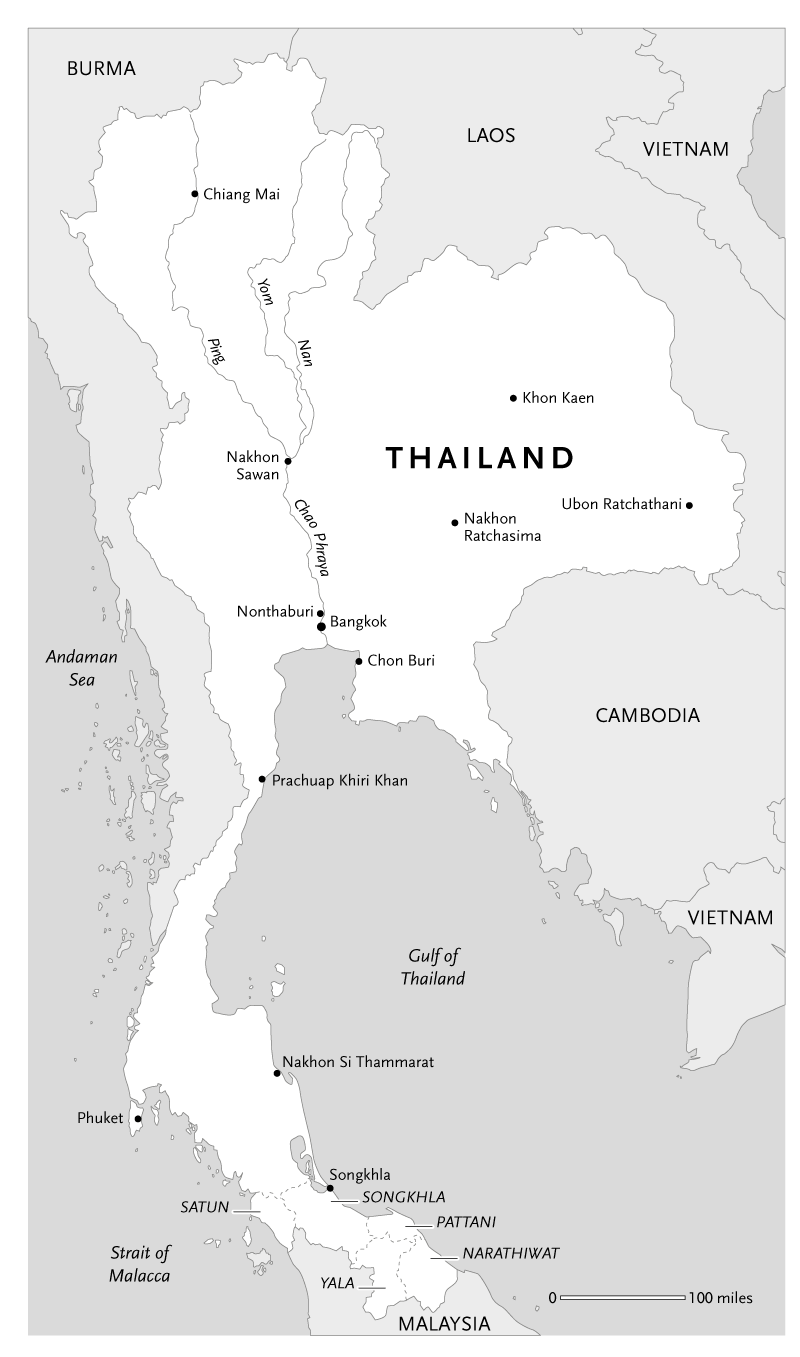
Journalists and scholars, both foreign and local, have put forward a number of explanations for the hatred and the violence of Thai politics: it is a struggle between dictatorship and democracy, conservatives and populists, monarchists and republicans, honesty and corruption—or between one class and another. These explanations are partial at best, and none of them captures the whole truth. Another theory speaks of Bangkok arrogance pitted against the rest of the country, which certainly has something to do with it. But in itself this cannot explain the most striking aspect of the whole political struggle, which is the regional distribution of support for the Reds and Yellows. The south is completely in the hands of the latter; Bangkok is also solidly Yellow; but the north and north-east of Thailand are Red strongholds. There is no explanation in terms of class conflict that can truly account for this polarization, and it has nothing to do with democracy either. Commentators do not talk about this regional dimension, even though it has been evident for a long time.
An encounter during a visit to Thailand encouraged me to think about this question. I was travelling to the airport in Bangkok; the taxi driver was an elderly Chinese man from the local Chinatown. We began talking about the political situation, and I asked him who he supported. He said, ‘Of course, I support Thaksin’, the leader of the Reds. Was it because he liked his policies, his attempts to provide greater social support, health care for the poor and so on? ‘No, the reason I support him is because he is a Hakka like me. We Hakkas are the only honest people in Thailand today. We work very hard, we had the courage to fight against the Manchu, we didn’t torture the feet of our women, we’re not pretentious.’3 I then asked his opinion of Abhisit Vejjajiva, the leader of the Yellow camp, whom he dismissed as a ‘goddamn Hokkien’; members of this group were lazy and not to be trusted in their dealings with others. My driver was equally hostile to Sondhi Limthongkul, another very important political figure.4 ‘He is Hailamese. Those people are so dirty, they never even wash; they’re ignorant, stupid and cruel.’ At this point I plucked up the courage to ask him about the King: ‘He is a Teochew, and they are opportunists who always suck up to people more important than them. They are cowards, who only came here because they could not land in Vietnam or Indonesia or the Philippines.’ Finally I asked him what he thought about the rural Thai. ‘They are nice people, but they are quite different from the Chinese; they are happy as long as they have good food to eat, plenty of alcohol, and plenty of sex. They have no politics.’ ‘Doesn’t this mean’, I said, ‘that your view of Thai politics is like the Romance of the Three Kingdoms—the classic Chinese novel of feuding warlords.’5 He agreed that it was. So the four main players in Thai politics all came from one or another of the Chinese diaspora groups, and my taxi driver hated three of them, but not his fellow Hakka, Thaksin.6 This led me to wonder about the identity of the overseas Chinese in Thailand, and where exactly they fit into Thai society.
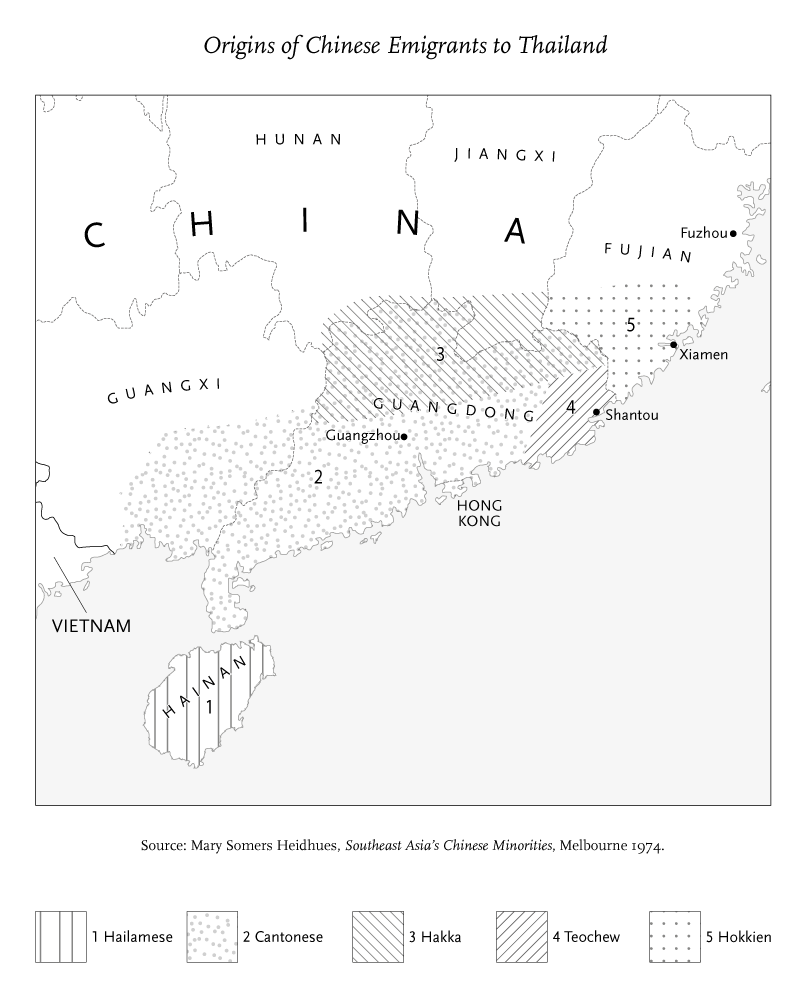
The story begins towards the end of the Ming dynasty, when the last and bravest enemies of the Manchu started to flee from places like Guangdong and Fujian in southern China. They knew they had lost the battle and could anticipate what punishment would be meted out to them, so they left the Middle Kingdom altogether. The Cantonese mostly worked their way down the coast to Vietnam; the Fujian or Hokkien people went further, to Cambodia, Indonesia and the Philippines; the Teochew followed them. The Hailamese and the Hakka came a century later.7 Of course, we know very little about what the people who left China at that time actually thought about their own identity, as most of them were illiterate. There is an illustration of this from the early days of Spanish colonization in the Philippines. Fujian traders went back and forth between Manila and Guangdong, making a good profit from their journeys. The Spanish asked them who they were, and the traders replied, ‘We are sengli’. In their own language, that simply meant traders or merchants. But the Spanish thought it was their ethnicity, so well into the nineteenth century they referred to the traders as sangleyes, until someone pointed out that they should change the word to chino. If those people simply identified themselves as traders and said nothing about being Fujian or Chinese, that suggests that they had little sense of belonging to a larger group; their identity merely encompassed their families, their local villages and so forth. It took a long time for that to change.
The exodus from China was followed by another very important development. The modern history of Siam begins in 1767, nine years before the United States declared their independence from Britain. In that year, a huge Burmese army sacked, looted and burnt the ancient capital of the Ayutthaya kingdom. Much of the vanquished realm then fell under Burmese occupation, and Siam went through years of chaos and devastation. The whole native aristocracy of the old regime was obliterated. In time, a militarily gifted Sino-Thai, known today as Taksin the Great, began driving the Burmese out, making use of experienced Chinese sailors who had settled in south-eastern Siam. Taksin is still greatly venerated in Thailand, but he proved to be rather cruel and paranoid once he had declared himself king. After a reign lasting fourteen years, he was overthrown in 1782 in a palace coup by one of his generals, and executed along with all of his kinfolk. The general who replaced Taksin founded the Chakri dynasty, which has lasted to this day; he made Cambodia into a Siamese vassal state, and is known to posterity as Rama I.
Taksin had been the son of a Teochew man and a local woman, and his replacement was also of Teochew stock. This was the only example anywhere in Southeast Asia of an overseas Chinese becoming the local monarch; Taksin actually applied several times to Beijing for recognition, but the rulers of China were very reluctant to grant it to him, because they did not like the idea of a Chinese king outside the Middle Kingdom itself. He did everything he could to encourage his fellow Teochew to come to the new capital, which was a port city where trade expanded very rapidly. This capital was effectively the forerunner of modern Bangkok. Having a king of their own marked a huge advance for the Teochew, who had previously been regarded by the other Chinese communities as small and insignificant. They became the dominant group among the overseas Chinese in Siam; they married into high families, and were given important jobs at the Court. Well into the nineteenth century, the Chakri monarchs continued to use a red seal that came from the Chinese Zheng clan for important state documents.8 Only with the rise of nationalism did it become embarrassing to admit that the king might be an immigrant, and the Chakri began to conceal the Sino-Thai origins of their dynasty.
The Hokkien, who, like the Teochew, had been concentrated in Chanthaburi, close to the modern Thai–Cambodian border, now began to move towards the west coast of southern Thailand, attracted by the growth of mining in this region. They also spread further south, into Penang and Singapore. Events in China precipitated further waves of emigration in the nineteenth century. The colossal Taiping Rebellion led to tremendous violence, especially from the generals who were sent to crush it, and caused a huge upheaval throughout southern China. It was at this time that the Hakka began to come, hoping to escape from the Manchu. They settled at first as farmers in an area west of Bangkok, near the Indian Ocean, thinking they would be safe there from anything that the Manchu might do; later they moved to western Thailand. The Hailamese travelled in the same direction, but went right down to the south. Although they were the poorest of all these groups, the Hailamese had one great advantage: they were immune to tropical diseases. Thailand’s southern area is still controlled today by Hokkien and Hailamese, and all the leaders of the Yellow Shirts come from this region. Periodically the Manchu would announce that anyone who had left China and wanted to come back would be summarily executed if they returned, so there was little incentive for them to do so.
The most important of the overseas Chinese in Thailand, who had close ties with the monarchy, managed the country’s trade and reaped the benefits from a monopoly held by the Court. But in 1855 the British arrived in Bangkok and issued a flat ultimatum to Rama IV, ordering him to break up the royal monopoly. This particular diplomat, John Bowring, is best known outside Thailand for having coined the slogan ‘Free trade is Jesus Christ, and Jesus Christ is free trade’. The Court’s trade monopoly was broken, which made things difficult for those Chinese who were used to working under royal patronage. It was also at this time that Britain forced open the southern Chinese ports in the Opium Wars. Colombia’s role in the contemporary drugs trade is nothing compared to the scale on which the British operated: all down Thailand’s western shore, as far as Penang and Singapore, the major import was now opium from British-ruled India. A new system had to be devised for handling the trade, based on tax farmers, who would be given the right to extract as much tax as they could from the local population, in return for a fee which they paid to the ruler. Of course, they would have to be very wealthy to pay for the license in the first place, but once they had it, it could be very lucrative indeed. The overseas Chinese who got hold of these tax farms also needed a lot of labour, tough young men to protect their territory and make sure that the boss got everything he expected. The opium trade was so successful, at least for the Court, that from the 1870s until the mid-twentieth century, year on year, about 50 per cent of the state budget came from opium.
During the reign of Rama V, which lasted from 1868 to 1910, there was a policy to encourage the immigration of poor, illiterate Chinese to work on commercial sugar plantations, or to build port facilities and a new transport network of roads and railways. The King’s policy closely followed the path of the British in Malaya and the Dutch in Sumatra; he was shrewd enough to realize that by importing workers from outside the country, he would avoid disturbing rural, semi-feudal Thai society too greatly. As a result, the country’s first working class was almost entirely Chinese, and it remained this way until World War Two. Initially, the Chinese were not allowed to consume opium, but for lonely, desperate young men working on construction projects, it was hard to resist such temptations. It was also a clever way for the bosses to keep their wages inside Siam; there was a tax farm in alcohol, a tax farm in prostitution, a tax farm in gambling. Most of these young men, if they did not die quickly, ended up very poor, and their money went into the pockets of the tax-farm organizations. There was a struggle over the control of opium among the secret societies that people in Thailand call ang yi, whose bosses would use some of the young men from their own groups as muscle, to beat or kill anyone who threatened the various tax farms.9 Since there was always friction between the boss in one place and the boss somewhere else, there was an incredible amount of violence as these secret societies fought one another, even burning down each other’s towns, right up to the end of the nineteenth century. These were very dangerous groups of people, accustomed to fighting with every conceivable method. The whole phenomenon was only brought under control by one of the British policemen who had already organized the suppression of secret societies in Singapore. Officially the ang yi more or less disappeared; in reality they persisted, and would surface again during the Great Depression.
Twentieth-century pressures
The fall of the Chinese monarchy in 1911 came as a huge shock to people in Bangkok. It was followed by an astonishing general strike of Chinese workers and merchants in protest against new taxes that had been imposed by the fun-loving and spendthrift Rama VI. Shortly afterwards, the King published two pamphlets under a pen-name, one of which described the local Chinese as ‘the Jews of the East’, with the other appealing to the Chinese themselves not to be influenced by Sun Yat-sen’s nationalism and to remain loyal to the Throne. In the decades after World War One, there was another huge influx of migrants from China. About 100,000 people came to Bangkok each year, a far bigger influx than anything that had happened before. But it didn’t really change the basic distribution between the groups.
In Bangkok, for example, the Teochews controlled 97 per cent of all pawn shops, and a similar proportion of rice mills; they also accounted for 92 per cent of Chinese medicine people. Sawmilling for the timber trade was overwhelmingly in the hands of Hailamese: 85 per cent. People who specialized in the leather business, on the other hand, were 98 per cent Hakka, and nine out of ten tailors were Hakka, too. Some 59 per cent of Bangkok’s machine shops were Cantonese-owned; 87 per cent of rubber exporters were Hokkien. So these Chinese communities were very sharply distinguished by occupation; the dominant ones especially did everything they could to make sure that the others wouldn’t come barging in, wanting to have a few rice mills or pawn shops of their own. There was quite a lot of tension. But one advantage of this period was that with the creation of the railways and the road network, it was possible for people to move much further away from the centre than before. The railway that ran up to the very north of the country started to draw Hailamese and Hakka. Thaksin, the Red leader, is a Hakka whose grandfather had travelled north, almost to the Laos border.
The 1930s were a difficult time for the overseas Chinese, because there was a lot of pressure on them to help during the Japanese invasion of China and the hideous occupation that followed. A struggle developed between those who supported Chiang Kai-shek and those who sympathized with Mao Zedong. The richer, more successful members of the diaspora were closer to the Nationalists, while the others tended to lean towards Mao and the Communists. It posed a question for all the new arrivals: what are you going to do about your identity? There was pressure in one direction to say they were just Chinese people who happened to be abroad, in the other to say, ‘We can be successful and do well here, perhaps we should be loyal to the country in which we’ve settled.’ This question has never been fully resolved. After World War Two, the loyalty of many Chinese to the system in Thailand was questioned. The country’s rulers were no longer absolute monarchs; power had now passed to the military. The army, police and intelligence services distrusted the Chinese, seeing them as potential spies or troublemakers, and they were often harassed. In fact, the founders of the Thai Communist Party were essentially poor people, workers from Bangkok and the surrounding area, who did not set about guerrilla activities until the mid 1960s.
By this point, the economy of Thailand was almost entirely in the hands of different Chinese-speaking groups—but not its political system. These groups lacked real political influence, especially under the military dictatorships. Many overseas Chinese wanted their children to be something more than business people: to become lawyers, doctors, judges, teachers and bureaucrats. Business was not regarded as a high social occupation: better to have a title, to be Doctor of this or Professor of that. One reason the Chinese tried to establish close ties with the Thai monarchy was the hope of obtaining feudal-style titles in return for funding some of its activities. Second-generation Chinese often sent their children to study in British and American universities. During the Cold War, the Americans decided that Thailand needed more universities: there were only two, and they were very hard to get into. Within five or six years, universities were built all over the country, and the total number of students rose from 15,000 to more than 100,000. This created more opportunities for everyone in Thailand, but especially for the overseas Chinese, who could now go to university at home, having had no real chance of doing so before. For a long time, the monarchy showed itself to be quite cunning. In the national museum in Bangkok there is a lovely photographic exhibition of the history of Thailand, but there are no Thai people in it at all—just the names of four kings. Thailand has no national heroes, which is rather striking; but it made it easier to absorb the Chinese immigrants. Things started to come apart when the military regime collapsed in 1973 and the top generals had to leave the country. There was a huge popular uprising in Bangkok, supported by people from almost every class, and for the first time a genuinely democratic government was established. Elections followed, with socialists and liberals winning seats in the national parliament.
This was the pivotal moment in the long reign of Rama IX, who had ascended to the throne in 1946. Soon afterwards, American Indochina collapsed, the Lao monarchy was abolished, and communist states ringed Thailand’s eastern borders. This fed paranoia in royalist circles about the future of the monarchy, and the King called in the brutes. In 1975–76, right-wing activists began killing leftist politicians, students and union leaders. On 6 October 1976, organized mobs—including members of the Border Police, whose sponsor was the Queen Mother—attacked Bangkok’s Thammasat University and set about murdering students in broad daylight. More than a hundred people were killed; bodies were strung up in the city’s biggest park, bearing the marks of hideous torture. Needless to say, no one was punished for these crimes. A military coup took place that night with the blessing of Rama IX, who insisted on choosing his own prime minister, a rabidly anti-communist judge. Hundreds of students fled Bangkok to join the communist maquis in distant parts of the country. Eventually most of these young people returned to the cities when the Thai Communist Party was betrayed by Deng Xiaoping, in pursuit of an alliance with Thailand against the Vietnamese.10
Since the demise of the communist movement and the end of the Cold War in Asia, there have not been any left-wing parties in Thailand; all of them are conservative and neoliberal. It was a perfect time for the bourgeoisie, Chinese or otherwise. One sign of this was a huge expansion of the banks: they now had branches all over the country, their buildings often bigger than those of the provincial governors. For those who wanted to go into politics, especially the Chinese, this was ideal; they could borrow plenty of money to pay off the people who were helping them. These individuals became something like small warlords, who had interests in real estate, gambling, smuggling and so on, and were effectively immune to local police forces. They were very eager to become members of parliament, where they would have many opportunities to secure higher jobs and funding for projects of various kinds. They were perfectly happy to move from one party to another as required. This was the first time that anyone thought it worthwhile to become a politician in Thailand. These ‘representatives’ had to rely on their own families in the incessant power struggles, and the top politicians filled every possible job with relatives and close friends, as they still do today. In this period, when small businessmen became much larger businessmen, they used exactly the same methods as the ang yi of earlier times. In the 1980s and 90s, for the first time since the nineteenth century, killings were going on in Thailand which were not vertical: it was not a case of the state repressing the left, it was businessmen who wanted to be politicians feuding with their rivals, with assassinations by hired gunmen, ambushes and bomb-throwing.11
Rise of Thaksin
Then came the Asian crash of 1997–98, ignited by developments in Thailand. The baht lost half its value, the Crown Property conglomerate suffered heavy losses, and the national economy was devastated. It was amidst this turmoil that Thaksin Shinawatra started his meteoric rise. A former policeman of Hakka origin, Thaksin had become one of Thailand’s richest men thanks to a near-monopolistic mobile-phone concession which he obtained under the last military regime. After founding his Thai Rak Thai (Thais Love Thais) party, he recruited a batch of ex-leftists who had been part of the maquis and were eager to become leaders at long last. Thaksin announced a series of ‘populist’ policies aimed at the masses, such as low-cost health care and the cancellation or deferment of farmers’ debts. He became the first Thai politician to win a controlling majority in parliament, and has won every election since by a decisive margin—even from exile. The other novelty was that he actually honoured his campaign promises. Huge sums of money from the now-recovering Thai exchequer completely outshone the ‘royal development projects’, and the Palace began to feel threatened. Even the fact that Thaksin’s name was so close to that of King Taksin the Great, who had been executed by the Chakri dynasty, caused the royals some anxiety. They turned to the predominantly royalist and conservative judiciary in the face of Thaksin’s control over the executive and legislature, and eventually to the military, which overthrew his government in the coup of September 2006. The new military regime was mild compared to its predecessors, but achieved nothing other than to have Thaksin tried in absentia and sentenced to two years in prison for corruption. When fresh elections were held, a repackaged version of the Thai Rak Thai party won again, and two proxies of Thaksin served as prime minister. They were ousted in turn by militant opponents, the so-called Yellow Shirts, who claimed to be defending the monarchy; a ‘palace nominee’ took over, and was opposed by the mobilization of Red Shirts.
In the struggle between Thaksin and the Court, the latter made some grave errors, betraying the weakness characteristic of dynasties in decline. The first was to arrange for an astonishing media campaign that would have made Kim Il Sung blanch. It is hard to find a public space anywhere today that does not have endless billboards with images of the King. ‘Beneficent royal activities’, such as charitable works, ceremonies and memorabilia of the King’s youth, were greatly expanded—not always in the best of taste. In his prime Rama IX had not needed any of this, as he was genuinely popular. Their second blunder was the unscrupulous expansion and deepening of the lèse-majesté laws, which are now the most repressive in the whole monarchist world: you can easily go to jail for twenty years. The royalist politician Sondhi was given a two-year sentence just for repeating comments made by one of Thaksin’s supporters, even though he was denouncing her for criticizing the monarchy. Tens of thousands of websites have been suppressed—in vain, as the disaffected young are far more technologically skilled than their enemies, elderly bureaucrats for the most part. Blogs openly hostile to the Palace have increased enormously over the last decade. The problem of succession, inherent to any monarchy, is becoming more and more obvious to the general public. The King is now 88 years old, and has been repeatedly hospitalized. The billboards tell another (unacknowledged) story: the vast majority of pictures show the King alone, save perhaps for his favourite dogs, from youth to old age. His wife and children only appear in ceremonial photographs. The Queen has lived a life of her own, while the rarely seen 63-year-old Crown Prince has no popular standing at all, and the absence of homey, father-son images betrays the profound dislike between the two men. For varying reasons, the three royal daughters are all implausible candidates for the throne. One might have expected the elderly ruler to firmly announce his choice as the next monarch, but for decades there has been nothing but silence. It is often said that King Taksin the Great, as he awaited execution, prophesied that the Chakri dynasty would expire with its tenth descendant. A myth, of course, but one that lingers and bites.
Who are the fanatical royalists? One might have expected that they would come from the capital’s bourgeoisie, but this would be to overlook the crucial factor. Over the past fifty years, almost every Thai prime minister has been a lukchin, like the monarchy itself. But this shared ‘Chinese ancestry’ conceals bitter rivalries between the Teochew, Hokkien, Hakka and Hailamese.12 The positive side of this phenomenon is that Thailand has never experienced the kind of anti-Chinese mobilizations that have characterized the modern histories of Malaysia, Vietnam, Indonesia, Burma and the Philippines. Capable, wealthy and ruthless Sino-Thais have been able to climb upwards—on condition that their ‘Chineseness’ remains very low-profile, especially under Rama IX. There are echoes here of the status enjoyed by wealthy Jews in Habsburg Vienna or Hanoverian London. In the last election, it turned out that 78 per cent of the seats in Thailand’s parliament were occupied by ethnic Chinese, even though they accounted for just 14 per cent of the population.
Against this backdrop, the question now is who will be President of the Republic of Thailand?’ Nobody will say so explicitly, but that is exactly what is in their minds. With the system of petty warlords in each of the territories, that creates frustration for everybody: they can be sure of winning in one place but not in another. The Reds can’t penetrate the territory of the Yellows, and the Yellows can’t penetrate the territory of the Reds; the south is Yellow and the north is Red. Another difficulty is that nobody can talk publicly about their Chinese identity, because it would be absurd to declare that one is Chinese but plans to be the President of the Republic. Everyone knows that they are, but it’s not considered appropriate to say so. There is no other way out, unless one of them gets killed, or something of that kind. Don’t fool yourself that the political contest in Thailand is about democracy or anything like that. It’s about whether the Teochews get to keep their top position, or whether it’s the turn of the Hakkas or the Hailamese.

留言
張貼留言