外交部駁斥《時代雜誌》「魯莽領導人」標籤
外交部駁斥《時代雜誌》「魯莽領導人」標籤
和平與穩定: 外交部表示,維持兩岸「現狀」一直是政府的立場。
記者方韋力、葉子綺/台北報導
外交部昨日表示,台灣致力於維持兩岸「現狀」,不尋求升高緊張局勢,駁斥《時代雜誌》(Time)一篇將總統賴清德形容為「魯莽領導人」的評論文章。
該文章標題為〈美國必須提防台灣的魯莽領導人〉(The US Must Beware of Taiwan’s Reckless Leader),作者為美國華盛頓智庫「國防優先研究所」(Defense Priorities)亞洲項目主任萊爾・高德斯坦(Lyle Goldstein)。
高德斯坦在文中指出,在中東戰火與俄羅斯入侵烏克蘭的背景下,台灣是「世界上最危險的火藥庫」。
批賴清德「太明確表達台灣主權」
他表示,台海局勢變得不穩定,部分原因是賴清德比前總統蔡英文更明確地表達了「台灣國家地位」與主權立場,並形容賴為「衝動」(brash)與「顯然魯莽」(evidently reckless)。
高德斯坦稱,賴清德關於台灣獨立地位的發言「不夠低調」,導致北京指控他是在「招致更多衝突與風險」。
他並警告:「華盛頓應謹慎行事」,建議美國將印太防務重心重新放在「真正的條約盟友」上,如日本、南韓、澳洲與菲律賓。
外交部回應:「和平是唯一選項」
外交部回應指出,政府一貫維護兩岸和平穩定,以穩健、務實、理性的態度推動對中政策。
台灣從未改變維持兩岸「現狀」的承諾,也未尋求升高緊張,並重申賴總統多次強調:「和平是唯一選項。」
外交部說,維持台海現狀一直是台灣的基本立場,也獲得國際社會廣泛共識。
相反地,北京才是破壞和平與穩定的一方,持續對台進行政治宣傳與軍事恫嚇,包括大規模軍演、「灰色地帶」行動與認知作戰。
政府將持續強化自我防衛能力與全民韌性,以捍衛台灣的民主。
外交部強調,堅實的自我防衛能力是維護台海與區域和平穩定的關鍵。
《時代雜誌》另兩篇涉台文章
《時代雜誌》週四同時刊登另外兩篇與台灣有關的文章。
其中一篇由該雜誌資深編輯查理・坎貝爾(Charlie Campbell)撰寫,題為〈戰爭陰影下的台灣〉(Taiwan in the Shadow of War),探討台灣面臨的地緣政治風險與日益升高的衝突威脅。
另一篇〈川普如何避免一場台海戰爭〉(How Trump Can Avoid a War Over Taiwan),作者是中國人民解放軍退役大校、清華大學國際安全與戰略中心研究員周波。
周波在文中呼應前兩篇文章的觀點,稱美國總統唐納・川普拒絕讓賴清德過境紐約「是正確的」,並指出台灣是「唯一可能讓美中兩強陷入全面衝突的問題。」
周波建議「禁台官員過境」
周波建議,川普應制定正式規則,禁止台灣官員過境美國主要城市,以「測試美國政府態度變化」,從而避免與北京爆發潛在衝突。
他還呼籲美方約束美軍高層對「中國何時可能攻台」的「煽動性言論」,並撤回駐台美軍教官。
周波寫道:「川普總統應警告賴清德謹言慎行,」並鼓勵台灣接受「一中原則下的九二共識」。
九二共識爭議
所謂「九二共識」是前陸委會主委蘇起於2006年承認在2000年杜撰的說法,指國民黨與中共之間有一種默契:雙方都承認「一個中國」,但各自表述「中國」的涵義。
賴清德所屬的民進黨從未承認「九二共識」,指出北京不承認中華民國的存在,接受該共識等同於同意中國對台灣的主權主張。
MOFA rejects ‘Time’ ‘reckless leader’ label
PEACE AND STABILITY: Maintaining the cross-strait ‘status quo’ has long been the government’s position, the Ministry of Foreign Affairs said


Taiwan is committed to maintaining the cross-strait “status quo” and seeks no escalation of tensions, the Ministry of Foreign Affairs (MOFA) said yesterday, rebutting a Time magazine opinion piece that described President William Lai (賴清德) as a “reckless leader.”
The article, titled “The US Must Beware of Taiwan’s Reckless Leader,” was written by Lyle Goldstein, director of the Asia Program at the Washington-based Defense Priorities think tank.
Goldstein wrote that Taiwan is “the world’s most dangerous flashpoint” amid ongoing conflicts in the Middle East and Russia’s invasion of Ukraine.
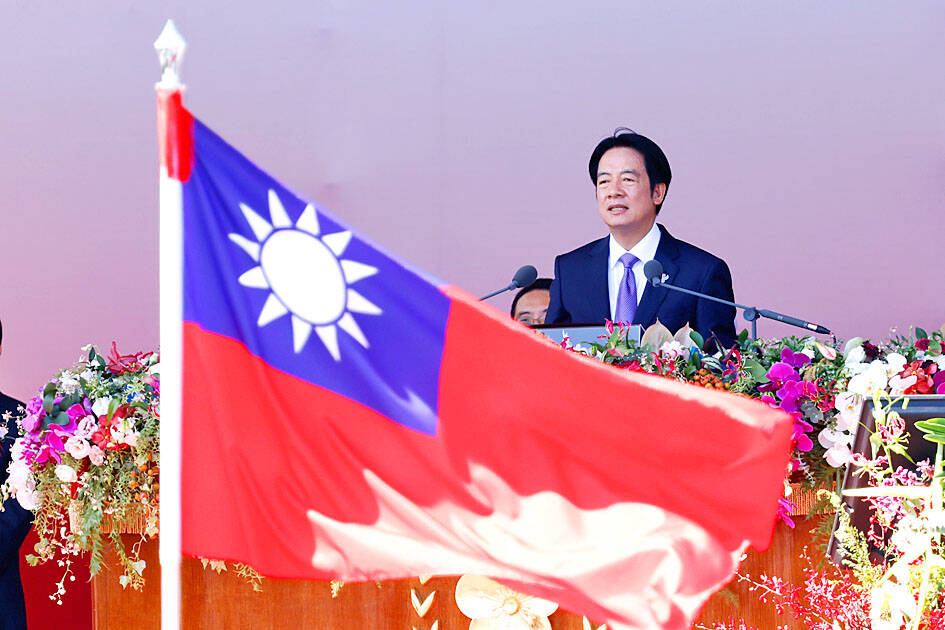
President William Lai speaks during Double Ten National Day celebrations in Taipei on Oct. 10.
Photo: Ritchie B. Tongo, EPA
He said that the situation in the Taiwan Strait has become less stable partly because Lai — whom he referred to as “brash” and “evidently reckless” — has been more explicit in “making the case for Taiwanese nationhood” and Taiwan’s national sovereignty than his predecessor, former president Tsai Ing-wen (蔡英文).
Goldstein said Lai’s statements on Taiwan’s independent status were not sufficiently low-profile and provoked accusations from Beijing that he was inviting “more conflict and risk.”
“Washington should tread carefully,” Goldstein said, adding that the US should refocus its defense efforts in the Indo-Pacific region on “actual treaty allies” such as Japan, South Korea, Australia and the Philippines.
In response, MOFA said the government consistently upholds cross-strait peace and stability, and promotes its China policy with a steady, practical and reasonable attitude.
Taiwan has never changed its commitment to maintaining the cross-strait “status quo,” nor has it sought to escalate tensions, it said, adding that Lai has repeatedly emphasized that “peace is the only option.”
Maintaining the cross-strait “status quo” across the Taiwan Strait has long been Taiwan’s position and is a widespread consensus within the international community, the ministry said.
Beijing is the party undermining peace and stability by continuing to engage in political propaganda, military intimidation against Taiwan, including large-scale drills, “gray zone” tactics and cognitive warfare operations, it said.
The government will continue to improve its self-defense capabilities and bolster whole-of-society resilience to safeguard Taiwan’s democracy, it said.
Robust self-defense capabilities are indispensable to maintaining peace and stability across the Taiwan Strait and throughout the region, it added.
Time also published two other Taiwan-related articles on Thursday. One, titled “Taiwan in the Shadow of War” by Charlie Campbell, editor-at-large at the magazine, examined the geopolitical risks and growing threat of conflict facing Taiwan.
Another, “How Trump Can Avoid a War Over Taiwan,” was written by retired Chinese People’s Liberation Army senior colonel Zhou Bo (周波), a research fellow at the Center for International Security and Strategy at Tsinghua University in Beijing.
In his piece, Zhou echoed themes raised in the other two articles, saying that US President Donald Trump was right not to allow Lai to stop over in New York, adding that Taiwan is “the only issue that can drag the two titans [the US and China] into a full-blown conflict.”
Zhou also suggested that Trump establish a formal rule prohibiting Taiwanese officials from transiting through major US cities as a way to “test the reaction of the US government over any changing attitude,” and thereby avoid a potential war with Beijing.
He urged Washington to silence “sensational remarks” by US military officers on when China might invade Taiwan, and withdraw US military trainers stationed in Taiwan.
“President Trump should warn Lai to watch his words,” Zhou wrote, adding that Trump should encourage Taiwan to accept “the ‘one China’ 1992 consensus.”
The “1992 consensus” — a term that former Mainland Affairs Council chairman Su Chi (蘇起) in 2006 admitted making up in 2000 — refers to a tacit understanding between the Chinese Nationalist Party (KMT) and the Chinese Communist Party that both sides of the Taiwan Strait acknowledge that there is “one China,” with each side having its own interpretation of what “China” means.
Lai’s Democratic Progressive Party has never recognized the “1992 consensus,” saying that Beijing does not acknowledge the existence of the Republic of China and that acceptance of the formula would imply agreement with China’s sovereignty claim over Taiwan.

留言
張貼留言