美國正在發動新冷戰:社會主義視角
內容
- Vijay Prashad介紹
- 是什麼促使美國加大國際軍事侵略?作者:約翰‧羅斯(Roos Siyi)
- 誰帶領美國走向戰爭?作者:Deborah Veneziale
- 約翰‧貝拉米‧福斯特為二十一世紀生態與和平運動所寫的《滅絕主義筆記》

介紹
維賈伊·普拉沙德
2022年5月23日,在達沃斯(瑞士)世界經濟論壇會議上,美國前國務卿亨利·基辛格就烏克蘭問題發表了一些令人震驚的言論。基辛格表示,以美國為首的西方國家不應該被「一時情緒」所左右,而應該促成一項讓俄羅斯滿意的和平協議。基辛格說:「如果繼續戰爭,就不再關乎烏克蘭的自由,而是對俄羅斯本身發動新的戰爭。」西方外交政策權威們大多對基辛格的言論翻白眼、不屑一顧。基辛格並不是和平主義者,但他指出,事態升級的巨大危險不僅在於在亞洲建立新的鐵幕,還可能在西方與俄羅斯以及中國之間引發公開的、致命的戰爭。這種難以想像的結果甚至對亨利·基辛格來說也難以接受,他的上司、前總統理查德·尼克松曾多次談及國際關係的“狂人理論”;尼克森告訴他的幕僚長鮑勃·霍爾德曼,他已經“把手放在核按鈕上”,要恐嚇胡志明,迫使他投降。
在2003年美國非法入侵伊拉克之前,我曾與美國國務院的一位高級官員進行過交談,他告訴我,華盛頓的主流理論就是一句簡單的口號:短期痛苦換取長期利益。他解釋說,普遍的觀點是,國家的精英願意忍受其他國家的短期痛苦——也許包括美國勞動人民,因為他們可能會因為戰爭造成的混亂和屠殺而遭遇經濟困難。然而,如果一切進展順利,這個代價將帶來長期收益,因為美國將能夠維持自第二次世界大戰結束以來一直尋求維持的地位,也就是首要地位。如果一切順利的話,這個前提讓他講話時不寒而栗,但同樣讓我不安的是關於誰必鬚麵對痛苦以及誰將享受收益的冷酷態度。華盛頓有人相當憤世嫉俗地表示,只要大型石油和金融公司能夠享受征服伊拉克的成果,那麼伊拉克人和美國勞工階級士兵受到負面影響(甚至死亡)也是值得的。這種「短期痛苦、長期利益」的態度是美國菁英們的典型幻想,他們不願意容忍建立人類尊嚴和自然長壽的工程。
短期痛苦,長期利益決定了美國及其西方盟國對俄羅斯和中國的危險升級。美國的姿態引人注目的是,它試圖阻止一個看似不可避免的歷史進程,那就是歐亞一體化進程。在美國房地產市場崩盤和西方銀行業發生重大信貸危機之後,中國政府與其他全球南方國家一道,轉向建立不依賴北美和歐洲市場的平台。這些平台包括2009年成立的金磚國家(巴西、俄羅斯、印度、中國和南非)和2013年提出的「一帶一路」(後來的「一帶一路」倡議,簡稱BRI)。俄羅斯的能源供應和大量金屬和礦產儲備,以及中國的工業和技術能力,吸引了許多國家加入「一帶一路」倡議,不論其政治傾向如何,而俄羅斯的能源出口是這一聯盟的支撐。這些國家包括波蘭、義大利、保加利亞和葡萄牙,而德國現在是中國最大的商品貿易夥伴。
歐亞一體化的歷史事實威脅了美國和大西洋菁英的主導地位。正是這種威脅驅使美國採取一切手段「削弱」俄羅斯和中國的危險嘗試。華盛頓仍然保留著舊習慣,長期以來一直尋求核主導地位以否定緩和理論。美國已發展出足以毀滅地球的核子能力和核態勢,以維護其霸權。削弱俄羅斯和中國的策略包括試圖透過升級美國實施的混合戰爭(如製裁和資訊戰)來孤立這些國家,以及希望肢解這些國家,然後永久地統治它們。
本卷中的三篇文章對烏克蘭目前所呈現的長期趨勢進行了嚴密而理性的分析。
《每月評論》主編約翰·貝拉米·福斯特列舉了美國當權派的「升級主導」理論,稱美國為了保住主導地位不惜冒著遭遇核冬天(意味著毀滅)的風險。儘管俄羅斯和美國實際上擁有的核武數量眾多,但美國已經發展了一整套反擊體系,它認為這套體係可以摧毀俄羅斯和中國的核武器,然後將這些國家碾壓至屈服。這種幻想不僅出現在美國決策者的華而不實的文件中,有時也出現在大眾媒體中,他們討論了對俄羅斯發動核攻擊的重要性。
義大利記者黛博拉·韋內齊亞萊深入挖掘了美國軍國主義的社會世界,觀察了美國政治精英的各個派系如何联合起來支持這種對抗俄羅斯和中國的戰略。智庫和軍火生產公司、政治人物和他們的文人之間的親密世界已經否定了憲法所保護的製衡機制。為了保護美國精英對全球社會財富的非凡控制權(美國最富有的400名公民的總資產淨值現已接近3.5萬億美元,而全球精英(其中許多來自美國)在非法避稅天堂囤積了近40萬億美元),衝突因此而爆發。
「反冷戰」聯盟成員約翰·羅斯撰文指出,美國透過烏克蘭衝突進一步升級了對地球的軍事攻擊。這場戰爭是危險的,因為它顯示美國願意直接與大國俄羅斯對抗,願意透過「烏克蘭化」台灣來升級與中國的衝突。羅斯認為,能夠制約美國的是中國的韌性和捍衛其主權及計劃的決心,以及全球南方國家對美國強加其外交政策目標日益增長的不滿。世界上大多數國家並不視烏克蘭戰爭為本國衝突,因為他們正致力於解決人類更廣泛的困境。值得注意的是,非洲聯盟主席穆薩·法基·馬哈馬特於 2022 年 5 月 25 日表示,非洲已成為「俄羅斯與烏克蘭之間遙遠衝突的附帶受害者」。這場衝突不僅在空間上遙遠,在非洲、亞洲和拉丁美洲國家的政治目標上也遙遠。
這項研究由《每月評論》、《沒有冷戰》和三大洲社會研究所共同進行。我們邀請您閱讀它、與朋友分享它、並在有機會的時候討論它。寶貴的人類生命和地球的壽命正受到威脅。這些事實是無法忽視的。世界上大多數人都願意與我們相處解決現實問題。我們不想被捲入西方菁英為維繫其主導權力而產生的狹隘慾望所驅動的衝突。我們肯定生命。
是什麼促使美國加大國際軍事侵略?
約翰·羅斯
介紹
導致烏克蘭戰爭的事件代表著美國在國際層面上升級軍事侵略行為二十多年趨勢的質的加速。烏克蘭戰爭前,美國祇是針對軍力弱小且不擁有核武的開發中國家進行軍事對抗,如1999年轟炸塞爾維亞、2001年入侵阿富汗、2003年入侵伊拉克、2011年轟炸利比亞。但作為戰爭主因的美國威脅將北大西洋公約組織擴張至烏克蘭,則代表著根本的差異。美國意識到北約擴張至烏克蘭將直接違背擁有強大軍事力量和龐大核武庫的俄羅斯的國家利益。儘管這會跨越俄羅斯的紅線,但美國已準備好承擔這個風險。
美國尚未派遣自己的軍隊參與烏克蘭戰爭,稱這將引發世界大戰並有引發核災的風險。但事實上,它正在對俄羅斯進行代理人戰爭。美國不僅堅持為烏克蘭加入北約保留可能性,還在戰爭前夕對烏克蘭軍隊進行訓練,如今又向烏克蘭提供了大量軍事武器並傳遞了衛星和其他情報資訊。迄今為止,美國對烏克蘭的援助已達約500億美元。
美國如何將烏克蘭推入戰爭
自 2014 年以來,美國及其盟友就一直在為烏克蘭的戰爭做準備,例如派遣數百名教官訓練烏克蘭軍隊。這與1990年伊拉克海灣戰爭期間的做法類似,反映了華盛頓似乎正在用來實現其地緣政治目標的模式。從2014年政變開始,俄羅斯就被有意引誘捲入烏克蘭局勢,當時反俄勢力在烏克蘭新納粹分子和美國的支持下在基輔掌權。當時,烏克蘭軍隊並不是一支強大的軍事力量,在1991年蘇聯解體後發起的「改革」中遭受了巨大損失。數十年的忽視和資金不足導致軍事基礎設施和裝備腐朽,官兵士氣低落。正如俄羅斯聯邦共產黨中央委員會委員維亞切斯拉夫·捷特金所說:“烏克蘭軍隊不想打仗,也不能打仗。”
2014 年政變後,國家支出不再用於改善社會福利,而是用於建設軍隊。 2015 年至 2019 年,烏克蘭軍事預算從 17 億美元增加到 89 億美元,佔 2019 年該國 GDP 的 6%。以 GDP 的百分比衡量,烏克蘭的軍費開支是西方大多數已開發國家的三倍。大量資金投入恢復和現代化國家軍事硬件,最終重建軍隊的戰鬥力。
在 2014 年至 2015 年對頓巴斯(烏克蘭東部俄語地區)的戰爭中,烏克蘭幾乎沒有獲得空戰支援,因為幾乎所有戰鬥機都需要維修。然而,到2022年2月,空軍已配備約150架戰鬥機、轟炸機和攻擊機。烏克蘭武裝部隊的規模也大幅擴張。值得注意的是,根據 Tetekin 的數據,截至 2021 年底,士兵的薪水增加了三倍。美國加強軍事力量並在頓巴斯附近建立強大的防禦工事,顯示美國有意在該地區挑起衝突。
然而,儘管進行了這些戰爭準備,烏克蘭軍隊仍然無法與俄羅斯進行認真的抗衡。力量對比顯然不利於基輔。這對美國來說並不重要,它試圖利用烏克蘭作為對付俄羅斯的砲灰。特特金稱,“美國為新軍事化的烏克蘭制定了兩個方案……第一個方案是征服頓巴斯、入侵克里米亞。第二個方案是激起俄羅斯的武裝干涉。”
2021年12月,俄羅斯意識到在美國影響下烏克蘭面臨的危險越來越大,因此向北約尋求一系列安全保障以化解危機。尤其是俄羅斯要求北約停止東擴,包括加入烏克蘭。 「西方…忽視了這些要求,」特特金寫道,「因為他們知道入侵頓巴斯的準備工作正在如火如荼地進行。烏克蘭軍隊的大多數戰鬥準備部隊,人數多達 15 萬人,都集中在頓巴斯附近。他們可以在幾天內打破當地軍隊的抵抗,徹底摧毀頓內茨克和盧甘斯克,造成數千人死亡。」11
烏克蘭問題是美國軍事侵略的質的升級
因此,無論從基本政治事實(美國堅持烏克蘭加入北約的「權利」),還是軍事事實(美國增強烏克蘭武裝力量)來看,都可以清楚地看出,美國正在準備在烏克蘭進行對抗,儘管這將不可避免地與俄羅斯發生直接衝突。因此,在評估烏克蘭危機時,必須注意到,美國準備將其軍事威脅從單純針對發展中國家(始終是不公正的,但不會直接冒與大國發生軍事衝突或世界大戰的風險)升級為侵略俄羅斯等非常強大的國家,而這確實有引發全球軍事衝突的風險。因此,分析美國軍事侵略行為不斷升級的原因至關重要。這是暫時的,之後美國將恢復更和解的路線,還是軍事升級是美國政策的長期趨勢?
當然,這對所有國家來說都至關重要,對於中國這樣一個強大的國家來說尤其如此。舉一個關鍵的例子,在美國對俄羅斯的侵略不斷升級的同時,美國不僅對中國經濟徵收關稅,還開展系統的國際運動,利用新疆局勢來推行自己的外交政策議程;它還試圖破壞有關台灣省的一個中國政策。
美國針對台灣省的行動包括:
- 這是美中建交以來拜登總統首次邀請台北代表出席美國總統的就職典禮。
- 眾議院議長南希·佩洛西(按總統繼任順序排列的第三高級美國總統官員)於 2022 年 8 月 2 日訪問台北。
- 美國呼籲台北參與聯合國。
- 美國加大了對台軍售力道。
- 訪問台北的美國代表團增加。
- 美國加大在南海地區的軍事部署,並定期派遣美軍艦穿越台灣海峽。
- 美國特種作戰部隊不僅訓練了台灣海軍士兵,也訓練了台灣地面部隊。
正如在烏克蘭和俄羅斯問題上一樣,美國充分意識到一個中國政策涉及中國最根本的國家利益,並且自1972年尼克森訪問北京以來的50年裡,這項政策一直是中美關係的基礎。放棄它超越了中國的紅線。由此可見,美國正試圖以對抗的方式破壞一個中國政策,就像它在烏克蘭問題上故意跨越俄羅斯的紅線一樣。
對於美國針對中俄兩國的這些挑釁是暫時的、長期的、甚至是永久的,筆者的明確結論是:美國軍事升級的趨勢也將持續。但鑑於這個問題極為嚴重,可能引發戰爭,具有極其重大的實際後果,任何誇大其詞和簡單的宣傳都是不可接受的。因此,這裡的目的是以事實、客觀和冷靜的方式提出美國在未來時期將試圖進一步升級軍事侵略的原因。此外,我將確定哪些趨勢可能有助於抵消美國這項危險的政策,以及哪些趨勢可能加劇這一危險的政策。
「舊冷戰」與「新冷戰」時期美國的經濟與軍事地位
歸納起來,推動美國軍事侵略政策不斷升級、迄今已持續二十多年的關鍵力量是顯而易見的。第一個因素是美國經濟在全球生產中永久喪失壓倒性的地位;第二個因素是美國軍事實力和軍事開支的優勢。這種不對稱將為人類帶來一個非常危險的時期,美國可能會試圖透過使用軍事力量來彌補其相對的經濟衰退。這有助於解釋美國對發展中國家的軍事攻擊,以及與俄羅斯在烏克蘭不斷升級的對抗。一個重要的問題是,美國的軍事侵略是否會進一步升級,包括與中國的對抗加劇,甚至考慮發動世界大戰。要回答這個問題,必須對美國的經濟和軍事狀況做出準確的分析。
首先從經濟角度來看,1950年,也就是第一次冷戰開始前,美國佔世界GDP的27.3%。相較之下,當時最大的社會主義經濟體蘇聯佔世界GDP的9.6%。換句話說,美國經濟規模幾乎是蘇聯經濟的三倍。2在整個二戰後時期(第一次冷戰),蘇聯的GDP從未接近美國,1975年也只相當於美國的44.4%。也就是說,即使在蘇聯經濟相對成就達到高峰的時候,美國經濟規模仍然是蘇聯經濟的兩倍以上。在整個「舊冷戰」期間,美國經濟顯著領先蘇聯,至少在傳統的產出衡量標準上是如此。
回顧目前的情況,美國在全球GDP所佔的比重已大大低於1950年,根據衡量方法不同,大約在15%到25%之間。中國作為當今美國的主要經濟競爭對手,經濟實力已大大接近美國。即使以市場匯率計算,中國的GDP已相當於美國的74%,而市場匯率的波動在某種程度上不受實際產出的影響,遠高於蘇聯曾經達到的水準。而且,一段時間以來,中國經濟成長速度一直遠超美國,未來也將繼續向美國靠攏。
以安格斯·麥迪遜和國際貨幣基金組織的衡量標準-購買力平價(PPP,用於考慮各國不同的物價水準)計算,到2021年,美國僅佔世界經濟的16%,也就是說,世界經濟的84%在美國之外。以同樣的標準,中國經濟規模已經比美國大18%。 2026年,以國際貨幣基金組織的購買力平價預測,中國經濟規模將比美國至少大35%。中美之間的經濟差距比蘇聯曾經取得的任何成就都要小得多。
考慮到其他因素,無論如何衡量,中國目前已成為世界遙遙領先的製造業強國。根據最新數據,2019 年中國佔世界製造業產出的 28.7%,而美國為 16.8%。換句話說,中國在全球製造業生產的比重比美國高出70%以上。另一方面,蘇聯在製造業生產方面從未超越美國。
從貨物貿易來看,在川普發起的貿易戰中,美國敗給中國,對他和美國來說,甚至有些羞辱。 2018年,中國的商品貿易額已經超過其他國家,儘管當時中國的商品貿易額僅比美國高出10%左右。到2021年,中國貨物貿易額超過美國31%。在商品出口方面,美國的情況更糟:2018年,中國出口比美國高出58%,而到2021年,中國出口將高出91%。綜上所述,中國不僅成為迄今為止全球最大的貨物貿易國,而且美國在川普和拜登政府發動的貿易戰中遭遇了明顯的失敗。
從宏觀經濟角度來看,更根本的是中國在儲蓄(家庭、企業和國家)方面的領先地位,而儲蓄是實際資本投資的來源和經濟成長的驅動力。根據2019年的最新數據,中國的總資本儲蓄絕對值比美國高出56%,即6.3兆美元,而美國為4.03兆美元。然而,這個數字大大低估了中國的領先地位:一旦考慮到折舊因素,中國每年的淨資本創造量比美國高出635%,相當於3.9兆美元,而美國僅為0.6兆美元。綜上所述,中國每年都在大幅增加資本存量,而美國則相對而言增加很少。
這些趨勢的最終結果是,中國經濟成長遠遠超過美國,不僅在眾所周知的1978年以來的整整四十年期間,而且一直持續到最近一段時間。以通膨調整後的價格計算,2007年(國際金融危機爆發前一年)以來,美國經濟成長了24%,而中國經濟成長了177%,也就是說,中國經濟成長率是美國經濟的7倍多。在相對和平的競爭環境中,中國正在獲勝。3
美國在生產力、技術、企業規模等方面的領先意味著,從整體來看,美國經濟還是強於中國,但兩國之間的差距已經比當年美國和蘇聯之間的差距要小得多。而且,不管兩大經濟體之間的經濟實力對比如何,美國已經明顯喪失了全球經濟主導地位。從純經濟角度來看,我們已經處於全球多極化時代。
經濟衰退時期的美國軍隊
美國經濟遭受的這些挫折,使得一些人,特別是西方少數圈子的人,相信美國的失敗是不可避免的,或已經發生了。中國國內也有少數人持類似觀點,認為中國的綜合實力已經超過美國。這些觀點都是不正確的。他們忘了列寧的名言:“政治必須先於經濟,這是馬克思主義的ABC”,也忘記了毛主席關於政治的名言:“槍桿子裡面出政權”。美國正在失去經濟優勢的事實並不意味著它會任由這種經濟趨勢和平地持續下去:如果認為情況如此,那就犯了將經濟置於政治之上的錯誤。相反,美國在經濟上落後於中國和其他國家的事實,正迫使它採取軍事和軍事相關的政治手段來克服經濟失敗的後果。
更確切地說,對所有國家來說,危險在於美國尚未喪失軍事霸權。事實上,美國的軍費開支比排在其後的九個國家的軍費開支總和還要高。只有在核武這一領域,美國的實力與另一個國家俄羅斯大致相當,這是由於俄羅斯從蘇聯繼承了核武。一般來說,各國擁有的核武確切數量是國家機密,但截至2022年,根據美國科學家聯合會的西方領先估計,俄羅斯擁有5,977枚核武器,而美國則擁有5,428枚。俄羅斯和美國各擁有約1,600枚現役戰略核彈頭(儘管美國的核武數量遠遠超過中國)。4同時,在常規武器領域,美國的開支遠遠超過其他國家。
美國在經濟和軍事領域地位的這種差異是美國推行侵略政策的基礎,也使得美國在當前「新冷戰」中與美國對蘇聯的「舊冷戰」中經濟和軍事地位有所區別。在舊冷戰中,美國和蘇聯的軍事實力大致相等,但如前所述,美國經濟規模要大得多。因此,在舊冷戰中,美國的策略是試圖將問題轉移到經濟領域。即便是 20 世紀 80 年代雷根的軍事擴張,目的也不是為了對蘇聯發動戰爭,而是為了與蘇聯進行軍備競賽,以損害蘇聯經濟。因此,儘管局勢緊張,冷戰從未演變成熱戰。美國現在的情況則相反,它的經濟相對地位已經大大減弱,但是它的軍事實力卻十分強大。因此,它試圖將問題轉移到軍事領域,這解釋了其不斷升級的軍事侵略行為以及為什麼這是一種長期趨勢。
這意味著人類已經進入一個非常危險的時期。美國可能在和平的經濟競爭中失敗,但它仍然保持對中國的軍事領先。美國可能會採取「直接」和「間接」的軍事手段來試圖阻止中國的發展。
美國軍事力量的直接和間接使用
美國展示軍事實力的手段既有“直接”,也有“間接”,遠比最極端的與中國發生正面戰爭的“直接”可能性要大得多。其中一些方法已投入使用,其他方法正在討論中。前者包括,例如:
- 讓其他國家屈服於美國軍隊,並試圖向這些國家施壓,讓它們對中國採取更敵對的經濟政策,就像美國對德國和歐盟所做的那樣。
- 試圖克服已經形成的世界多極經濟特徵,轉而建立由美國單方面主導的聯盟。北約、四方安全聯盟(美國、日本、澳洲、印度)以及其他一些國家的情況顯然是如此。
- 試圖迫使與中國有良好經濟關係的國家削弱這些關係。這在澳洲尤為明顯,目前其他地方也正在嘗試。
同時,正在討論的策略包括對中國和俄羅斯的盟友發動戰爭的可能性,並試圖將中國拖入與美國圍繞台灣省的「有限」戰爭。
英國《金融時報》首席美國政治評論員賈南·加內什在烏克蘭戰爭爆發後列舉了美國綜合運用直接和間接軍事壓力的一個例子,他解釋說「美國將成為烏克蘭危機的最終『贏家』」。加內什寫道,在俄羅斯干預烏克蘭三天內,德國就加快了該國首兩個液化天然氣(LNG)終端的建設。到2026年,美國很可能成為德國最大的液化天然氣供應國,因為它在地理和政治上都比德國更接近,從而消除德國對俄羅斯能源進口的依賴。 Ganesh 也認為,德國承諾增加國防預算也將使美國受益,因為德國將「分擔更多目前由美國承擔的北約財政和後勤負擔」。最後,他指出,這對美國來說可能是一個巨大的進步:
歐洲與美國的聯繫更加緊密,同時對美國的負擔也更小:沒有哪個基辛格能夠策劃出克里姆林宮準備透過意外手段實現的目標。烏克蘭戰爭非但不能結束美國向亞洲的轉向,反而可能使其成為可能。
至於太平洋沿岸地區,如果中國的目標是至少消除美國在環太平洋地區的影響力,那麼過去六週已經讓人們認識到這項任務的規模。日本幾乎不可能再與基輔站在一起,從而與華盛頓站在一起。5
簡言之,美國利用軍事壓力加大了德國和日本的經濟從屬地位。儘管還可以設想許多其他的變體,但它們的共同特點是美國利用其軍事實力來試圖彌補其疲軟的經濟地位。這樣理解,顯然美國已經開始實行直接或間接使用軍事力量的根本政策。
由於中國經濟發展速度超過美國,其軍事實力最終有可能與美國匹敵。然而,即使中國決定採取這項政策,也需要數年時間才能建立與美國相當的核武庫。由於如此先進的空軍和海軍以及其他許多方面需要大量的技術開發和人員培訓,製造與美國相當的常規武器可能需要更長的時間。因此,美國的武裝力量將在相當長的一段時間內比中國強大,這將使美國始終受到誘惑,試圖使用軍事手段來彌補其不斷下滑的經濟地位。
烏克蘭戰爭的意義
從導致烏克蘭戰爭的事件中,我們可以得出兩個基本教訓。
首先,它證實了向美國尋求同情是毫無意義的。 1991年蘇聯解體後,俄羅斯十七年來一直奉行試圖與美國建立友好關係的政策。在鮑里斯·葉爾欽的領導下,俄羅斯屈辱地屈服於美國。普丁執政初期,俄羅斯曾向美國所謂的反恐戰爭以及美入侵阿富汗提供直接援助。美國的回應是違背北約不會向俄羅斯「推進一寸」的所有承諾,同時積極增加對俄羅斯的軍事壓力。
其次,這一動態表明,烏克蘭戰爭的結果不僅對俄羅斯至關重要,而且對中國和整個世界都至關重要。俄羅斯是唯一在核武方面能與美國匹敵的國家,中俄之間的良好關係是美國不採取直接攻擊中國政策的重大嚇阻。美國在烏克蘭的目的正是試圖從根本上改變俄羅斯的政策,在莫斯科建立一個不再捍衛俄羅斯國家利益的政府──一個敵視中國、服從美國的政府。一旦實現這一目標,中國不僅將面臨來自美國的軍事威脅大大增加,而且其與俄羅斯漫長的北部邊界也將成為戰略威脅;中國將從北部被包圍。換言之,俄羅斯和中國的國家利益都將受到損害。歐亞經濟聯盟執行機構俄羅斯委員謝爾蓋·格拉濟耶夫說:「在未能通過貿易戰正面削弱中國後,美國人將主要打擊轉向俄羅斯,他們認為俄羅斯是全球地緣政治和經濟的薄弱環節。盎格魯-撒克遜人正試圖實施他們永恆的仇俄共和國思想,摧毀我們的國家,同時削弱中國,因為俄羅斯聯邦和中華人民共和國的戰略聯盟對美國人民共和國的戰略聯盟。
美國軍事行動及其面臨的限制因素
由於美國受到其不斷下滑的經濟地位和軍事實力的雙重推動,其在「內部」層面的侵略範圍是沒有限制的。歷史清楚地表明,美國已經準備好進行最殘酷的軍事侵略,甚至願意摧毀整個國家。舉個例子,在韓戰中,美國摧毀了北韓幾乎所有的城市和城鎮,其中包括約 85% 的建築物。
越戰期間,美國對印度支那的轟炸規模更大,既使用了爆炸裝置,也使用了化學武器,例如臭名昭著的橙劑,能使人產生可怕的畸形。從 1964 年到 1973 年 8 月 15 日,美國空軍在印度支那投下了超過 600 萬噸炸彈和其他軍械,而美國海軍和海軍陸戰隊的飛機在東南亞又投下了 150 萬噸。正如邁克爾·克洛德費爾特在《空中力量的極限》一書中指出的那樣:
這一噸位遠遠超過了第二次世界大戰和朝鮮戰爭中所消耗的噸位。美國空軍在第二次世界大戰和韓戰中消耗彈藥215萬噸,其中歐洲戰區消耗161.3萬噸,太平洋戰區消耗53.7萬噸,韓戰中消耗45.4萬噸。7
愛德華·米格爾和傑拉德·羅蘭在關於越南轟炸的長期影響的研究中詳細闡述了同樣的觀點,他們指出:
因此,越戰的轟炸重量至少是第二次世界大戰歐洲戰區和太平洋戰區轟炸總重量的三倍,是韓戰總噸位的十五倍。鑑於戰前越南人口約3,200萬,美軍在戰爭期間的轟炸就意味著每個越南人要使用數百公斤的炸藥。再比較一下,投在廣島和長崎的原子彈的威力分別約為15,000和20,000噸TNT。 ……美國在印度支那的轟炸其威力相當於廣島和長崎原子彈威力總和的 100 倍。8
在入侵伊拉克時,美國準備(並且確實)使用貧鈾等恐怖武器摧毀這個國家,而在美國襲擊多年後,貧鈾仍然會產生可怕的先天性缺陷。 2011年,美國轟炸利比亞,讓這個非洲人均收入最高、福利制度發達的國家,變成了一個部落衝突頻繁、奴隸公開販賣的社會。諸如此類。
簡而言之,證據表明,無論何種程度的犯罪或暴行,美國都不願犯下。如果美國聲稱它可以透過發動核戰來消除來自中國的經濟挑戰,那麼沒有證據表明它不會這樣做。此外,雖然美國國內確實存在反戰運動,但如果美國決定使用核武器,這些運動遠遠不夠強大,無法阻止美國使用核武。美國內部沒有足夠的限制來阻止其對中國發動戰爭。
但如果說美國的侵略行為沒有受到根本的內部限制,那麼,外部限制就一定非常大。第一是其他國家擁有核武。這就是為什麼1964年中國第一顆原子彈的爆炸被理所當然地視為一項偉大的國家成就。中國擁有核武是對美國核武攻擊的根本威懾。然而,與對手不同的是,中國採取不先使用核武的政策,顯示出其克制和防禦的軍事態勢。
美國、中國和俄羅斯三國爆發的全面核戰將是人類歷史上史無前例的軍事災難。這樣的戰爭,至少會有幾億人死亡。在美國軍事侵略升級到這一程度之前阻止其升級無疑是最理想的,但這樣做的可能性有多大?
第二次世界大戰以來美國政策的整體走向呈現出清晰而合乎邏輯的模式。當美國感到自己處於強勢地位時,它的政策是侵略性的;當它感到虛弱時,它會變得更加和解。這在越戰之前、期間和之後表現得最為明顯,但在其他時期也有所體現。
第二次世界大戰剛結束時,美國就認為自己處於強勢地位,並準備對北韓發動戰爭。即使在韓戰中美國未能打贏,它仍然有足夠的信心在20世紀50年代和60年代試圖在外交上孤立中國,剝奪中國在聯合國的席位,阻止與中國建立直接外交關係等等。然而,美國在越戰中試圖挫敗越南人民的民族解放鬥爭,以及他們從中國和蘇聯獲得的大規模軍事支持,因此遭受了嚴重的失敗。由於美國在越南的失敗(甚至在 1975 年戰爭正式結束之前就開始了),美國的全球地位被削弱,導致它採取了更為和解的政策,以尼克森 1972 年訪問北京以及隨後與中國建立全面外交關係為標誌。 1972 年後不久,美國對蘇聯採取了緩和政策。然而,到了 1980 年代,美國從越戰的失敗中重整旗鼓,在時任總統雷根的領導下,又對蘇聯採取了更激進的政策。
美國在實力強大時採取進攻姿態,在實力弱小時採取較為和解的態度,在2007/8年國際金融危機期間也曾出現過類似的情況。這次危機對美國經濟造成了嚴重打擊,美國開始強調國際合作。儘管二十國集團成立於 1999 年,涵蓋了世界最大經濟體和三分之二的人口,但直到 2007/8 年經濟危機之後,它才開始每年舉行會議。 2009年,二十國集團承諾將成為國際經濟和金融合作的主要力量,其中美國將扮演主要角色。尤其是在自身感覺減弱的情況下,美國在這些領域對中國表現出更合作的態度。
隨著美國從國際金融危機中復甦,對華姿態愈發咄咄逼人,最終導致川普對中國發動貿易戰。也就是說,一旦美國感覺自己強大了,它就變得具有攻擊性。
當今現實與二戰前時期的比較
從歷史角度進行對比,我們可以將目前的情況與第二次世界大戰前夕的情況進行對比。這場戰爭的直接導火線是1931年日本軍國主義的加強及其對中國東北的入侵,以及1933年希特勒在德國掌權。然而,儘管發生了這些不祥的事件,戰爭並非不可避免。 1931年至1939年間,同盟國在與日本軍國主義和德國納粹的鬥爭中相繼失敗、投降,日本軍國主義和德國法西斯主義的首次勝利最終升級為世界大戰。
中國執政的政黨國民黨在 1920 世紀 30 年代的大部分時間裡,專注於對抗共產黨,而不是擊退日本。與此同時,美國一直未能幹預阻止日本,直到 1941 年日本自己在珍珠港遭到攻擊。在歐洲,英國和法國未能阻止納粹德國的重新軍事化,即使他們有權根據《凡爾賽條約》這樣做。此外,他們也不支持1936年西班牙合法政府反抗希特勒支持的弗朗西斯科·佛朗哥發動的法西斯政變和內戰。然後,他們根據 1938 年臭名昭著的《慕尼黑協定》直接向希特勒投降,要求肢解捷克斯洛伐克。
今天,我們看到的模式與 1931 年類似,那一年是第二次世界大戰爆發的開始。儘管對發動世界大戰的支持在美國肯定不會得到大多數人的支持,但在美國外交政策/軍事機構內部,確實有一小部分迄今為止還處於邊緣地位的人支持這場戰爭。如果美國遭遇政治失敗,它不會直接與中國或俄羅斯展開正面戰爭。儘管如此,中期危險仍然存在——正如1931年日本侵華和1933年希特勒上台後的情況一樣——如果美國在較為有限的鬥爭中取得勝利,它很可能會走向一場全球大規模軍事衝突。決定性的鬥爭必須是防止這樣的全球衝突。這意味著,至關重要的是,美國不會贏得眼前的鬥爭,例如它在烏克蘭挑起的戰爭、它在台灣問題上破壞一個中國政策的企圖、以及它對許多其他國家發動的經濟戰爭。
反對美國軍事侵略的主要力量
反對美國軍事侵略的強大力量有兩股。第一個也是最強大的國家是中國,其經濟發展不僅對提升人民生活水準至關重要,而且最終還能使中國的軍事力量與美國相提並論。這很可能將成為對美國軍事侵略的終極威懾。第二股強大的力量是,許多國家(包括許多南方國家,佔世界人口的大多數)不僅從道德角度,而且從直接的自身利益出發,反對美國的侵略行為。美國試圖透過軍事和政治手段來克服經濟失敗的後果,這不可避免地導致其採取損害許多其他國家利益的行動。
這些行動的影響有許多例子,其中之一是,美國挑起烏克蘭戰爭,導致世界糧食價格大幅上漲,因為俄羅斯和烏克蘭是世界上最大的小麥和化肥國際供應國。同時,禁止中國電信公司華為參與5G電信建設意味著每個同意美國禁令的國家的居民將為電信支付更多費用。美國迫使德國購買美國液化天然氣而不是俄羅斯天然氣,導致德國的能源價格上漲。在拉丁美洲,美國試圖阻止各國推行民族獨立政策。美國對中國出口產品徵收關稅增加了美國家庭的生活成本。事實上,其他國家的人民被迫為美國侵略性的軍國主義提供資金,必然會引起對此類政策及其結果的反對。
中國自身的發展和美國的政策違背世界絕大多數人口的利益這兩股互相促進的力量,構成了美國侵略行為的主要障礙。因此,把中國的發展同反對美國攻擊的國際力量結合起來,是世界絕大多數人的當務之急。雖然我們這些外國人不能完全理解中國領導人所面臨的複雜情況,但我們可以說,他們肩負著重大責任,不僅要推動世界走向和平和可持續發展,而且要兌現革命的承諾,並為農民和工人的巨大犧牲正名——正是這些犧牲才使得中國在世界上有了目前的地位。
美國面臨的選擇
美國在喪失經濟霸權的同時,軍事侵略的升級也已經開始。在烏克蘭,美國直接強力挑戰擁有強大核武的俄羅斯,增加了爆發核戰的風險。同時,美國也對德國等盟友施加最大壓力,迫使它們屈服於美國的政策,從而損害自身利益。
但美國對於動用全部軍事力量仍猶豫不決,顯然正在權衡升級軍事侵略的利益與風險。儘管美國威脅將北約擴張至烏克蘭,從而獲得更致命的武器和情報,進而挑起烏克蘭戰爭,但它至今還不敢直接派遣軍隊參與這場戰爭,這表明美國國家機器最高層仍然存在相當大的不確定性。
這一切都直接影響著俄羅斯和中國之間的關係,也使得烏克蘭戰爭的結果對全世界都至關重要。由於中俄友好關係對美國的戰爭威脅構成了巨大的經濟和軍事障礙,因此美國政策的中心戰略目標是分化俄羅斯和中國。如果能夠實現這一點,那麼美國將擁有更大的能力對它們進行單獨攻擊,包括利用其軍事力量。
結論
美國將加強對中國以及其他國家的侵略行動,不僅在經濟領域,而且特別是透過直接和間接地使用美國的軍事力量,只有遭受失敗時才會猶豫。當然,美國必須利用每一個發展和解方針的機會,但必須明確的是,美國的政策在遭受失敗的時期,會試圖重組力量,實施新的侵略政策。
擊敗美國的侵略,很大程度上取決於中國國內經濟、軍事等各領域的全面發展,這也符合其他遭受美國侵略的國家的利益。在中國自身發展之後,阻止美國侵略的最重要力量是世界大多數人口和因美國政策而地位惡化的國家的反對。美國直接和間接的軍事侵略將加劇到何種程度,取決於美國在個別鬥爭中失敗的程度。它越成功,就越有攻擊性;它越是衰弱,就越是趨於和解。
因此,從短期來看,烏克蘭戰爭的結果對於更廣泛的地緣政治現實至關重要。儘管我們無法提前預測美國侵略性外交政策的具體細節,但除非遭受重大失敗,否則美國侵略行為的全面升級顯然是其經濟疲軟和軍事實力增強的結果。
筆記
1 Vyacheslav Tetekin,“美國如何將烏克蘭推入戰爭”,俄羅斯聯邦共產黨,2022 年 4 月 4 日,https://cprf.ru/2022/04/how-the-us-pushed-ukraine-into-the-war/。本節的引述和分析均出自此來源。
2請參閱安格斯‧麥迪遜,《世界經濟:全球視野》(巴黎:經濟合作暨發展組織,2001 年)。值得注意的是,其他來源給出的估計數字是 1950 年美國經濟在全球 GDP 中的比例要大得多,超過 40%。
3美國與中國經濟表現的比較數據取自IMF隨2022年4月《世界經濟展望》發布的資料庫,https://www.imf.org/en/Publications/WEO/weo-database/2022/April;美國經濟分析局,國際數據,https://apps.bea.gov/iTable/iTable.cfm?ReIDID062 =4;交易經濟學,https://tradingeconomics.com/;世界銀行,《世界發展指標》 ,https://databank.worldbank.org/reports.aspx?source=world-development-indicators 。
4美國科學家聯合會,“世界核武力量現狀”,2022 年,https://fas.org/issues/nuclear-weapons/status-world-nuclear-forces/。
5 Janan Ganesh,“美國將成為烏克蘭危機的最終贏家”,《金融時報》,2022 年 4 月 5 日,https://www.ft.com/content/cd7270a6-f72b-4b40-8195-1a796f748c23。
6「這樣的事件百年一遇」:謝爾蓋·格拉濟耶夫談論時代的崩潰和生活方式的改變, The Saker,2022 年 3 月 28 日,https://thesaker.is/events-like-this-happen-once-a-century-sergey-glazyev-on-the-break-of-eping-ways-m-ep-m-h-h-m-m-片。
7 Micheal Clodfelter 引自 Edward Miguel 和 Gerard Roland,“轟炸越南的長期影響”,發展經濟學雜誌96(1),2011:1-15。 https://eml.berkeley.edu/~groland/pubs/vietnam-bombs_19oct05.pdf。
8 Edward Miguel 和 Gerard Roland,“轟炸越南的長期影響”,發展經濟學雜誌96(1),2011 年:1-15。 https://eml.berkeley.edu/~groland/pubs/vietnam-bombs_19oct05.pdf。
誰帶領美國走向戰爭?
德博拉·文尼齊亞萊
世界正感受到美國日益增長的戰爭慾望。1隨著烏克蘭危機的發展,美國與北約一方面試圖升級與俄羅斯的代理人戰爭,另一方面不斷加緊對中國的圍剿與挑釁。這種發動戰爭的意圖在 2022 年 5 月 15 日 NBC 的《與媒體見面》節目中得到了展示,該節目模擬了美國對中國的戰爭。2值得注意的是,此次「兵棋推演」是由新美國安全中心(CNAS)組織的,該中心是華盛頓特區一家著名智庫,其資金來自美國及其盟國政府,包括台北經濟文化代表處、喬治·索羅斯的開放社會基金會,以及雷神公司、洛克希德·馬丁公司、諾斯羅普·格魯曼公司、通用軍事公司、微軟公司、美國科技公司和美國科技公司、通用軍事公司、英國汽車公司、英國汽車公司、英國汽車公司、英國汽車公司、英國汽車公司、許多國家科技公司。3
這次模擬與國會和五角大廈發出的其他戰爭警報信號一致。 4月5日,美國戰略司令部司令查爾斯·理查德在美國國會上辯稱,俄羅斯和中國對美國構成核威脅,中國很可能為自身利益使用核脅迫。4隨後,4月14日,美國國會兩黨議員代表團訪台。 5月5日,韓國宣布加入北約旗下網路防禦組織。今年 6 月,北約在年度峰會上將俄羅斯列為北約“最重大、最直接的威脅”,並將中國列為“對我們利益的挑戰”。此外,韓國、日本、澳洲、紐西蘭等國均首次參加此次峰會,預示未來有可能成立亞洲分會。最後,8月2日,美國眾議院議長裴洛西(拜登政府第三高階官員)在美國空軍的護送下訪問台灣,這是對北京的公然挑釁。5
面對拜登政府咄咄逼人的外交政策,人們不禁要問:在美國統治菁英中,誰在主張戰爭?該國是否存在某種機制來遏止這種好戰行為?
本文得出三點結論。首先,在拜登政府時期,兩個曾經相互競爭的精英外交政策派別——自由派鷹派和新保守派——實現戰略合併,形成了1948年以來美國精英階層內部最重要的外交政策共識,將美國的戰爭政策推向了新的高度。第二,美國大資產階級出於長遠利益的考慮,已經形成以中國為戰略對手的共識,並對這項外交政策建立了堅實的支持。第三,由於美國憲法的設計、極右翼勢力的擴張以及選舉的赤裸裸的貨幣化,所謂的民主制衡制度根本無力遏制這項好戰政策的蔓延。
好戰的外交政策菁英的融合
美國自由干涉主義的早期代表 包括杜魯門、甘迺迪、約翰遜等民主黨總統,其思想根源可以追溯到伍德羅·威爾遜提出的美國應站在世界舞台上為民主而戰的理念。入侵越南就是在這種意識形態的指導下進行的。
美國在越戰失敗後,民主黨一度減少了乾預作為其外交政策一部分的呼聲。然而,自由派鷹派民主黨參議員亨利·「斯庫普」·傑克森(當時也被稱為「波音參議員」)與其他反共主義者和堅定的干涉主義者聯手,幫助激發了新保守主義運動。 1970 年代末,包括大量傑克森的支持者和前職員在內的新保守主義者支持共和黨人羅納德·雷根,因為他致力於對抗所謂的蘇聯擴張主義。
1991年蘇聯解體、美國單邊主義興起,新保守派以其思想領袖、曾擔任亨利·傑克遜助手的保羅·沃爾福威茨為代表進入美國外交政策主流。 1992年,蘇聯解體僅幾個月後,時任國防部主管政策的副部長沃爾福威茨提出《國防政策指導》,明確主張美國保持永久的單極地位。他解釋說,這將透過擴大美國軍事力量到前蘇聯的勢力範圍及其所有邊界來實現,目的是阻止俄羅斯重新成為一個大國。美國主導、透過軍事力量投射實施的單極戰略指導了老布希、小布希、柯林頓和歐巴馬的外交政策。美國之所以能夠發動第一次海灣戰爭,很大程度就是因為蘇聯的軟弱。隨後,美國和北約對南斯拉夫進行了軍事肢解。 「9·11」事件後,小布希政府的外交政策完全由新保守派主導,包括副總統切尼和國防部長拉姆斯菲爾德。
雖然自由派鷹派和新保守派都熱衷於主張外國軍事幹預,但從歷史上看,他們之間有兩個重要差異。首先,自由派鷹派傾向認為美國應影響聯合國等國際機構,進行軍事幹預;而新保守派則傾向忽視多邊機構。其次,自由派鷹派尋求與西方盟友一起進行軍事幹預,而新保守派更願意進行單邊軍事行動並公然違反國際法。正如哈佛大學歷史學家尼爾·弗格森所說,新保守主義者樂於接受美利堅帝國的稱號,並單方面決定攻擊任何國家作為世界霸權國家。6
儘管共和黨和民主黨歷史上都發展了自己的政策和倡導機構,但認為他們在外交政策策略方面有不同的做法是一種誤解。誠然,傳統基金會等智庫是傾向共和黨政策的新保守主義主要堡壘,而布魯金斯學會以及後來成立的CNAS等智庫則是更多親民主黨的自由派鷹派人士的大本營。然而,兩黨成員都曾在這些組織中工作過,分歧主要集中在具體政策主張上,而非黨派關係。事實上,在白宮和國會背後,由非營利基金會、大學、智庫、研究團體和其他機構組成的兩黨政策規劃網絡共同將企業和資本家的議程塑造成政策建議和報告。
另一個常見的誤解是,自由主義所謂的進步面將促進社會發展、提供國際援助並限制軍事開支。然而,始於1970年代中期的新自由主義時期的特徵是國家服從市場力量,緊縮醫療、糧食援助和教育等領域的社會支出,同時鼓勵無限制的軍費開支,嚴重損害了絕大多數人口的生活品質。共和黨和民主黨都奉行新自由主義原則,拜登的2022年度預算就是一個例證,其中包括軍費開支增加4%;而新冠疫情期間,美國政府提供的5萬億美元刺激計劃資金中,有1.7萬億美元直接進入了企業的口袋。7新自由主義對全球南方產生了尤其具有破壞性的影響,它將發展中國家拖入債務陷阱,並迫使它們向國際貨幣基金組織和世界銀行無休止地償還債務。
在外交政策領域,第二次世界大戰以來美國最具影響力的智庫是外交關係委員會(CFR),其資金來自許多統治階級的資助。該委員會的創始人級企業成員包括能源(雪佛龍、埃克森美孚、赫斯、特盧里安)、金融(美國銀行、貝萊德、花旗、高盛、摩根大通、摩根士丹利、穆迪、納斯達克)、科技(埃森哲、蘋果、AT&T、思科)和互聯網(布什、Meta)等領域的現任董事會成員,而奧巴馬·哈斯頓的首席顧問。德國雜誌 《明鏡周刊 》將外交關係委員會描述為“美國和西方世界最具影響力的私人機構”和“資本主義的政治局”,而《 華盛頓郵報》前高級編輯兼監察員理查德·哈伍德稱該委員會及其成員是“最接近美國的統治機構”。8、外交關係委員會的政策主張體現了美國資產階級的長期戰略思考,其在2022年1月就提出“加強美日在台灣問題上的協調”,這比同年8月佩洛西訪台還早。
無論這些機構的工作人員在選舉中支持哪個黨派的候選人,這個長期存在的兩黨合作網絡始終保持著華盛頓一致的外交政策。該網絡宣揚美國至上主義的世界觀,否認其他國家參與國際事務的權利,這種意識形態可以追溯到 1823 年宣揚美國主宰整個西半球的門羅主義。當今美國外交政策菁英已將理論的適用範圍從美洲擴展到了全世界。跨黨派協同和黨派轉換是這群外交政策制定者的常見行為,他們與統治資本階級及其在控制美國外交政策的政治權力精英中的代理人以及深層政府(情報部門和軍方)關係密切。
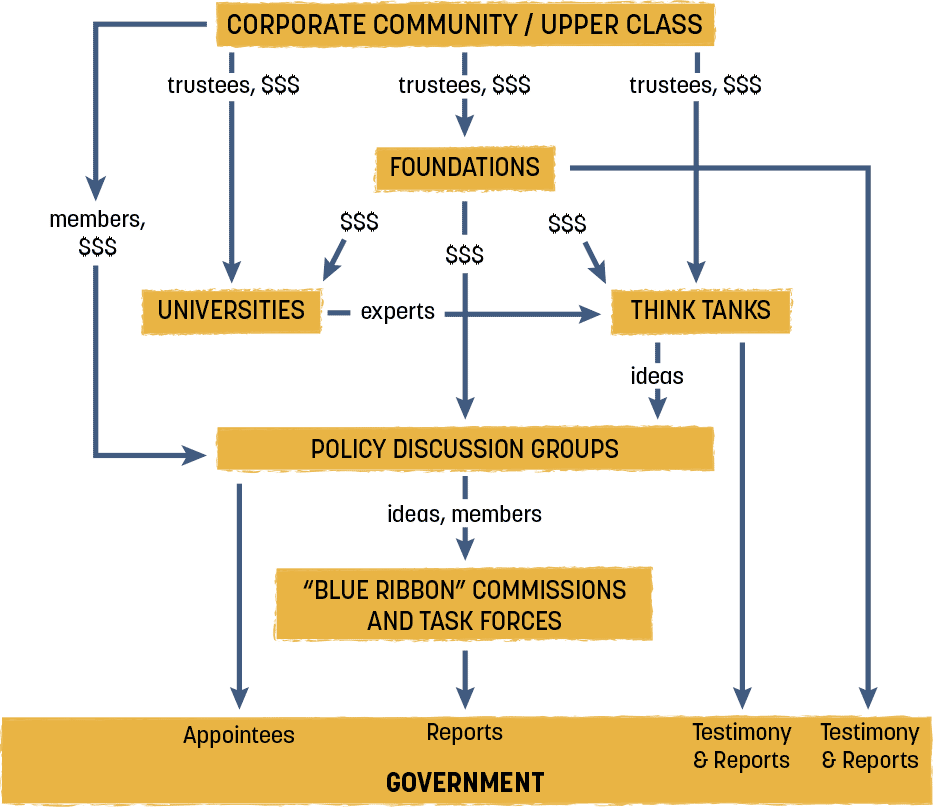
政策制定過程,摘自《誰統治美國? 》作者:威廉‧多姆霍夫 (William Domhoff)。
世紀之交,聚集在共和黨內的新保守派比起中國更關心俄羅斯解體和無核化。然而,2008年前後,美國政界精英內部的力量開始意識到中國經濟將繼續強勁崛起,其未來的領導人不會屈服於美國的影響;中國不會有與戈巴契夫或葉利欽相當的人。從這個時期開始,新保守派對中國採取了全面對抗、遏制的政策。同時,一些民主黨自由派鷹派人士成立了新國家安全委員會,時任國務卿的希拉蕊·柯林頓牽頭制定並實施了「重返亞洲」戰略,這一美國外交政策戰略轉變受到當時仍屬於共和黨陣營的新保守派的讚賞。柯林頓被政治評論員、外交關係委員會高級研究員馬克斯·布特譽為“強有力的聲音”,他在 2003 年寫道:“鑑於‘帝國主義’的歷史包袱,美國政府沒有必要接受這一術語。但它絕對應該接受這種做法。” 9今天,將北約擴展到烏克蘭並對抗俄羅斯仍然是新保守派和自由派鷹派的首要任務。這兩個群體都不同意現實主義者所主張的與俄羅斯緩和關係以加強與中國的對抗。
然而,2016年川普的當選一度引發了CFR共識的動盪。正如約翰·貝拉米·福斯特在 《川普在白宮:悲劇與鬧劇》一書中所寫,這位前總統的崛起部分是透過動員以白人中下階層為基礎的新法西斯主義運動來實現的。10最初,只有大資本菁英中的一小部分人支持他。其中包括航運巨頭Uline的老闆迪克·尤萊因 (Dick Uihlein);建材零售商家得寶(Home Depot)創始人伯尼·馬庫斯(Bernie Marcus);極右翼媒體《布賴特巴特新聞網》投資者羅伯特·默瑟 (Robert Mercer);以及銀行業大亨安德魯·梅隆的孫子蒂莫西·梅隆。川普減少參與全球事務的傾向——從敘利亞撤軍、啟動從阿富汗撤軍以及與北韓的外交接觸——符合中下資產階級的短期利益,贏得了包括亨利·基辛格在內的外交政策現實主義者的支持,但卻讓新保守主義者感到不安。一群精英新保守主義者在反對川普的運動中發揮了重要作用,約有 300 名支持布希政府的官員在 2020 年大選中支持民主黨。其中包括前文提到的布特,他已經成為外交政策的思想領袖,對拜登政府產生了強大的影響。
在拜登的領導下,CFR共識恢復,新保守派和自由派鷹派在國家戰略取向上完全一致。對中國崛起的共同認識,促進了兩大群體之間幾十年來罕見的團結。這種團結的基礎是這樣的國際事務理論:美國應該積極幹預其他國家的政治,盡一切努力促進“自由和民主”,打擊那些挑戰西方經濟和軍事主導地位的國家,罷免不受歡迎的政府,並用一切手段確保全球霸權——其主要目標是俄羅斯和中國。 2021年5月,國務卿安東尼·布林肯(曾任奧巴馬政府副國務卿)宣布,美國將捍衛模糊的“基於規則的國際秩序”,這一術語指的是美國主導的國際和安全組織,而不是更廣泛的聯合國機構。布林肯的立場表明,在拜登政府的領導下,自由派鷹派已正式放棄了追隨聯合國或其他國際多邊組織的幌子,除非它們屈服於美國的命令。
2019年,著名新保守主義者羅伯特·卡根與安東尼·布林肯合著文章,呼籲美國放棄川普的「美國優先」政策。他們呼籲遏制(即圍困和削弱)俄羅斯和中國,並提出對美國的對手採取「預防性外交和威懾」政策,即在任何必要的地方部署軍隊和坦克。11巧合的是,卡根的妻子維多利亞·紐蘭曾擔任歐巴馬政府負責歐洲和歐亞事務的助理國務卿。紐蘭在組織和支持烏克蘭 2014 年顏色革命/政變中發揮了關鍵作用,並吹噓美國為在該國「推動民主」而花費了數十億美元。12她目前擔任拜登政府主管政治事務的副國務卿,是繼布林肯國務卿和溫迪謝爾曼副國務卿之後國務院第三高的職位。她也是其導師、自由派鷹派領袖馬德琳·奧爾布賴特的精神繼承者。
卡根和布林肯所宣揚的強硬傾向,被北約智庫大西洋理事會進一步推進,主張核邊緣政策。今年2月,大西洋理事會斯諾克羅夫特戰略與安全中心副主任馬修·克羅尼格主張美國考慮先發制人地使用「戰術」核武。十三
從這一小群戰爭販子中,我們很容易發現兩個外交精英集團的深度融合,而這兩個集團正是烏克蘭危機的真正推手。這次危機的演變,揭示了這個好戰集團採取的一套策略:
- 加強美國對北約的領導,利用軍事聯盟(而非聯合國)作為外國幹預的主要機制;
- 拒絕承認其對敏感地區的主權和安全主張,挑起所謂的戰爭對手;
- 策劃使用戰術核武並在所謂對手領土內或周圍進行「有限核戰」;和
- 透過單方面強制措施,將經濟制裁與金融、資訊、宣傳和文化措施以及色彩革命、網路戰、法律戰和其他戰術結合起來,實施混合戰爭以削弱和顛覆對手。
如果在烏克蘭取得預期效果,同樣的策略無疑將在西太平洋複製。
戰略一致並不意味著政策菁英在他們認為不太重要的其他議題(例如氣候變遷)上沒有分歧。但即使在這問題上,美國也要求歐洲停止從俄羅斯進口天然氣。拜登的氣候特使約翰·克里對此舉可能帶來的負面環境影響猶豫不決,部分原因是美國希望用自己的天然氣銷售取代俄羅斯在歐洲的天然氣銷售。
近年來,世界各地進步力量發起多場國際運動,表達對美國推行的侵略性全球戰略的擔憂,並經常使用「新冷戰」一詞。然而,這些敘述有時低估了當前美國外交政策某些方面的墮落程度。與蘇聯的「舊冷戰」遵循一定的規則和底線:美國使用各種政治和經濟手段對蘇聯施加壓力並尋求顛覆蘇聯國家,雙方承認彼此的利益範圍和安全需求。不過,美國並沒有試圖改變核對手的國家邊界。如今情況已不同,正如《 華爾街日報》公開宣稱美國應該展示其贏得核戰的能力一樣,這一立場得到了外交政策精英的支持,他們聲稱烏克蘭和台灣必須受到保護,因為它們都是西方軍事邊界內的戰略要地。14就連冷戰領袖基辛格也對美國現行外交政策表示擔憂和反對,認為正確的策略是分化中俄,並警告說,如果美國同時直接對這兩個擁有核武的國家發動戰爭,將會產生危險的後果。
美國資產階級準備對華開戰
華盛頓試圖透過貿易和技術戰在經濟上使美國與中國脫鉤,這項進程由川普政府發起,並在拜登的領導下繼續進行。然而,這項政策卻引發了意想不到的後果。一方面,由於全球供應鏈的形成,美歐製造業嚴重依賴從中國進口,拜登面臨國內反對聲音,要求縮減貿易戰關稅,以緩解美國巨大的通膨壓力。另一方面,中國雖然沒有主動發起經濟脫鉤,但貿易戰和技術戰的壓力促進了國內「內部大循環」的發展(減少對出口的依賴,更多地依靠國內消費)。自疫情爆發以來,中美之間的貨物貿易表面上出現了階段性增長。
但必須看到,美國對華關係的基本邏輯正在改變:美國資產階級不斷加強反華聯盟,並支持華府的好戰戰略。出現這種情況既有經濟因素,也有意識形態因素。首先,美國和其他西方國家的GDP數據掩蓋了全球南方工廠勞動力的貢獻。例如,蘋果公司在美國的高額銷售利潤雖然出現在美國的GDP數字中,但其高額利潤的真正來源是富士康工廠所在的深圳、重慶等中國城市大量高效、低成本的先進生產勞動力所創造的剩餘。15中國已經擺脫了大型工廠和低薪非技術工人的時代,發展出了極其複雜的工業、物流和社會基礎設施,截至 2019 年,佔全球製造業的 28.7%。16將整個供應鏈從中國轉移到印度或墨西哥將是一個長達數十年的過程,而且不能僅僅基於較低的工資。
美國經濟中很少有產業嚴重依賴中國本土市場的銷售,美國晶片製造商是個例外。波音、卡特彼勒、通用汽車、星巴克、Nike、福特和蘋果(佔 17%)等大公司來自中國的營收佔不到 25%。17標準普爾 500 指數成分股公司的總收入為 14 兆美元,其中不超過 5% 來自中國境內的銷售。18美國執行長不太可能反對美國對華外交政策的方向,因為他們並沒有得到明確的途徑來增加其長期進入中國不斷增長的內部市場的管道。這種態度在迪士尼 2022 年 5 月的財報電話會議上得到了體現,當時執行長 Bob Chapek 表示,即使沒有進入中國市場,他也對公司的成功充滿信心。19這種對華政策體現在美國各主要產業:
科技/網際網路。 美國十大富豪中有九人從事科技/互聯網行業,這是我們這個時代的潮流,只有電動汽車製造商特斯拉的首席執行官埃隆·馬斯克是個例外,他的第一桶金也是來自互聯網行業。與過去幾十年的美國富豪榜相比,來自製造業、銀行業和石油等傳統行業的富豪人數已經被新興的科技精英所取代,而這些科技精英由於難以進入中國市場,對中國抱有強烈的反華情緒。 Google、亞馬遜、Facebook等美國科技巨頭在中國幾乎沒有市場,而蘋果、微軟等公司則面臨越來越大的困難。過去十年,中國科技和電信公司華為在中國的市場份額超過了蘋果,但由於美國的製裁,蘋果重新奪回了頭把交椅,美國禁止向華為出售半導體晶片(智慧型手機的關鍵部件)。據報道,中國政府正在採用本土的 Linux 和 Office Productivity 系統來取代微軟的 Windows 和 Office 軟體。在阿里巴巴掀起的「去IOE」浪潮中,IBM、Oracle、EMC(統稱IOE)等傳統IT企業早已在中國市場被邊緣化,IBM伺服器、Oracle資料庫、EMC儲存設備均被本土化和開源解決方案所取代。美國科技巨頭渴望中國政治體制改變,從而打開中國龐大市場的大門,而該領域的主要參與者正積極致力於推動華盛頓的敵對外交政策。谷歌前執行長兼執行董事長艾瑞克·施密特2016年主導成立了美國政府國防創新部門,2018年又牽頭成立了國家人工智慧安全委員會。他熱衷於宣揚“中國威脅論”,反映出美國科技界的主流觀點,並影響著輿論走向。 Twitter 和 Facebook 與美國和西方政府合作,以打擊中國和其他所謂對手發起的虛假宣傳活動的名義,越來越多地審查對其外交政策的批評,並影響有關疫情、香港和新疆等關鍵問題的討論。
製造業。美國製造業仍依賴中國的生產能力。在新自由主義時期,美國製造業的持續投資和技術創新實際上被拋棄了,儘管歐巴馬和川普都呼籲近岸製造業回歸北美,但在這方面卻收效甚微。然而,近年來美國在中國的製造業投資減少,只有特斯拉在上海的大型工廠是個明顯的例外。但即使在這種情況下,也值得注意的是,埃隆·馬斯克通過其太空探索公司SpaceX贏得了眾多美國政府和軍方採購合同,該公司的星鏈衛星系統因在2021年兩次與中國空間站“近距離接觸”而受到中國的批評。中國人民解放軍警告稱,美國可能會尋求將星鏈系統軍事化。戰爭期間,Starlink 服務在烏克蘭的部署就是這種動態的證據。馬斯克可能收購 Twitter 不太可能改變該公司與美國和西方政府的關係以及對中國和俄羅斯的立場。
金融。美國金融服務業長期以來一直期望中國資本市場能夠對其進一步開放,最終希望是中國實現政權更迭,從而徹底走上新自由主義道路。頗具影響力的匈牙利裔美國金融巨頭、慈善家喬治·索羅斯的反華態度是眾所皆知的。 2022年1月,索羅斯在推特上表示,「中國的習近平是當今開放社會面臨的最大威脅」。20此前,摩根大通執行長傑米·戴蒙於 2021 年 11 月宣布,這家跨國銀行的壽命將比中國共產黨更長(儘管他後來為這一言論道歉,並表示自己只是在開玩笑)。戴蒙也暗示,如果中國試圖統一台灣,中國將遭受嚴厲的軍事打擊,而戴蒙對這項威脅毫無歉意。21這種敵對態度是對中國資本市場並未按照華爾街希望的方向發展的反應,中國政府加強資本管制以及將一系列中國股票從美國證券交易所退市就是明證。在投資集團波克夏海瑟威2022年年度股東大會上,該公司副董事長查理蒙格表示,中國仍「值得」投資。然而,即使在這種情況下,芒格也接受了採訪者的前提,即將中國政府描述為犯下「侵犯人權」行為的「獨裁政權」。對芒格來說,中國值得承擔額外的風險,因為人們可以以更低的價格投資更好的企業。
零售和消費領域。美國零售和消費品產業長期受到中國競爭對手的擠壓。 2021年3月,耐吉等公司以強迫勞動為由抵制新疆棉花。此後不久,耐吉發布的廣告因宣揚針對中國人的種族主義刻板印象而受到批評,導致其市場份額進一步下滑,而此前其市場份額已開始被中國品牌安踏搶佔。
此外,兩國的文化娛樂產業也有顯著脫節,2021年國產電影佔中國票房的85%。曾經深受中國影迷歡迎的漫威超級英雄電影由於意識形態方面的擔憂而無法進入中國市場,2021年在中國的票房為零。最近漫威製作的《奇異博士2:瘋狂多元宇宙》再次出現反華場景,包括對極右翼反政府報紙《大紀元時報》的提及。該片還未在中國上映。這些案件體現了美國企業在商業利益(進入中國消費市場)與政治意識形態(反對中國政治體制)之間的權衡。
美國軍工複合體與戰爭動力
美國軍工複合體在促進經濟、技術、政治和軍事等戰略部門之間的合作以實現帝國主義利益方面發揮著特殊作用。 2021 年,全球六大軍事承包商——洛克希德·馬丁、波音、雷神技術公司、BAE 系統公司、諾斯羅普·格魯曼公司和通用動力公司——向美國政府的總銷售額超過 1280 億美元。亞馬遜、微軟、谷歌、甲骨文、IBM、Palantir(由極端分子彼得·泰爾創立)等22家大型科技公司與美國軍方建立了密切聯繫,近幾十年來簽署了數千份價值數百億美元的合約。23 科技產業在美國龐大的情報帝國中扮演著收集資料的戰略角色,並且是美國軟實力媒體和社群媒體霸權的核心,確保了對全球南方大多數國家的數位主宰。因此,該行業不再受到有意義的監管或非壟斷威脅。
美國對軍事霸權的追求導致其在武器、電腦技術(特別是矽晶片)、先進通訊(包括衛星網路戰)和生物技術領域投入巨額資金。美國政府已正式要求在2023年預算中為軍方提供8130億美元的資金(這還不包括隱藏在整體預算其他部分中的額外軍事開支),而五角大樓聲稱未來十年將需要至少7萬億美元的撥款。24
新自由主義下的國家私有化導致過去四十年來美國政府和私營部門之間形成了旋轉門。國家已經成為國會議員、參議員、政策和安全顧問、內閣成員、上校、將軍以及兩黨總統等高級政府官員利用他們在私人利益集團中的政治圈內地位成為千萬富翁的工具。25在政府官僚機構中,「國家安全」一詞為個人和企業的貪婪以及激進的軍事擴張打開了更大的大門。在這種第一世界盛行的合法腐敗形式下,公司通常會在官員離職後向他們提供賄賂。這些合法賄賂本質上是任職期間提供服務的拖欠款項。例如,卸任後,前公職人員經常被他們以前擔任公職時代表過的公司、為其提供過有利投票或授予過政府合約的公司聘為有償僱員、董事會成員或顧問。26這種普遍動態的一些突出例子包括:
- 比爾·柯林頓聲稱,他在 2001 年離開白宮時負債 1600 萬美元,但到 2021 年,他的財富估計已達到 8000 萬美元。二十七
- 令人震驚的是,在希拉蕊擔任歐巴馬總統國務院總理期間,有 154 名私人利益集團人士曾與她見面或進行過電話交談,其中至少有 85 人向柯林頓基金會捐贈了總計 1.56 億美元。二十八
- 詹姆斯「瘋狗」馬蒂斯是一名退役四星上將,曾任川普政府的國防部長和 CNAS 前董事會成員,2018 年,即他從軍隊「退役」五年後,他的淨資產為 700 萬美元。這筆錢是透過從眾多軍事承包商那裡獲得的大筆付款獲得的,其中包括主要國防承包商通用動力公司 60 萬至 125 萬美元的股票和選擇權。二十九
- 拜登總統任期內的國防部長勞埃德‧奧斯汀曾任聯合技術公司、雷神科技公司等多家軍工公司的董事會成員。奧斯汀 700 萬美元淨資產的大部分是在以四星上將身份「退役」後獲得的。三十
2009年至2011年間,超過70%的美國高級將領退役後都為軍事承包商工作。將軍們還可以同時獲得五角大廈的報酬和私人軍事承包商的付款,從而享受雙重福利。31光 在2016年,就有近100名美國軍官通過了政府與私人軍事承包商之間的旋轉門,其中包括25名將軍、9名海軍上將、43名中將和23名海軍中將。三十二
在川普政府期間,許多奧巴馬時代的官員轉向私營部門,為世界上最大的公司提供諮詢和建議,但在拜登的領導下又回到了白宮。在這扇旋轉門的驚人展示中,拜登政府任命了 15 多名來自企業諮詢公司 WestExec Advisors 的高級官員,該公司由前奧巴馬政府官員團隊於 2017 年創立,聲稱為客戶提供「無與倫比的地緣政治風險分析」(包括「在戰略競爭時代管理與中國相關的風險」)。33該公司促進大型科技公司與美國軍方之間的合作,客戶包括波音、Palantir、Google、Facebook、Uber、AT&T、無人機監視公司 Shield AI 和以色列人工智慧公司 Windward。在拜登政府工作的 WestExec 校友包括國務卿布林肯、國家情報總監艾薇兒·海恩斯、中央情報局副局長戴維·科恩、國防部負責印度-太平洋安全事務的助理部長埃利·拉特納和前白宮新聞秘書珍·普薩基。三十四
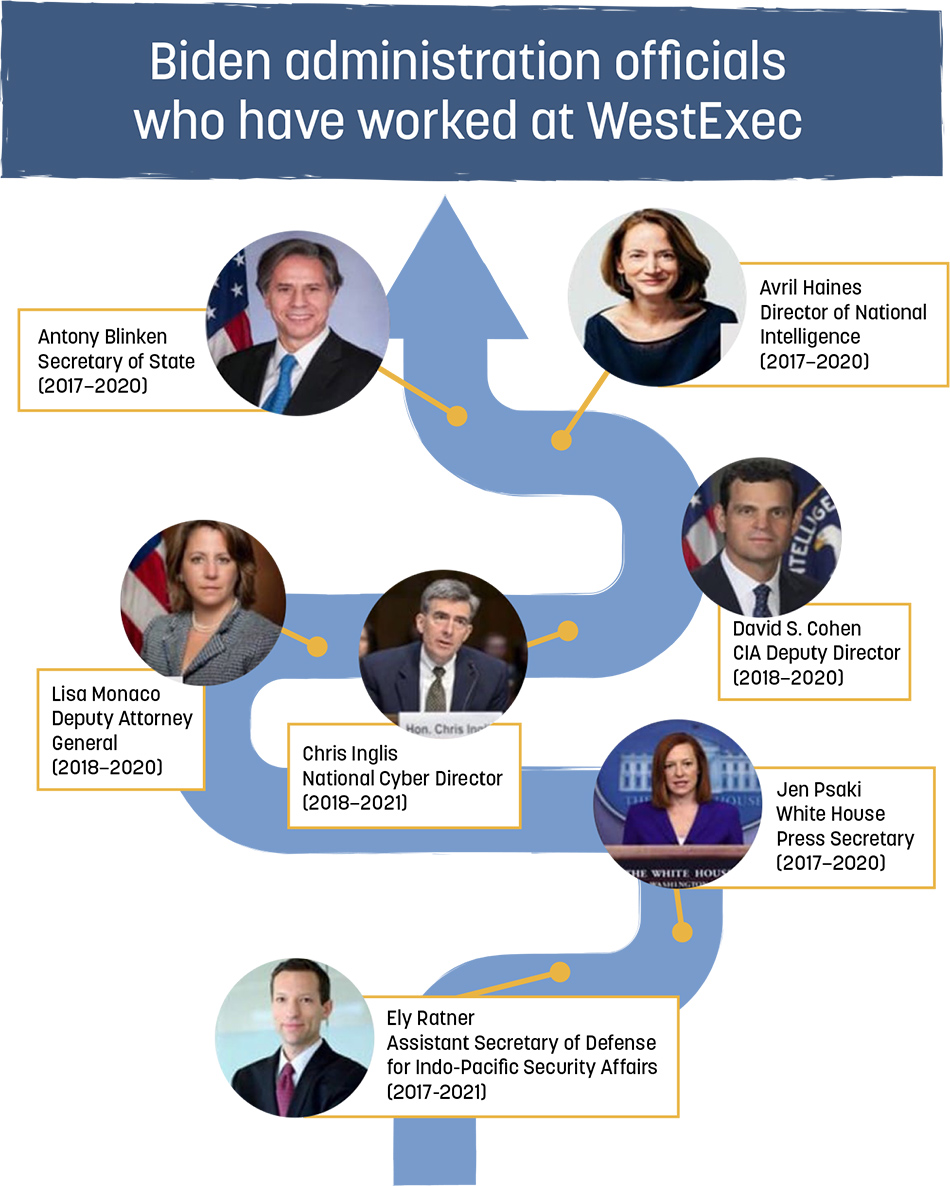
WestExec 至拜登政府的管道,第一部分。圖片:Soohee Cho/The Intercept。三十五
國內對美國軍國主義的抵抗力量減弱
1973年,美國廢除了徵兵制,即所謂的徵兵令,此後,美國軍隊巧妙而誤導性地稱自己為全志願軍隊。這樣做是為了減少國內對美國海外戰爭的反對聲音,尤其是那些反對美國侵略越戰的有產階級和中產階級家庭子女的反對聲音。儘管這項措施以選拔更專業、更敬業的士兵為名,但實際上,資產階級試圖利用貧困工人階級家庭的經濟弱點,透過提供技術培訓和穩定的收入來招募這些家庭服兵役。戰爭技術的進步使得美國能夠同時提高在入侵國家殺死平民和敵方戰鬥人員的能力,同時降低美國士兵的死亡率。例如,在2001年至2021年間耗資2.2兆美元的阿富汗戰爭中,24.1萬名死亡人員(包括7.1萬多名平民)中,只有2,442名(佔1%)是美國軍事人員。36美國死亡人數的減少削弱了國內對美國戰爭的情感聯繫,而私人軍事承包商的崛起進一步削弱了這種聯繫。到2010年代中期,估計駐伊拉克和阿富汗的美國武裝部隊中近一半是由私人軍事承包商僱用的。37 2016 年,全球最大的私人軍事承包商 ACADEMI(最初由埃里克·普林斯創立,原名為黑水公司)被全球最大的私募股權公司 Apollo 以約 10 億美元的價格收購。38如今,美國軍隊已不再是一支全志願軍,相反,越來越貼切的說法是一支全僱傭軍。
美國雖然入侵或參與了上百個國家的軍事行動,但從未遭到外國政府的入侵,也沒有遭受大規模平民傷亡,這更增強了美國戰爭的膽量。美國例外論的心理形成原因在於,當前一代政治精英大多是在冷戰結束之後成長起來的,這一時期被定義為所謂的“歷史的終結”,當時他們的國家似乎是不可戰勝的。在中國崛起之前,美國無論在國內或國外,都從未經歷過嚴峻的挑戰。因此,這個精英階層的世界觀特別不符合歷史,被自大妄想症所控制,因此感到無拘無束——這是一種極其危險的組合。
由將軍、政客、科技公司和私人軍事承包商組成的軍工複合體正在大規模擴張美國的軍事能力。如今,華盛頓幾乎所有人都以中國和俄羅斯作為軍事擴張的藉口。同時,他們中的許多人在伊拉克、阿富汗、敘利亞、利比亞等地犯下或支持戰爭罪行。
美國很少有影響力的個體資本家願意公開反對妖魔化中國的言論,而這樣做的人則會受到紀律處分或排斥。在《紐約時報》 或《 華爾街日報》的專欄文章中,很少看到公開發表不同意見或呼籲克制的言論。 2020年總統競選期間,麥可·布隆伯格(Michael Bloomberg)因表示共產黨對民眾負責、拒絕將習近平主席貼上獨裁者的標籤而受到嚴厲批評,並被指對中國「軟弱」。彭博社似乎已成功受到約束;拜登政府時期,他加入了戰爭狂熱的行列,並於2022年2月被任命為五角大廈國防創新委員會主席。全球管理顧問公司麥肯錫一直主張加強與中國的經濟接觸,但該公司因這些觀點而面臨越來越多的批評,被《紐約時報》抹黑為「幫助提升全球威權和腐敗政府的地位」。39由此,麥肯錫在美國企業界的影響力被大幅削弱。儘管少數人物——例如億萬富翁投資者、橋水基金創始人雷·達裡奧——繼續對中美關係表示樂觀,但他們只是個例。
更關鍵的是,當前美國資產階級精英的上層投資已實現多元化,涉及多個行業,這使得他們能夠克服單一行業狹隘的短期經濟利益,與美國戰略的「大局」保持一致。與過去幾代專注於單一行業的百萬富翁相比,當今的億萬富翁已經形成了更共同的意識,可以預見中國政府被推翻後,完全自由化的中國市場將帶來巨大的長期回報。因此,這些億萬富翁有動力支持美國遏制中國,儘管他們可能會因此遭受短期損失。如上文所述,這個大資產階級透過非營利基金會資助大量智庫和政策團體,影響美國的政策討論和建議。
在上層中產階級菁英中,有一小群極右翼自由主義孤立主義者,主要由知識分子組成,並以卡托研究所為代表。這個政治網絡反對美國聯邦儲備體系和外國幹預,並反對美國在烏克蘭扮演的角色。然而,它在美國外交政策領域處於邊緣地位,沒有太大的影響力。
正如卡爾馬克思曾經指出的,資本家從來都是一群「交戰的兄弟」。這個團體維持著一個現代國家,擁有大量永久的武裝男女、情報人員和間諜。 2015 年,美國有 430 萬人擁有存取「機密」、「秘密」或「絕密」政府資料的安全許可。[40]無論選舉結果如何,這個國家機器最終都能發揮主導作用,引導美國的外交政策,川普政府無法推行自己的外交政策就是明證。
極右翼勢力崛起與美國政治體系製衡的虛假本質
美國統治資產階級菁英和中產階級對中國的敵意有著深刻的種族主義根源。川普執政四年恰逢民粹主義和白人至上主義右翼運動聯合聯盟(即另類右翼)的形成。該運動的發言人史蒂芬班農曾擔任白人至上主義網站 布賴特巴特新聞網主席,毫無疑問是美國最活躍的反華活動人士之一。另類右翼的支持者來自中下階層:大多數是家庭年收入約 75,000 美元的白人。儘管班農乃至川普本人都喜歡吹噓自己得到了「白人工人階級」的支持,但他們的主要支持基礎實際上是下層中產階級,而不是工人階級。
這個新法西斯投票集團的成立使共和黨在選舉中獲益。另類右翼傾向於崇拜大資本家人物,並渴望向上流動以加入精英階層。同時,這個團體也表達了對菁英政治和文化領袖的仇恨,因為他們阻礙了他們致富的道路,也對工人階級表示仇恨。 1951年,美國著名社會學家C.賴特·米爾斯(C. Wright Mills)對美國中產階級做出如下描述:
他們是後衛者。短期內,他們會陷入恐慌,追求威望;從長遠來看,他們會跟隨權力的腳步,因為最終威望是由權力決定的。同時,在政治市場上……新中產階級正在被出售;誰看起來足夠受人尊敬、足夠強大,誰就有可能得到它們。到目前為止,還沒有人提出認真的競標。41
川普政府將中下階層對不斷惡化的經濟狀況的不滿情緒導向中國。美國經濟至今仍未完全從2008年次貸危機中恢復過來,當時寬鬆的貨幣政策使大資本家獲得了巨額利潤,而工人階級和中下階層則遭受了巨大損失。後者對自己的處境感到憤怒和沮喪,急需一個代言人,在川普的動員下,他們成為了自己關鍵的票倉,借助白人至上、種族資本主義和新冷戰,全力壓制中國這個對手。
如今,對華敵意已在美國民眾中普遍存在。主流媒體和網路平台極力強化了人們對於中國是自由世界的死敵、對美國的最大威脅的印象,而反對這一危險趨勢的言論自由則受到日益限制。任何承認俄羅斯和中國的觀點或批評美國對這些國家的外交政策的行為都會遭到公眾的強烈批評。美國的公眾輿論越來越像20世紀50年代的麥卡錫主義時期,在某些方面,社會氛圍與1930年代初期的德國有著令人不安的相似之處。
外界人士常誤解美國政治體系中製衡和權力分立的真正本質。與歐洲受社會革命運動推動的憲法改革歷史不同,美國憲法最初是由一群財產持有者(包括奴隸主)制定的,其目的從一開始就是保護私有財產所有者的權利,防止他們擔心出現暴民多數統治。時至今日,憲法仍允許廢除大多數傳統的資產階級社會和法律權利。
選舉團制度等措施原本是為了保護南方奴隸主州和其他較小農業州的利益而實施的,其目的是為了阻礙人民直接選舉總統(一人一票)。這個不民主的製度,需要透過艱難而繁重的修憲程序來維護,導緻小布希和川普儘管獲得的選票比各自的對手少,卻都贏得了總統職位。儘管投票權最終擴大到黑人、婦女和無財產者,但選民被剝奪權利的現象至今仍在繼續。截至2021年,已有19個州頒布了共34項選民壓制法,這些法律可能會限制這些州多達5,500萬選民的投票權。42同時,未經選舉產生的最高法院有權推翻投票權立法、取消平權行動,並允許宗教組織限制公民權利。
2010 年,最高法院的一項名為「聯合公民」的裁決 取消了對私人和企業對選舉捐款的限制,使其成為一場財力的競賽。43在 2020 年選舉中,總統、國會和參議院競選的總支出為 140 億美元。44除了金融競爭,還有心理科技的競爭:基於社群媒體、行為經濟學和大數據的說服性科技工具在塑造選舉過程方面發揮巨大作用。同時,這些工具極為昂貴,有助於確保政治幾乎成為富人的專屬遊戲。 2015年,美國參議員的平均財富超過300萬美元。45這幾乎不是一個受到人民制衡的政府。
我們注定要經歷戰爭嗎?
2014年,剛成為中國最高領導人的習近平對時任美國總統歐巴馬說:「寬廣的太平洋足以容納中國和美國」。46時任美國國務卿希拉蕊·柯林頓拒絕了這一外交橄欖枝,並在一次私人演講中誇口說美國可以把太平洋稱為“美國海”,並威脅“要用導彈防禦系統包圍中國”。47 2020年,英國經濟與商業研究中心(CEBR)預測,到2028年,中國將超過美國成為世界最大經濟體,這項門檻讓美國菁英們心神不寧。近年來,美國的外交政策和輿論都致力於做好在中國實現和平之前發動一場熱戰以遏制中國的準備。烏克蘭的代理人戰爭可視為這場熱戰的前奏。美國國內備戰的思想動員已全面展開。新法西斯主義的車輪正在轉動,麥卡錫主義的新時代已經到來。所謂民主政治,只不過是資產階級菁英統治的幌子;它們不會成為戰爭機器的煞車裝置。
美國有1.4億勞動人民和貧窮人口,其中1,700萬名兒童遭受飢餓,比疫情前增加了600萬。48雖然這個階層的一部分人確實在意識形態上支持美國的戰爭政策,但這種支持與他們的利益直接相悖:近萬億美元的軍事預算是以犧牲保障醫療、教育、基礎設施和其他人權以及應對氣候變遷的資金為代價的。歷史上,美國黑人運動、女權運動等進步團體有著強烈的反戰鬥爭精神,馬丁·路德·金、馬爾科姆·艾克斯等領袖英勇奮鬥,在國內掀起了反抗美國在東南亞侵略的浪潮。可悲的是,今天美國的一些(但不是全部)進步領袖不願挑戰華盛頓的反華運動,甚至更糟的是,成為其支持者。
美國國內有一些重要的道德聲音發出了聲音。然而,必須看到,少數反對新冷戰的進步團體卻因涉嫌為新疆種族滅絕辯護而受到誹謗。美國政治體制無情地邊緣化這群社會的群體的聲音。
儘管美國及其盟友透過北約積極推行全球軍事擴張,但世界上絕大多數國家並不歡迎他們發動戰爭。 2022年3月2日,聯合國大會舉行第十一屆緊急特別會議,佔世界人口一半以上的國家對「侵略烏克蘭」決議草案投了反對票或棄權票。同時,佔世界人口85%的國家並未支持美國主導的針對俄羅斯的製裁。49華盛頓試圖升級和延長戰爭,並迫使莫斯科和北京脫鉤,這將導致大規模的經濟混亂,對美國的統治產生相當大的負面反應。就連印度、沙烏地阿拉伯等國家,也對美國凍結俄羅斯外匯存底、強化美元霸權的過度行為深感關切。同樣,由於古巴、委內瑞拉和尼加拉瓜被排除在外,墨西哥、玻利維亞、宏都拉斯、薩爾瓦多和瓜地馬拉的總統也沒有出席2022年6月美國在洛杉磯主辦的美洲國家峰會。拉丁美洲對美國統治的抵抗日益高漲。但也要看到,聯合國這樣的國際平台,實際上並無能力遏制美國發動戰爭。除了基於自身規則的國際秩序以外,華盛頓拒絕受任何事物的約束。
在美國,拜登政府正在向烏克蘭提供大規模軍事援助,製造持久戰,以最大程度地削弱俄羅斯並實現政權更迭。並違背中美三個聯合聲明的精神,以各種方式破壞台海穩定。美國雖然擁有強大的軍事力量,但目前的經濟實力雖然龐大,卻一直處於衰退和危機狀態。
正如約翰·羅斯在本項研究中所指出的,美國的經濟霸主地位正在減弱,並可能被中國經濟巨頭終結。此外,美國及其北約盟國也面臨多重深刻的經濟和生態困難。美國發動的戰爭將使這些問題進一步加劇。戰爭可能會導致歐洲的GDP成長放緩,甚至出現負成長,同時還會出現通貨膨脹以及軍事開支增加而對社會毫無用處的局面。美國實際上已經放棄了應對氣候變遷的任何嚴肅策略,更不用說其無休止的戰爭追求加劇了氣候災難。諷刺的是,儘管美國國內政治家已經就經濟脫鉤達成共識,但美國企業卻仍在繼續增加對中國的訂單,實質脫鉤仍是個白日夢。
然而,美國不僅會經濟崩潰;華盛頓的戰爭、制裁和經濟脫鉤行為將繼續損害其自身經濟並危及世界糧食供應鏈。由此造成的全球社會不穩定,反過來進一步削弱美國經濟,並對其統治產生更多挑戰,包括對美元霸權的反對聲浪日漸高漲。
正如中國國務委員楊潔篪所說,中國相對穩定的社會治理、強大的國防、和平的外交戰略、不向美國強權屈服等,可以使中國“站在強勢地位”,最終迫使美國放棄與中國開戰並取得勝利的幻想。50中國繼續作為一個強大的社會主義主權國家,並繼續推行全球治理的替代政策,如「建構人類命運共同體」的理念和全球發展倡議,這符合全球南方國家的利益。必須立即致力於重振金磚國家和不結盟運動等全球南方可行的多邊項目,因為世界許多國家對這些倡議有著共同的利益。世界人口絕大多數位於南半球,必須抵制戰爭、呼籲和平。美國並不是第一個因傲慢和自大而過度擴張的帝國,而且它的權力最終也將走到盡頭。
筆記
1本文最初是為中國讀者撰寫的,並在中國新聞網站觀察家上發表。
2與媒體見面,“戰爭遊戲:台灣之戰會是什麼樣子?”,NBC 新聞,2022 年 5 月 15 日, https://www.nbcnews.com/meet-the-press/video/war-game-what-would-a-battle-for-taiwan-look-like-1400430977 3097723097723009730。
3新美國安全中心,“CNAS 支持者”,2022 年 8 月 9 日訪問, https://www.cnas.org/support-cnas/cnas-supporters。
4 Roxana Tiron,“美國認為中國核能擴張‘驚人’風險上升”,彭博社,2022 年 4 月 4 日, https://www.bloomberg.com/news/articles/2022-04-04/us-sees-rising-risk-in-breathtaking-china-nuclear-expansion。
5北大西洋公約組織,“北約 2022 戰略概念”,2022 年 6 月 29 日, https://www.nato.int/nato_static_fl2014/assets/pdf/2022/6/pdf/290622-strategic-concept.pdf。
6尼爾‧弗格森,《巨人:美國帝國的興衰》(紐約:企鵝圖書,2005 年)。
7 Joan E。 ley,“5 兆美元疫情刺激資金去哪裡了”, 《紐約時報》,2022 年 3 月11 日, https://www.nytimes.com/interactive/2022/03/11/us/how-covid-stimulus-money-was-spent.html。
8瑞士政策研究,“美國帝國及其媒體”,2022 年 3 月, https://swprs.org/the-american-empire-and-its-media/;勞倫斯·H·舒普,《華爾街的智庫:外交關係委員會與新自由主義地緣政治帝國,1976-2019》(紐約:每月 193 年)出版社,《華盛頓》 1093年 1993 年。月 30 日, https://www.washingtonpost.com/archive/opinions/1993/10/30/ruling-class-journalists/761e7bf8-025d-474e-81cb-92dcf271571e/。
9 Ivo H. Daalder 和 James M. Lindsay,“美國帝國,不是‘是否’而是‘什麼樣的’”,《紐約時報》,2003 年 5 月 10 日, https://www.nytimes.com/2003/05/10/arts/american-empire-not-if-butkin-n-d .
10約翰貝拉米福斯特,《川普在白宮:悲劇與鬧劇》(紐約:每月評論出版社,2017 年)。
11安東尼·J·布林肯和羅伯特·卡根,「美國優先」只會讓世界變得更糟。這是一種更好的方法,」布魯金斯學會,2019 年 1 月 4 日, https://www.brookings.edu/blog/order-from-chaos/2019/01/04/america-first-is-only-making-the-world-worse-heres-a-better-approach/。
12 Victoria Nuland,《在美國-烏克蘭基金會會議上的演講》,美國國務院,2013 年 12 月 13 日, https://2009-2017.state.gov/p/eur/rls/rm/2013/dec/218804.htm。
13馬修·克羅尼格,“華盛頓必須為與俄羅斯和中國的戰爭做好準備”,《外交政策》,2022 年 2 月 18 日, https://foreignpolicy.com/2022/02/18/us-russia-china-war-nato-quadrilate-security-dialogue / 。
14 Seth Cropsey,“美國應證明自己能夠贏得核戰”,《華爾街日報》,2022 年 4 月 27 日, https://www.wsj.com/articles/the-us-show-it-can-win-a-nuclear-war-russia-putin-ukraine-show-it-can-win-a-nuclear-war-russia-putin-ukraine-nato-sar-mis-misning 375-1375-1375-1375-303對話”,外交關係委員會,2022 年 4 月 6 日, https://www.cfr.org/event/conversation-representative-michael-mccaul;艾略特·艾布拉姆斯 (Elliot Abrams),《烏克蘭戰爭、中國和台灣》,外交關係委員會,2022 年 5 月 3 日,《烏克蘭戰爭、中國和台灣》,外交關係委員會,2022 年 5 月 3 日, .
15 John Smith, “GDP幻覺:價值增加價值與價值獲取”,《每月評論》第 64 卷,第 1 期,2015 年。 3 (2012年7月 - 8月), https://doi.org/10.14452/MR-064-03-2012-07 ;三大洲:社會研究所,“如今的 iPhone 工人比 19 世紀英國紡織工人受的剝削多 25 倍:第 3999 年 2019 月 2019 月 9 月 2019 月 9月) issue/iphone-workers-today-are-25-times-more-exploited-than-textile-workers-in - 19th-century-england-the-thirty-ninth-newsletter-2019/。
16 Felix Richter,“中國是世界製造業超級大國”, Statista,2021 年 5 月 4 日, https://www.statista.com/chart/20858/top-10-countries-by-share-of-global-manufacturing-output/。
17 “10 家在中國收入最高的美國公司”,雅虎! Finance,2020 年 8 月 2 日, https://finance.yahoo.com/news/10-us-companies-highest-revenue-225350456.html。
18 Yardeni Research, Inc.,《標準普爾 500 指數收入與經濟》,2022 年 6 月 13 日, https://www.yardeni.com/pub/stmktbriefrev.pdf;美國貿易代表辦公室,《中華人民共和國:中美貿易事實》,2022 年 8 月 9 日訪問, ina。
19 Phil Hall,“漫威電影不進軍中國市場能盈利嗎?迪士尼首席執行官鮑勃·查佩克這麼說”,Benzinga, 2022 年 5 月 12 日, https://www.benzinga.com/general/entertainment/22/05/27166040/dis-fin-chain-chain-chain-chain-chain-chain-chain-chain-chain-chain-chain-chain-chain-chain-chain-chain-chain-chain-chain-chain-cha
20喬治·索羅斯(@georgesoros),“中國的習近平是當今開放社會面臨的最大威脅”,推特,2022 年 1 月 31 日, https://twitter.com/georgesoros/status/1488233860584427530 ?lang= en。
21 David Henry 和 Anshuman Daga,“傑米·戴蒙開玩笑說,摩根大通將比中國共產黨存在得更久”,路透社,2021 年 11 月 23 日, https://www.reuters.com/business/jpmorgan-ceo-dimon-jokes-his-bank-will-outlast-2011-10
22彭博政府,《十大國防承包商》,2021 年 6 月 10 日, https://about.bgov.com/top-defense-contractors/。
23 Big Tech Sells War,2022 年 8 月 9 日訪問, https://bigtechsellswar.com/; April Glaser,“數千份合約凸顯大型科技公司與美國軍方之間的秘密聯繫”, NBC 新聞,2020 年 7 月 8 日, https://www.nc anc.com /techn-1/news.com 171 ; Joseph Nograles,“買入 PLTR 股票:Palantir 是國防承包商巨頭”,納斯達克,2021 年 10 月 14 日, https://www.nasdaq.com/articles/buy-pltr-stock%3A-palantir-is-a-defense-contractor-powerhouse-2021-100亞馬遜國家安全;億美元合約”,Nextgov,2021 年 8 月 10 日, https://www.nextgov.com/it-modernization/2021/08/nsa-awards-secret-10-billion-contract-amazon/184390/。
24 Mike Stone,“烏克蘭危機拉響警報,拜登希望獲得 8130 億美元國防經費”,路透社,2022 年 3 月 28 日, https://www.reuters.com/world/us/biden-wants-813-billion-defense-ukraine-crisis-raises-alarm-20209.D .國會對安全網計畫爭論不休”, MSNBC, 2021 年 10 月 1 日, https://www.msnbc.com/opinion/bloated-defense-budget-passes-easily-congress-fights-over-safety-net-n1280568。
25 Open Secrets,2022 年 8 月 9 日訪問, https://www.opensecrets.org/。
26 Ben Freeman,“明星地位上升的隱性成本:將軍退休後收入高於服役期間”, POGO:政府監督項目,2012 年 2 月 8 日, https://www.pogo.org/analysis/2012/02/hidden-costs-of-star-creep-genelysis/2012/02/hidden-costs-of-star-creep-genes-making-more-in-retire。
27山姆‧迪薩爾沃,《比爾‧柯林頓身價多少? 》雅虎新聞,2021 年 2 月 12 日, https://ca.news.yahoo.com/much-bill-clinton-worth-234218086.html。
28 CNBC,“許多在克林頓任國務卿期間與他會面的人向基金會捐款”,2016 年 8 月 23 日, https://www.cnbc.com/2016/08/23/most-of-those-who-met-with-clinton-as-secretary-of-state-donated-to-foundation.html。
29 Jeremy Herb 和 Connor O'Brien,“五角大樓新任總統馬蒂斯披露國防工業工作”, Politico,2017 年 1 月 8 日, https://www.politico.com/blogs/donald-trump-administration/2017/01/james-mattis-defense-disclosures-23331。
31 Luke Johnson,“報告:70% 的退役將軍就職於國防承包商或顧問機構”,《赫芬頓郵報》,2012 年 11 月 20 日, https://www.huffpost.com/entry/defense-contractors-generals_n_2160771。
32 Tom Vanden Brook、Ken Dilanian 和 Ray Locker,“一些退役軍官如何成為高薪顧問”, ABC News,2009 年 11 月 18 日, https://abcnews.go.com/Politics/retired-military-officers-retire-paid-consultants/story/retired-military-officers-retire-paid-consultants/story ?idGO915368; 018年 11 月 5 日, https://www.pogo.org/report/2018/11/brass-parachutes。
33 Jonathan Guyer 和 Ryan Grim,“認識為拜登政府配備人員的諮詢公司”, The Intercept,2021 年 7 月 6 日, https://theintercept.com/2021/07/06/westexec-biden-administration/; WestExec Advisors,2022 年 8 月 14 日訪問,
34 Jonathan Guyer 和 Ryan Grim,“認識為拜登政府配備人員的諮詢公司”, The Intercept,2021 年 7 月 6 日, https://theintercept.com/2021/07/06/westexec-biden-administration/;亞歷克斯·湯普森 (Alex Thompson) 和西奧多里克·邁耶 (Theodod J 1 年1月 1 日, https://www.politico.com/news/2021/01/01/yellen-made-millions-in-wall-street-speeches-453223; Eric Lipton 和 Kennet P. Vogel,“拜登助手與和投資公司的關係帶來道德諮詢”,紐約時報20120 年 120 年 1 月,《紐約時報》https://www.nytimes.com/2020/11/28/us/politics/biden-westexec.html。
35 Jonathan Guyer 和 Ryan Grim,“認識為拜登政府配備人員的顧問公司”, The Intercept,2021 年 7 月 6 日, https://theintercept.com/2021/07/06/westexec-biden-administration/。
36 Neta C. Crawford 和 Catherine Lutz,“迄今為止美國在阿富汗戰爭的人力和預算成本”,戰爭成本項目,2021 年 4 月 15 日, https://watson.brown.edu/costsofwar/files/cow/imce/figures/2021/Human%20and%20Budgeary% 1-2021.pdf 。
37 Bryan Stinchfield,“美國武裝部隊的漸進式私有化”,《新聞周刊》, 2017 年 5 月 28 日, https://www.newsweek.com/creeping-privatization-americas-forces-616347。
38 Ross Wilkers,“阿波羅集團和 Constellis 高管將收購安保服務承包商”, GovCon Wire,2016 年 8 月 15 日, https://www.govconwire.com/2016/08/apollo-group-constellis-executives-to-buy-out-security/services-contractor services-buy-out-security/services-contractor services-buy-out-security/services-contractor services-buy-out-security/services-contractor services-buy-out-security/services-contractor services-buy-out-security/services-contractor services-buy-out-security/services-contractor services-buy-outservices。
39 Walt Bogdanich 和 Michael Forsythe,“麥肯錫如何幫助提升威權政府的地位”,《紐約時報》,2018 年 12 月 15 日, https://www.nytimes.com/2018/12/15/world/asia/mckinsey-china-russia.html。
40國會研究服務處,“安全審查流程:常見問題解答”,2016 年 10 月 17 日, https://crsreports.congress.gov/product/pdf/R/R43216。
41 C. Wright Mills,《白領:美國階級》(紐約:牛津大學出版社,1951 年),第 353 頁。
42 Tony Eskridge 和 Shailly Gupta Barnes,“投票權簡要事實”, Kairos Center,2022 年 8 月 9 日訪問, https://kairoscenter.org/quick-facts-on-voting-rights/。
43 Ian Vandewalker,“自聯合公民組織以來,十年的超級政治行動委員會”,布倫南司法中心,2020 年 1 月 14 日, https://www.brennancenter.org/our-work/analysis-opinion/citizens-united-decade-super-pacs。
44 Brian Schwartz,“2020 年選舉總支出將達到近 140 億美元,是 2016 年總額的兩倍多”, CNBC, 2020 年 10 月 28 日, https://www.cnbc.com/2020/10/28/2020-election-spenbc.com/2020/10/28/2020-election-spen-tod-T-html。
45 Dan Kopf,“典型的美國國會議員比典型的美國家庭富裕 12 倍”, Quartz,2018 年 2 月 12 日, https://qz.com/1190595/the-typical-us-congress-member-is-12-times-richer-than-the-tyical-amcaneri。
46中國駐美國大使館,《習近平與美國總統歐巴馬舉行會談》,2014 年 11 月 12 日, http://us.china-embassy.gov.cn/eng/zmgx/zxxx/201411/t20141115_4909273.htm。
47威廉·加洛,“克林頓稱美國將‘用導彈防禦系統圍剿中國’”,美國之音,2016 年 10 月 14 日, https://www.voanews.com/a/clinton-says-us-would-ring-china-with-missile-defense/3550418.html。
48 Shailly Gupta Barnes,“解釋 1.4 億:分解道德預算背後的數字”, Kairos Center,2019 年 6 月 26 日, https: //kairoscenter.org/explaining-the-140-million/ ;救助兒童會,《美國兒童飢餓問題》,2021 年, https ://ameage/toofall-alla-alla-all,pose.
49 No Cold War,“簡報:世界不想要一個全球性的北約”,2022 年 7 月 28 日, https://nocoldwar.org/news/briefing-the-world-does-not-want-a-global-nato。
50「中國稱美國不能以『強勢地位』發言」 BBC 新聞,2021年3月19日, https://www.bbc.com/news/av/world-56456021。
二十一世紀生態與和平運動的“滅絕筆記”
約翰·貝拉米·福斯特
1980年,英國偉大的歷史學家、馬克思主義理論家、《 英國工人階級的形成》一書的作者 、歐洲核裁軍運動領導人EP湯普森撰寫了開創性的文章《滅絕主義——文明的最後階段筆記》。1 儘管自那以後世界發生了許多重大變化,湯普森的文章仍然是理解我們時代核心矛盾的有用起點,這些矛盾的特點是全球生態危機、COVID-19 大流行、新冷戰和當前的「混亂帝國」——所有這些都源於當代資本主義政治經濟中根深蒂固的特徵。2
對湯普森來說, 「滅絕主義」一詞 並不是指生命本身的滅絕,因為即使面對全球熱核交換,某些生命仍會存活下來,而是指「滅絕我們(當代)文明」的趨勢,這是最普遍的意義。然而,滅絕主義指向大規模滅絕,其定義是「社會特徵——以不同程度體現在經濟、政體和意識形態中——這些特徵將社會推向必然導致大眾滅絕的方向」。3 《滅絕主義筆記》寫於氣候學家詹姆斯漢森於 1988 年向美國國會就全球暖化問題作證的著名年份,同年聯合國氣候變遷政府間小組也正式成立。因此,湯普森對滅絕主義的處理主要集中在核戰上,並沒有直接談到當代社會正在出現的另一個滅絕主義傾向:全球生態危機。然而,他的觀點是深刻的社會生態學觀點。因此,現代社會的滅絕主義傾向被視為與「人類生態生存的需要」直接對立,要求全世界為建立一個社會平等和生態永續的世界而奮鬥。4
1991年,隨著蘇聯解體和冷戰的結束,自第二次世界大戰以來籠罩全球的核威脅似乎已經消退。因此,隨後對湯普森滅絕主義論點的大多數考慮主要從全球生態危機的背景來考慮,而生態危機本身就是「大眾滅絕」的根源。5 然而,近十年來新冷戰的到來,使核毀滅的威脅再次成為世界關注的焦點。 2022 年烏克蘭戰爭的起因可以追溯到 2014 年美國策劃的獨立廣場政變以及由此引發的烏克蘭內戰(基輔與烏克蘭俄語頓巴斯地區的分離共和國之間爆發),現已演變為莫斯科與基輔之間的全面戰爭。 2022 年 2 月 27 日,這一事件在全球範圍內具有不祥的意義,俄羅斯在對烏克蘭發動軍事進攻三天后,將其核力量置於高度戒備狀態,警告北約直接幹預戰爭,無論是採用非核手段還是核手段。6 目前,主要核子大國之間爆發全球熱核戰爭的可能性比後冷戰時期的任何時候都要大。
因此,有必要解決這兩種滅絕主義傾向:地球生態危機(不僅包括氣候變化,還包括跨越科學家定義的其他八個對於地球成為人類安全家園至關重要的關鍵行星邊界)和全球核毀滅日益增長的威脅。在探討這兩大全球生存威脅之間的辯證聯繫時,必須強調更新對核滅絕主義傾向的歷史認識,因為這種傾向在美國單極霸權的幾十年中發生了變化,而當時全世界的注意力都集中在其他地方。為什麼在冷戰結束三十年後,在不可逆轉的氣候變遷風險迫在眉睫之際,全球熱核戰爭的威脅再次籠罩全球?和平與環境運動需要採取哪些方法來應對這些相互關聯的全球生存威脅?要回答這些問題,必須解決核子冬天爭議、反制力量理論以及美國對全球核霸權的追求等問題。只有這樣,我們才能全面認識到當今災難資本主義對全球生存的威脅。
核子冬天
1983年,美國和蘇聯的大氣科學家團隊製作了模型,發表在各大科學期刊上,預測核戰將導致「核子冬天」。此事發生在羅納德·雷根政府擴大核武力量、實施戰略防禦計畫(即眾所周知的星際大戰)以及核戰威脅日益加劇的時期。研究發現,全球熱核交換會導致一百多個城市發生特大火災,而這種火災會將煙塵推入大氣並阻擋太陽輻射,從而大大降低地球的平均溫度。氣候將發生更為突然的變化,且與全球暖化的方向相反,導致全球迅速降溫,在一個月內導致全球(或至少整個半球)的氣溫下降幾度甚至「幾十度」攝氏度,給地球上的生命帶來可怕的後果。因此,儘管 全球熱核爆炸的 直接影響將導致數億人(甚至十億或更多)死亡 ,但其間接 影響將更加嚴重,地球上的大多數人將因飢餓而滅絕,甚至包括那些沒有受到核爆直接影響的人。核子冬天理論對當時正在進行的核武軍備競賽產生了強大的影響,並在促使美國和蘇聯政府從邊緣撤退方面發揮了作用。7
然而,美國的權力菁英將核冬天模型視為對核武工業和五角大樓的直接攻擊,尤其是針對星際大戰計畫。因此,它引發了有史以來最大的科學爭議之一,儘管這場爭議更多的是政治性的而非科學性的,因為科學結果從未受到質疑。儘管有人聲稱 NASA 科學家最初提出的核冬天模型過於簡單,且有研究表明其影響沒有最初預想的那麼極端——而是「核秋天」而不是核冬天——但核冬天理論還是被科學模型一次又一次地驗證了。8
然而,如果公眾和政治領導人對核冬天研究的最初反應有助於形成一股強大的拆除核武的運動,為核武軍備控制和冷戰的結束做出貢獻,那麼這很快就遭到了美國核戰機器背後強大的軍事、政治和經濟利益的反擊。因此,企業媒體與政治力量共同發起了各種旨在抹黑核冬天理論的運動。9 2000年,科普雜誌《 發現》 甚至將核子冬天列為「過去20年裡最大的20個科學失誤」之一。然而, 《發現》雜誌在這方面最多 只能聲稱,20世紀80年代最具影響力的核冬天研究背後的主要科學家在1990年撤回了他們的主張,聲稱全球核交換導致的平均氣溫下降估計比最初設想的要小一些,最多會導致 北半球平均氣溫下降36°F(20°C)。然而,這項更新後的估計對於全球而言仍然是災難性的。10
這是科學史上最偉大的否定主義事例之一,甚至超過了對氣候變遷的否定,公眾和軍方普遍斷然拒絕了有關核冬天的科學發現,理由是最初的估計在某種程度上被「誇大了」。幾十年來,直到現在,統治階層一直使用誇大其詞的指控來淡化核戰的全部影響。就五角大廈資本主義而言,這種否認顯然是出於這樣的現實考慮:如果核冬天的科學成果被認可,那麼旨在打一場「可贏」的核戰爭,或者至少是一場自己一方將「獲勝」的核戰的戰略規劃將毫無意義。一旦考慮到大氣影響,全球破壞就不會局限於特定的核戰區;難以想像的後果是,在全球熱核交換後的幾年內,地球上除了極小一部分人口之外的所有人口都會被摧毀,這一程度甚至超出了相互保證摧毀 (MAD) 的設想。
從某種程度上來說,核戰的災難性影響一直被核子規劃者淡化。正如丹尼爾·艾爾斯伯格在《末日機器》中指出的那樣 ,美國戰略分析家提供的全面核戰爭死亡人數估計從一開始就是“嚴重低估”,“甚至在發現核冬天之前”就已如此,因為他們故意忽略了核爆炸引起的城市火災——對城市總體人口影響最大的因素,理由值得懷疑,即破壞程度難以估計。11 艾爾斯伯格寫道:
然而,即使在六十年代,熱核武引起的火災也被認為是核戰中造成最多傷亡的事件。 ……此外,沒有人會認識到...... [直到古巴飛彈危機二十一年後首次出現核冬天研究] 我們計劃的第一次打擊所產生的間接影響嚴重威脅了人類的另外三分之二。這些影響源自於我們攻擊城市的另一個被忽視的後果:煙霧。實際上,在忽視火力時,參謀長聯席會議及其規劃人員忽略了有火就有煙這一事實。但對我們的生存構成威脅的並不是普通火災產生的煙霧,即使是非常大的火災——這些煙霧停留在低層大氣中,很快就會被雨水沖走——而是 我們的核武器必定會在目標城市引發的火災風暴中向高層大氣噴射的煙霧。
這些多重火災風暴產生的猛烈上升氣流會將數百萬噸的煙霧和煙塵捲入平流層,這些煙霧和煙塵不會由雨水沖刷而下,並將迅速環繞地球,形成一層遮蔽地球大部分陽光的毯子,持續時間長達十年或更長。這將導致全球日照減少、氣溫降低,甚至導致所有收成都無法進行,並導致人類(以及其他依靠植物為食的動物)——不是全部但幾乎所有東西——餓死。南半球的人口幾乎免受核爆的直接影響,甚至沒有受到放射性塵埃的影響,但他們將幾乎被消滅,歐亞大陸(參謀長聯席會議已經預見到,不會受到直接影響)、非洲和北美洲的人口也將幾乎被消滅。12
艾爾斯伯格在 2017 年撰文指出,比最初反對核冬天理論更糟糕的是,在隨後的幾十年裡,美國和俄羅斯的核能規劃人員“不斷 納入在城市附近引爆數百次核爆炸的‘選項’,這些爆炸將使大量煙塵和煙霧進入上層平流層,導致[通過核冬天]地球上幾乎所有人都都包括十三人都包括我們自己十三。
鑑於最初的核冬天研究從未被推翻,而且基於比 20 世紀 80 年代早期更為複雜的計算機模型的 21 世紀核冬天研究表明,核冬天可以在比原始模型預想的更低的核交換水平下引發,末日機器所固有的否認主義(五角大樓資本主義根深蒂固的滅絕主義傾向)就顯得更加重要。14 這些新研究的重要性體現在 《發現 》雜誌上,該雜誌在 2007 年刊登了一篇題為“核冬天的回歸”的文章,本質上否定了其早期的文章,而就在七年前,該雜誌將核冬天列入了過去二十年二十個“最大科學失誤”之列。15
最近的研究表明,如果印度和巴基斯坦之間爆發一場核戰,使用 100 顆 15 千噸(廣島原子彈大小)的原子彈,將造成與第二次世界大戰所有死亡人數相當的直接人員傷亡,此外,從長遠來看,全球飢荒還會造成人員傷亡和苦難,而這些研究的動機部分是核擴散。原子彈爆炸會立即引發三至五平方英里的火海。燃燒的城市會向平流層釋放約五百萬噸煙霧,在兩週內環繞地球一圈,這些煙霧無法透過降雨消除,而且可能會停留十多年。阻擋陽光會導致全球糧食產量減少 20% 至 40%。平流層煙霧層會吸收變暖的陽光,將煙霧加熱到接近水沸點的溫度,導致人口稠密地區附近的臭氧層減少20%至50%,並產生人類歷史上前所未有的紫外線B增強,以至於白皮膚的人可能會在大約六分鐘內嚴重曬傷,皮膚癌的發病率也會飆升。同時,預計多達20億人將死於飢荒。16
自 2007 年開始至今,在主要同行評審科學期刊上發表的一系列新核冬天研究並沒有就此止步。他們也研究瞭如果五個核子大國(美國、俄羅斯、中國、法國和英國)進行全球熱核交換會發生什麼事。光是美國和俄羅斯就擁有全世界核武庫的大部分,它們就擁有數千枚戰略核武器,其爆炸力是廣島原子彈的七到八十倍(雖然 20 世紀 50 年代和 60 年代開發的一些熱核武器的威力是原子彈的 1000 倍,但後來已停產)。一枚戰略核武擊中一座城市將引發一場覆蓋90至152平方英里面積的大火。科學家計算出,全球大規模熱核交換產生的火災將向平流層推進1.5億至1.8億噸黑碳煙塵,這些煙塵將持續20至30年,並將阻止高達70%的太陽能到達北半球,阻止高達35%的太陽能到達南半球。正午的太陽最終會看起來像午夜的滿月。全球平均氣溫將持續一兩年,每天降至冰點以下,北半球主要農業區的氣溫甚至持續更久。平均氣溫將降至上一個冰河時期的水平以下。農業區的生長季節將消失十多年,降雨量將減少高達 90%。大多數人類將死於飢餓。17
蘭德公司物理學家赫爾曼·卡恩在 1960 年出版的《論熱核戰爭》一書中 提出了「末日機器」的概念,一旦發生核戰,這種機器將殺死地球上的所有人。18 卡恩並不主張建造這樣一台機器,也不認為美國或蘇聯已經這樣做了,或者正在尋求這樣做。他只是建議,建立一種能夠確保在核戰中無法生存的機制,是一種廉價的替代方案,可以實現對各方的全面和不可撤銷的威懾,並消除核戰的可能性。艾爾斯伯格本人曾是核子戰略家,他與幫助開發核冬天模型的科學家卡爾·薩根和理查德·圖爾科一致認為,當今主要核大國手中的戰略武庫一旦被引爆,將構成一台真正的世界末日機器。一旦啟動,末日機器幾乎肯定會直接或間接地消滅地球上的大多數人口。19
反制力量和美國爭奪核霸權
從1960年代莫斯科與華盛頓實現大致核均勢,直至蘇聯解體,美蘇冷戰期間的主導核戰略是基於「相互確保摧毀」(MAD)的概念。這項原則意味著雙方都有可能遭受徹底毀滅,包括數億人死亡,這實際上意味著核均勢。然而,核冬天研究表明,全面核戰的後果將遠不止於此,它將毀滅整個地球上幾乎所有人類生命(以及大多數其他物種)。然而,擁有遠超蘇聯資源的美國無視核冬天的警告,試圖超越MAD,走向美國「核武主導」的方向,恢復冷戰初期美國的核武優勢水準。 核優勢與核均勢相對 ,意味著“消除報復性打擊的可能性”,因此也被稱為“先發製人打擊能力”。20 在這方面,值得注意的是,華盛頓的官方防禦態勢一直包括美國對核武國家或無核國家實施先發制人核打擊的可能性。
除了提出末日機器概念外,身為美國著名戰略規劃師之一,卡恩還創造了反價值和反力量這兩個關鍵字。21 反制是指針對敵人的城市、平民和經濟,以徹底消滅敵人為目標,進而導致 MAD。 相較之下,反擊力量是指瞄準敵人的核武設施以防止報復。
當反擊戰略最初由約翰·F·甘迺迪政府的美國國防部長羅伯特·麥克納馬拉提出時,它被視為一種「無城市」戰略,即攻擊對手的核武而不是平民,而自那時起,這種說法有時被錯誤地辯護。然而,麥克納馬拉很快就意識到反制戰略的缺陷,即它會引發以實現(或否定)核主導地位為目標的核武軍備競賽。此外,認為「先發制人」的反擊不涉及攻擊城市的想法從一開始就是錯誤的,因為目標包括城市中的核子指揮中心。因此,他不久後就放棄了這項努力,轉而支持基於 MAD 的核子戰略,他認為這是實現核威懾的唯一真正方法。22
這一核戰略在 20 世紀 60 年代和 70 年代的大部分時間敵占主導地位,其特點是接受與蘇聯大致相同的核平衡,從而接受 MAD 的可能現實。然而,這一局面在吉米·卡特政府的最後一年被打破了。 1979年,華盛頓強迫北約允許在歐洲部署核子巡航飛彈和潘興II飛彈(這兩種反核武都是針對蘇聯核武庫的),這項決定引發了歐洲反核運動。23在隨後的羅納德·雷根政府領導下,華盛頓全面採取了反擊戰略。24雷根政府發起了「星際大戰」計劃,旨在發展能夠保衛美國本土的綜合反彈道飛彈系統。儘管該項目後來因為不切實際而被放棄,但它仍然導致了後來政府推出其他反彈道飛彈系統。25 此外,在雷根政府時期,美國大力推行 MX 飛彈(後來被稱為「和平締造者」),將其視為一種能夠在蘇聯飛彈發射前將其摧毀的反擊武器。所有這些武器都威脅著蘇聯軍隊的第一次攻擊,以及透過反彈道飛彈系統攔截少數倖存的蘇聯飛彈。26 反擊武器需要更高的精確度,因為它們不再像「反擊」攻擊那樣被設想為摧毀城市,而是精確瞄準堅固的飛彈發射井、機動式陸基飛彈、核潛艇和指揮與控制中心。正是在反擊武器方面,美國擁有技術優勢。
這項大規模核武建設始於1979年,當時美國計劃在歐洲部署攜帶核彈頭的飛彈運載系統。這項措施引發了1980年代歐洲和北美的大規模核戰抗議,以及湯普森對滅絕主義和核子冬天科學研究的批判。然而,用軍備控制協會的詹尼·諾蘭的話來說,今天“反制力量仍然是美國核戰略不可侵犯的原則”,目的是奪取核主導地位。二十七
隨著1991年蘇聯解體和冷戰的結束,華盛頓立即開始將其新的單極地位轉化為美國永久霸權的願景,這一進程始於1992年2月時任 國防部副部長保羅·沃爾福威茨發布的《國防政策指導》 。 28該計劃透過將西方主導區域進行地緣政治擴張,擴展到原蘇聯地區或其勢力範圍內的地區來實現,以阻止俄羅斯重新崛起為大國。同時,在核裁軍的氣氛下,隨著葉爾欽領導下的俄羅斯核武力量的衰落,美國尋求「現代化」其核武器,用技術更為先進的戰略武器取而代之,其目的不是為了增強威懾力,而是為了取得核主導地位。二十九
美國透過持續推廣反制武器來尋求在後冷戰時代的核主導地位,在當時的核子政策辯論中被稱為「最大化」戰略,而主張依賴MAD的「最小化」戰略的人則對此表示反對。最終,極端主義者獲得了勝利,新世界秩序由北約的擴張和美國對絕對核優勢和先發製人能力的極端目標的追求所定義。北約的擴大將烏克蘭視為最終的地緣政治和戰略支點。三十
2006年,凱爾·A·利伯和達裡爾·G·普雷斯在美國外交關係委員會的旗艦刊物《外交事務》上發表了具有里程碑意義的文章《美國核主導地位的崛起》 。利伯和普雷斯在文章中指出,美國“即將實現核主導地位”,即先發製人打擊的能力,而這至少是冷戰結束後美國的目標。正如他們所說,“大量證據表明,華盛頓實際上正在有意尋求核主導地位。” 31
使得華盛頓看似能夠擁有這種先發制人打擊能力的,是與核子現代化相關的新型核武器,而冷戰後,核子現代化進程加速發展。攜帶核子巡航飛彈、能夠在岸邊發射飛彈的核潛艇以及攜帶核巡航飛彈和核重力炸彈的低空飛行的 B-52 隱形轟炸機等武器可以更有效地突破俄羅斯或中國的防禦。更精確的洲際彈道飛彈可以徹底消滅堅固的飛彈發射井。改進的監視可以實現對陸基機動飛彈和核潛艇的追蹤和摧毀。同時,美國核潛艇上裝備的精度更高的三叉戟 II D-5 飛彈攜帶了當量更大的彈頭,可用於強化發射井。美國在遙感技術方面處於領先地位,其探測陸基機動飛彈和核潛艇的能力大大提高。瞄準其他核子大國衛星的能力可能會削弱或消除其運載核子飛彈的能力。三十二
在新加入北約且靠近或位於俄羅斯邊境的國家部署戰略武器,將加快核武襲擊莫斯科和其他俄羅斯目標的速度,使克里姆林宮沒有時間做出反應。美國在波蘭和羅馬尼亞建立的宙斯盾彈道飛彈防禦設施也是能夠發射攜帶核彈頭的戰斧巡弋飛彈的潛在攻擊性武器。33 核飛彈防禦設施主要用於對抗美國首次打擊後的報復,它能夠擊落對方發射的少量倖存飛彈,但是這些反彈道飛彈系統在首次打擊面前將毫無作用,因為它們會被數量龐大的飛彈和誘餌擊潰。此外,近幾十年來,美國還開發了大量高精度、 非核 空天武器,用於對敵方飛彈或指揮控制設施實施反擊,由於採用衛星精確瞄準,其反擊效果可與核武相媲美。三十四
利伯和普雷斯在 2006 年撰文指出:“北京在未來十年內獲得可生存的核威懾力量的可能性很小”,而面對美國的大規模先發製人打擊,俄羅斯威懾力量的生存能力也受到質疑。 “我們的分析意義深遠:俄羅斯領導人不再能依賴可生存的核威懾力量。”正如他們所寫,美國“正在尋求在現代軍事技術的各個方面佔據主導地位,包括常規武器庫和核力量”,即所謂的“升級優勢”。三十五
2010 年,美國和俄羅斯簽署了《新削減戰略武器條約》(簡稱新 START),雖然限制了核武器,但並未阻止雙方競相進行反擊武器的現代化升級,因為這種武器可以讓一方摧毀另一方的軍備。 2010 年,美國和俄羅斯簽署了《新削減戰略武器條約》,雖然對核武進行了限制,但並未阻止雙方競相升級反擊武器以摧毀對方的武器。事實上,核武數量的限制使美國佔上風的反擊戰略變得更加可行,因為核武報復武庫生存的三大主要基礎之一(其他兩個是陸基飛彈發射場的強化和隱蔽性)就是這種武器的絕對數量和冗餘度。36 在華盛頓確立的核主導地位的目標下,美國開始單方面退出冷戰時期建立的一些主要核子條約。 2002年,小布希政府單方面退出《反彈道飛彈條約》。 2019年,在唐納德·川普政府的領導下,華盛頓退出了《中程核武條約》,聲稱俄羅斯違反了該條約。 2020 年,在川普的領導下,美國再次退出了《開放天空條約》(該條約對其他國家上空的偵察飛行進行了限制);隨後俄羅斯於 2021 年退出。毫無疑問,退出這些條約對華盛頓有利,因為這樣華盛頓可以在爭奪核主導地位的過程中擴大其反制措施選擇。
鑑於美國追求全面核主導地位,俄羅斯在過去20年中一直試圖對其核武系統進行現代化改造,儘管在反擊能力方面處於明顯的劣勢。因此,其根本核子戰略取決於對美國先發制人打擊的擔憂,因為這種打擊可能有效消除其核威懾力和報復能力。因此,它致力於重建可靠的威懾力量。正如哥倫比亞大學索爾茲曼戰爭與和平研究所的辛西婭·羅伯茨 (Cynthia Roberts) 在 2020 年的《俄羅斯核威懾政策揭秘》一書中所寫,俄羅斯人認為美國進一步提升常規和核戰略力量,是其持續努力的一部分,目的是“遏制俄羅斯的核威懾力量,使莫斯科無法實施二次威懾的二次擊懾”,通過“首威懾力量”,徹底地消除其威懾力量。37 儘管美國採取了最大限度的核“防禦”態勢,威脅“首先使用核武器並分階段升級”,從而在各個升級層面上都佔據主導地位,但相比之下,俄羅斯的做法是“一旦威懾失敗就發動全面戰爭”,同時繼續主要依賴 MAD。三十八
然而,近年來,俄羅斯和中國在戰略武器技術和系統方面取得了飛躍性進步。為了對抗華盛頓發展先發打擊能力和抵消其核威懾力量的企圖,莫斯科和北京都已轉向非對稱戰略武器系統,旨在平衡美國在飛彈防禦和高精度瞄準方面的優勢。洲際彈道飛彈之所以脆弱,是因為雖然它們可以達到高超音速(通常定義為5馬赫,即音速的5倍或更高),但當它們重新進入大氣層時,它們會像子彈一樣,沿著一條可預測的彈道路徑的弧線飛行。因此他們缺乏驚喜;其目標是可預測的,理論上可被反彈道飛彈攔截。裝有洲際彈道飛彈的加固飛彈發射井也是明顯的目標,如今,由於美國擁有核子飛彈和非核彈,這些發射井更容易受到攻擊。面對這些對其基本威懾力量的反擊威脅,俄羅斯和中國在研發高超音速飛彈方面已領先美國,這種飛彈可以透過空氣動力學機動來躲避飛彈防禦系統,並阻止對手獲知最終目標。俄羅斯已經研發出一種名為「匕首」的高超音速飛彈,據稱其自身速度可以達到10馬赫或更高,另一種高超音速武器「先鋒」在火箭助推下可以達到驚人的27馬赫。中國擁有一種「乘波體」高超音速巡航飛彈,速度可達6馬赫。借用中國民間傳說,它被稱為“殺手鐧”,是一種對付裝備更精良的對手的有效武器。39 與此同時,俄羅斯和中國一直在研發反衛星「反太空」武器,旨在消除美國在高精度核武和非核武方面的優勢。40
鑑於其他主要核武大國的技術實力,所謂的核主導地位仍然超出了華盛頓的掌控。此外,以反擊戰略為主導的核武軍備競賽從根本上來說就是不合理的,它有可能引發全球熱核戰爭,其後果將遠遠超出MAD情景所設想的嚴重程度,雙方都將造成數億人死亡。核冬天意味著,在全球核戰中, 整個地球 將被環繞平流層的煙霧和煙塵吞沒,幾乎所有人類都會滅亡。
鑑於這一現實,美國的核態勢(其基礎是贏得全面核戰的理念)尤其危險,因為它否認城市火災風暴的作用,從而也否認煙霧升入高層大氣並遮蔽大部分太陽光線的影響。因此,對核主導地位的追求將導致從瘋狂走向瘋狂。41 艾爾斯伯格寫道:
透過斬首攻擊來成功避免相互毀滅的希望一直都是和其他任何希望一樣沒有根據的。現實的結論是,美國和蘇聯之間的核子交換幾乎肯定會是一場無可挽回的災難,不僅對雙方如此,對全世界也是如此。 ……[政策制定者]選擇採取這樣的行動,就好像他們相信(並且可能確實相信)這種威脅並非事實:它隨時可能引發全球滅絕。四十二
新冷戰與歐洲戰場
在《滅絕主義筆記》及其作為 20 世紀 80 年代歐洲核裁軍運動領袖的總體立場中,湯普森指出,當時歐洲的核武建設是軍事機器和技術要求的產物,「與國際外交的興衰無關,儘管每次危機或『敵人』的每次創新都會為歐洲核武建設帶來推動力」。43他的論點是東西方和平運動聯合起來反對各自當權派的戰略的一部分,其前提是核武建設是雙方共同的產物。但在這方面,他掩蓋了自己的證據,他的證據顯示華盛頓正在積極建立核反擊武器,並在歐洲部署針對蘇聯的戰略武器。哈里·馬格多夫和保羅·斯威齊在1982年9月的《每月評論》上發表了一篇題為《核雞》的文章 ,對湯普森的這一部分論點提出了質疑,他們不僅指出了美國領導下的北約的戰略擴張,而且指出美國的帝國秩序嚴重依賴於針對其他國家(無論是核國家還是非核國家)的可信的先發製人打擊威脅。四十四
1981 年,艾爾斯伯格在為湯普森和丹·史密斯編輯的《抗議與生存》美國版所寫的序言中 列舉了自 1949 年以來一系列有據可查的實例,在這些實例中,美國使用先發製人的核打擊威脅來迫使其他國家(包括核國家和非核國家)退縮,以實現其帝國主義目的。45 僅在 1945 年至 1996 年間,就記錄了 25 起核威脅案例,儘管此後又發生了其他核威脅案例。46 從這個意義上講,使用核戰作為威脅已融入美國戰略。透過反制武器實現核主導地位表明,這種威脅可能再次可靠地指向俄羅斯和中國等主要核武大國。馬格多夫和斯威齊把整個做法稱為“核雞遊戲”,其中美國是最具進攻性的玩家。
核雞並沒有隨著冷戰的結束而結束。美國國家安全局受到茲比格涅夫·布熱津斯基(卡特的國家安全顧問、後冷戰時期北約擴張的主要設計師之一)等關鍵人物的影響,繼續尋求美國對歐亞大陸的最終地緣政治霸權,他將其稱為“大棋盤”。布熱津斯基認為,「將軍」戰略將使烏克蘭加入北約,成為其戰略核聯盟(儘管布熱津斯基在闡述其地緣政治戰略時小心翼翼地排除了核方面),這將意味著俄羅斯大國地位的終結,並可能導致其分裂為多個國家,從而標誌著美國在全球的霸權地位。47為了將冷戰後的美國單極權力轉變為永久的全球帝國,北約向東擴張成為必然。這項擴張始於 1997 年比爾·柯林頓執政期間,逐漸將西歐與烏克蘭之間的幾乎所有國家併入大西洋聯盟,而烏克蘭則是最終的獎賞,也是刺向俄羅斯心臟的匕首。48 在這裡,美國主導的北約擴張戰略和華盛頓追求核主導地位的戰略表現出一種一致性,幾乎步調一致。
面對北約試圖向烏克蘭進行軍事擴張,俄羅斯被迫考慮自身的國家安全問題,這一事實並不令人感到驚訝。北約東擴十年後,已涵蓋了原華沙條約組織和蘇聯的十一個國家,而就在 《外交事務》強調美國近乎佔據核主導地位一年後,俄羅斯總統弗拉基米爾·普京在 2007 年慕尼黑安全會議上明確宣布“單極模式在當今世界不僅是不可接受的,而且是不可能的”,此言一出,世界震驚。49 儘管如此,為了履行其向布熱津斯基所說的歐亞大陸「地緣政治支點」延伸的長期戰略,從而致命地削弱俄羅斯,北約在 2008 年布加勒斯特峰會上明確宣布,它打算將烏克蘭納入軍事戰略(核)聯盟。
2014年,美國策劃的烏克蘭獨立廣場政變推翻了該國民選總統,並推翻了白宮選定的領導人,使烏克蘭落入右翼極端民族主義勢力手中。俄羅斯的回應是,透過全民公投將克里米亞納入其領土,該公投讓以俄語為主的克里米亞居民選擇是留在烏克蘭還是加入俄羅斯,克里米亞居民認為自己是獨立的,不是烏克蘭的一部分。這場政變(或稱「顏色革命」)導致基輔對烏克蘭俄語頓巴斯地區民眾實施暴力鎮壓,最終引發烏克蘭內戰,戰爭雙方為基輔(受華盛頓支持)和分離出來的俄語頓巴斯共和國頓內茨克和盧甘斯克(受莫斯科支持)。烏克蘭內戰在 2014 年至 2022 年初期間造成 14,000 多人死亡。儘管 2014 年簽署了旨在結束衝突並賦予烏克蘭境內頓巴斯共和國自治權的《明斯克和平協議》,但內戰在隨後的八年中仍持續處於低潮。 2022年2月,基輔在烏克蘭東部頓巴斯邊境集結了13萬軍隊,並向頓內茨克和盧甘斯克開火。50
隨著烏克蘭危機的惡化,普丁堅持俄羅斯與國家基本安全需求相關的一些紅線,包括:
- 遵守先前的《明斯克協議》(由俄羅斯、烏克蘭、法國和德國制定,並由頓巴斯人民共和國簽署,並得到聯合國安理會支持),從而保證頓內茨克和盧甘斯克的自治和安全,
- 結束北約對烏克蘭的軍事化,以及
- 一項烏克蘭將繼續留在北約以外的協議。51
在美國的慫恿下,北約不斷跨越所有這些紅線,增加對基輔的軍事援助以支援其對頓巴斯共和國的戰爭,而俄羅斯則將此解讀為事實上試圖將烏克蘭納入北約。
2022年2月24日,俄羅斯介入烏克蘭內戰頓巴斯一側,攻擊基輔政府的軍事力量。 2月27日,莫斯科自冷戰結束以來首次將其核武力量置於高度戒備狀態,世界面臨全球核浩劫的可能性,這次是在相互競爭的資本主義大國之間。華盛頓的某些人士,例如參議員喬·曼欽三世(西維吉尼亞州民主黨人),支持美國在烏克蘭設立禁飛區的想法,這意味著擊落俄羅斯飛機,很有可能升級為第三次世界大戰。52
滅絕主義的兩個方向
今天人們普遍認識到氣候變遷代表全球生存威脅,使人類的生存陷入危險。我們面臨的情況是,以燃燒越來越多的化石燃料為基礎的資本主義不斷擴張,這預示著工業文明有可能(甚至是很有可能)衰落,如果生產體系在幾十年內沒有根本性的改變,人類的生存將受到威脅。這就是我們這個時代環境滅絕主義的涵義。根據聯合國氣候變遷政府間小組 (IPCC) 的說法,如果世界希望將全球平均氣溫升幅控制在比工業化前水平高 1.5°C 以下,或遠低於 2°C,那麼到 2050 年必須實現二氧化碳淨零排放。如果不實現這一目標,地球作為人類和無數其他物種的安全家園將會遭到毀滅。
氣候變遷是跨越九大行星邊界的更普遍的行星生態危機的一部分,除了氣候變遷本身之外,還包括與物種滅絕、平流層臭氧消耗、海洋酸化、氮和磷循環中斷、地面覆蓋/森林喪失、與荒漠化相關的淡水資源減少、大氣氣溶膠負荷以及新合成化學品和新基因形式等新實體的引入有關的危機。53 此外,還應該加上新的人畜共患病的出現,例如 COVID-19 大流行,這主要是由於農業綜合企業推動了人類與環境關係的轉變。54
然而,毫無疑問,氣候變遷是當前全球生態危機的核心。如同核子冬天一樣,它對文明和人類物種的延續構成了威脅。 IPCC 在 2021-22 年氣候變遷物理科學及其影響報告中告訴我們,最樂觀的情況雖然可以避免不可逆轉的氣候變化,但未來幾十年全球災難仍將日益加劇。必須立即採取行動,保護數億甚至數十億人的生命和生活條件,因為他們將面臨全球文明從未見過的極端天氣事件。55 為了因應這個問題,需要世界上前所未有的最大規模的工人和人民運動,以恢復被資本政權篡奪的生存條件,並重建一個根植於實質平等的生態可持續的世界。56
諷刺的是,2022 年 IPCC 報告本應引起全世界對當今氣候危機災難性的關注,卻恰恰是在 2022 年 2 月 28 日發布的,也就是俄羅斯無視北約介入烏克蘭內戰四天后,導致人們對全球發生熱核戰爭可能性的擔憂日益加劇。因此,全世界的注意力不再關注危及全人類的全球生存威脅——碳毀滅,而因為另一個威脅——核毀滅——的突然出現而轉移 。
當全世界都將注意力轉向主要核武大國之間爆發戰爭的可能性時,科學上所理解的「核子冬天」所代表的全球範圍的核威脅卻並未出現在人們的視野中。雖然全球暖化和核冬天產生的原因不同,但在氣候方面卻緊密相關,顯示世界正處於以某種方式毀滅地球上大多數居民的邊緣:全球暖化將使人類陷入無可挽回的境地,和/或數億人死於核火災,隨後是數天和數月的全球降溫(核冬天),世界其餘大部分人口將因飢餓而滅絕。正如當權者在很大程度上否認氣候變遷對人類生存的全部破壞性影響一樣,當權者也否認核戰對全球造成的全部影響。有關核冬天的科學研究表明,核戰將有效消滅地球上每個大陸的人口。此外,如果全球暖化加劇到破壞全球文明的程度(自然科學家預測,如果全球平均氣溫上升4°C,就會發生這種情況),資本主義民族國家之間的競爭將會加劇,從而增加發生核火災和核冬天的風險。57
今天,我們面臨 滅絕主義 和 人類生態責任之間的選擇。58 目前威脅人類的兩場全球生存危機的起因是相同的:資本主義及其在有限的全球環境中對倍增資本累積和帝國權力的非理性追求。對這一無限威脅的唯一可能的回應是一場植根於生態與和平的普遍革命運動,這種運動擺脫當前對地球及其居民的系統性破壞,走向一個實質平等和生態可持續的世界:即社會主義。
筆記
1 EP Thompson,《論滅絕主義-文明的最後階段》, 《新左派評論》 121(1980 年):3-31。本文對這篇文章的引用來自 E.P. Thompson 所著《 超越冷戰》 (紐約:萬神殿,1982 年),第 41-79 頁,該書略加修改。另請參閱 EP Thompson 等人著《 滅絕主義與冷戰》 (倫敦:Verso,1982 年); EP Thompson 和 Dan Smith 編輯, 《抗議與生存》 (紐約:每月評論出版社,1981 年)。
2湯普森, 《超越冷戰》,55;薩米爾·阿明,《 混亂帝國》 (紐約:每月評論出版社,1992 年)。
3湯普森, 《超越冷戰》,第 64、73 頁。
4湯普森, 《超越冷戰》,75–76 頁。
5 Rudolf Bahro, 《避免社會與生態災難》 (巴斯:Gateway Books,1994 年),第 19-20 頁;約翰·貝拉米·福斯特, 《生態革命》 (紐約:每月評論出版社,2009 年),27–28;伊恩·安格斯, 紐約:每月評論出版社,2009 年),27–28;伊恩·安格斯,《面對紐約:每月評論》(紐約:每月人類評論)。
6有關導致當前烏克蘭戰爭的事件的簡要討論,請參閱編輯部,“編輯註釋”, 《每月評論》 第 73 卷,第 1 期。 11(2022 年 4 月)。
7 Stephen Schneider,“核冬天到底發生了什麼?”, 《氣候變遷》 第 12 卷(1988 年):215馬修·R·弗朗西斯,《當卡爾·薩根警告核冬天來臨時》, 史密森尼雜誌,2017 年 11 月 15 日;卡爾·薩根和理查德·圖爾科, 1990 百萬 9-44 頁。
8 Malcolm W. Browne,《核子冬天理論家撤退》, 《紐約時報》,1990 年 1 月 23 日。
9 Steven Starr,《對世界末日視而不見-美國領導人拒絕核冬天研究》,《 公共利益報告》 (美國科學家聯合會),第 69 卷,第 1 期。 2 (2016–17): 24。
10 Judith Newman,《過去 20 年科學領域最大的 20 個失誤》, 《發現》雜誌,2000 年 1 月 19 日。
11丹尼爾‧艾爾斯伯格, 《末日機器:一名核戰策劃者的自白》 (紐約:布魯姆斯伯里,2017 年),第 140 頁。五角大廈根深蒂固地沒有將以火災形式襲擊城市的熱核武器造成的首要死亡原因納入考量。美國國防部2008年公佈的解密核武儲存和管理實用指南中有二十多頁描述了核武爆炸對城市的影響,但隻字未提火災風暴。請參閱美國國防部, 《核子問題:實用指南》 (華盛頓:五角大樓,2008 年),第 135-58 頁。
12艾爾斯伯格, 《末日機器》,141–42。
13艾爾斯伯格, 《末日機器》,18,142。
14 Owen B. Toon、Allan Robock 和 Richard P. Turco,“核戰爭的環境後果”, 《今日物理學》 (2008 年):37-42;艾倫·羅伯克 (Alan Robock) 和歐文·布萊恩·圖恩 (Owen Brian Toon), 《局部核戰爭,全球苦難》 (紐約:《科學美國人》,2009 年。
15 Emily Saarman,《核子冬天的回歸》, 《發現》雜誌,2007 年 5 月 2 日。
16 Starr,《對世界末日視而不見》,4–5; Alan Robock、Luke Oman 和 Geeorgiy L. Stenchikov,“通過現代氣候模型和現有核武器庫重新審視核冬天:仍然是災難性的後果”, 地球物理研究雜誌 112(2007 年)(D13107):1-14。
17 Starr,《對世界末日視而不見》,5–6 頁; Robock、Oman 和 Stenchikov,《重訪核冬天》; Joshua Coupe、Charles G. Bardeen、Alan Robock 和 Owen B. Toon,《整個大氣社區氣候模型第 4 版和戈達德空間研究所模型 E 中對美俄核戰爭的冬季反應: 艾倫Robock ) 與歐文‧B‧圖恩 (Owen B. Toon),《自我毀滅:核戰對氣候的影響》, 《 原子科學家公報》 68,第 68 期。 5 (2012): 66-74;史蒂文·斯塔爾,《核戰、核子冬天與人類滅絕》,美國科學家聯合會,2015 年 10 月 14 日。
18 Herman Kahn, 《論熱核戰》 (新澤西州新不倫瑞克:Transaction Publishers,2007 年),145–51。
19艾爾斯伯格, 《末日機器》,18–19;薩根和圖爾科, 《一條無人思考的道路》,213–19。這裡的末日機器不應與史丹利庫柏力克的電影 《奇愛博士》中的末日機器版本混淆。然而,庫伯力克的電影借鑒了卡恩的觀點,並在當代核子現實背景下具有具體的意義。參見艾爾斯伯格, 《末日機器》,第 18-19 頁。
20 Keir A. Lieber 和 Daryl G. Press,“美國核主導地位的崛起”, 《外交事務 》(2006 年),第 44 頁。
21薩根和圖爾科,《 一條無人思考的道路》,215。
22約翰‧T‧科雷爾,《反擊力量的興衰》, 《空軍雜誌》 ,2005 年 10 月 1 日;艾爾斯伯格, 《末日機器》,120–23、178–79。
23 Harry Magdoff 和 Paul M. Sweezy,《核雞》, 《每月評論》 第 34 卷,第 1 期,第 1979-1996 年。 4 (1981年9月):4; Richard J. Barnet,《為什麼信任蘇聯? 》 《世界政策期刊》 第1卷,第1期。 3 (1984):461-62。
24 Correll,「反作用力的起伏」。
25史蒂文‧皮弗,《美國飛彈防禦的限制》,布魯金斯學會,2015 年 3 月 30 日。
26 Cynthia Roberts,《有關俄羅斯核威懾政策的揭露》,《戰爭之岩》(德州國家安全評論),2020 年 6 月 19 日; Correll,《反作用力的起伏》。
27 Janne Nolan,引自 Correll 的《反作用力的起伏》。
28 “五角大廈計畫摘錄:防止新對手的再次出現”, 紐約時報,1992 年 3 月 8 日。
29 Lieber 和 Press,“美國核霸權的崛起”,45–48。
30 Richard A. Paulsen, 《後冷戰時代美國核武的角色》 (阿拉巴馬州麥克斯韋空軍基地:空軍大學出版社,1994 年),第 84 頁; Michael J. Mazarr,《冷戰後的核武》, 《華盛頓季刊》 第 15 卷,第 1 期。 3 (1992): 185, 190-94;茲比格涅夫‧布熱津斯基, 大棋盤》 (紐約: Basic Books ,1997 年),第 46 頁。
31 Lieber 和 Press,“美國核霸權的崛起”,43、50。
32 Lieber 和 Press,“美國核霸權的崛起”,第 45 頁。
33傑克·德奇 (Jack Detsch),“普京對老式美國導彈發射器的迷戀”, 《外交政策》,2022 年 1 月 12 日;雅克·鮑德(採訪),“美國的政策一直是阻止德國和俄羅斯進行更緊密的合作”, 瑞士立場,2022 年 3 月 15 日;愛沙尼亞擁有以色列提供的巡弋飛彈:大衛·阿克斯,《愛沙尼亞正在獲得強大的巡弋飛彈。現在它需要找到目標》,《 富比士》,2021 年 10 月 12 日。俄羅斯也擔心歐洲可能重新引入潘興 II 中程彈道飛彈。
34 Jaganath Sankaran,“俄羅斯的反衛星武器:對美國航空航天優勢的不對稱回應”,軍備控制協會,2022 年 3 月。
35 Lieber 和 Press,“美國核主導地位的崛起”,48–49、52–53; Karl A. Lieber 和 Daryl G. Press,《反擊力量的新時代:技術變革和核威懾的未來》,《 國際安全》 41,第 41 號,2017 年。 4(2017年)。北京核子威懾的關鍵因素是降低核潛艇的聲學特徵或噪音水平。 2011年,人們認為中國需要花費數十年的時間才能將其潛艇的聲學特徵降低到足以抵禦美國的先發制人的打擊的程度。然而,不到十年的時間,中國就朝著這個目標取得了重大進展。 Lieber 和 Press,“反擊力量的新時代”,47;卡萊布·拉爾森 (Caleb Larson),《中國潛艇正變得更安靜》,《 國家利益》,2020 年 9 月 10 日;吳日強,“中國海基核力量的生存力”, 《科學與全球安全》 第19卷,第19頁第17頁。 2 (2011): 91-120。 2006 年,利伯和普雷斯在《外交事務》上發表的文章引發了俄羅斯和中國的批評,同時也引起了這些國家的擔憂,導致它們恢復並現代化核子能力。然而,美國對核霸權的追求所帶來的威脅持續困擾著俄羅斯和中國的戰略規劃者。請參閱 Karl Lieber 和 Daryl G. Press,《核武、威懾與衝突》,《戰略研究季刊》第10 卷,第 1 期。 5 (2016): 31-42。
36 Lieber 和 Press,“反制力量的新時代”,第 16-17 頁。
37 Roberts,「有關俄羅斯核威懾政策的揭露」;桑卡蘭,「俄羅斯的反衛星武器」。
38阿列克謝‧阿爾巴托夫,《美俄戰略對抗的隱藏面》,軍備控制協會,2016 年 9 月;布拉德‧羅伯茲 (Brad Roberts),《 21世紀美國核武案例》 (史丹佛:史丹佛大學出版社,2015 年)。
39 Richard Stone,“民族自豪感岌岌可危:俄羅斯、中國、美國競相打造高超音速武器”, 《科學》,2020 年 1 月 8 日,第 176–96 頁; Dagobert L. Brito、Bruce Bueno de Mesquita 和 Michael D. Intriligator,《潛射非核彈道、Bruce Bueno de Mesquita 和 Michael D. Intriligator,《潛射非核彈道研究所的案例》,貝克導彈道研究所的案例 102 年 2002 月。
40 Sankaran,「俄羅斯的反衛星武器」。由於美國在反擊力量方面處於領先地位,俄羅斯和中國強調發展「對抗」戰略和技術,以避免國家核威懾遭到反擊。請參閱 Lieber 和 Press,“反擊力量的新時代”,46–48。
41請參閱黛安·約翰斯頓,“世界末日被推遲了? ”,載保羅·約翰斯頓著 《從瘋狂到瘋狂:五角大樓核戰規劃內幕》 (佐治亞州亞特蘭大:Clarity,2017 年),第 272–86 頁。
42 Ellsberg, 《末日機器》,307。今天,美國戰略圈內再次熱烈討論美國的「低傷亡」或「斬首」式先發打擊能力,這似乎可以降低核風暴的可能性。請參閱 Lieber 和 Press,“反擊力量的新時代”,27-32。
43湯普森,《超越冷戰》,46 頁。
44 Magdoff 和 Sweezy,《核雞》,3–6。
45丹尼爾‧艾爾斯伯格,《引言:號召叛亂》,載於湯普森與史密斯編輯的《 抗議與生存》第 i-xxviii 頁。它被重印為《號召叛亂》, 載於《每月評論》 第 33 期。 4 (1981年9月):1-26。
46艾爾斯伯格, 《末日機器》,第319–22頁。
47布熱津斯基, 《大棋局》,46,92–96,103。
48編輯,「編者註」。
49黛安娜·約翰斯通,《世界末日被推遲了嗎? 》,第277頁。
50編輯,「編註」;黛安‧約翰斯通,《對華盛頓來說,戰爭永無結束》, 《財團新聞》 第 27 卷,第 1 期,2015 年。 76 (2022);約翰‧米爾斯海默,《論西方為何應對烏克蘭危機負主要責任》, 《經濟學人》,2022 年 3 月 19 日。
51 Mark Episkopos,“普丁警告西方注意俄羅斯在頓巴斯的紅線”, 《國家利益》,2021 年 12 月 21 日;美聯社,“克里姆林宮對烏克蘭的威脅加劇緊張局勢,俄羅斯公佈對美國和北約的‘紅線’要求”, Marketwatch,2021 年 12 月 18 日。
52 Luke Broadwater 和 Chris Cameron,“美國立法者表示他們大多反對在烏克蘭上空設立禁飛區”, 《紐約時報》,2022 年 3 月 6 日。
53 Will Steffen 等人,“行星邊界:指導變化星球上的人類發展”, Science 347,no. 6223 (2015): 736–46。
54請參閱 Rob Wallace, 《死去的流行病學家:論 COVID-19 的起源》 (紐約:每月評論出版社,2020 年)。
55聯合國氣候變遷政府間小組,“決策者摘要”,《 氣候變遷 2022:影響、適應和脆弱性》 (日內瓦:IPCC,2022 年)。另請參閱《政策制定者摘要》,《 氣候變遷 2021》。
56這個結論其實與聯合國氣候變遷政府間小組 第六次評估報告 (AR6)第三部分(關於緩解)中科學家最初的評估一致。科學家 對 AR6 第三部分的評估《決策者摘要》 被洩露,比 2022 年 4 月的最終發布提前了幾個月。已發布的 《決策者摘要》 第三部分(稱為政府評估報告)遭到各國政府的嚴格審查和重寫,抹去了科學家提供的關於緩解措施的主要發現。請參閱編輯,“編者註”, 《每月評論 》 (2022 年 6 月), https://monthlyreview.org/2022/06/01/mr-074-02-2022-06_0/。
57艾爾斯伯格, 《末日機器》,18。
58 Thompson, 《超越冷戰》,76頁。
Contents
- Introduction by Vijay Prashad
- What Is Propelling the United States into Increasing International Military Aggression? by John Ross (Luo Siyi)
- Who Is Leading the United States to War? by Deborah Veneziale
- “Notes on Exterminism” for the Twenty-First-Century Ecology and Peace Movements by John Bellamy Foster
Introduction
Vijay Prashad
At the World Economic Forum meeting in Davos (Switzerland) on May 23, 2022, former U.S. Secretary of State Henry Kissinger made some remarks about Ukraine that struck a nerve. Rather than be caught up “in the mood of the moment,” Kissinger said, the West—led by the United States—needs to enable a peace agreement that satisfies the Russians. “Pursuing the war beyond [this] point,” Kissinger said, “would not be about the freedom of Ukraine, but a new war against Russia itself.” Most of the commentary from the Western foreign policy establishment rolled their eyes and dismissed Kissinger’s comments. Kissinger, no peacenik, nonetheless indicated the great danger of escalation towards not only the establishment of a new iron curtain around Asia but perhaps open—and lethal—warfare between the West and Russia as well as China. This sort of unthinkable outcome was too much, even for Henry Kissinger, whose boss, former President Richard Nixon, spoke frequently of the Madman Theory of international relations; Nixon told his chief of staff Bob Haldeman that he had his “hand on the nuclear button” to terrify Ho Chi Minh into capitulation.
During the lead-up to the U.S.’s illegal invasion of Iraq in 2003, I spoke to a senior member of the U.S. State Department who told me that the prevailing theory in Washington amounts to a simple slogan: short-term pain for long-term gain. He explained that the general view is that the nation’s elites are willing to tolerate short-term pain for other countries—and perhaps for working people in the United States, who could experience economic difficulties due to the disruptions and carnage created by war. However, if all goes well, this price will result in long-term gain as the United States would be able to maintain what it has sought to maintain since the end of the Second World War, which is primacy. If all goes well is the premise that sent shivers down my back as he spoke, but what rattled me just as much was the callousness about who must face the pain and who would enjoy the gain. It was quite cynically said in Washington that it was worth the price that Iraqis and working-class U.S. soldiers be negatively impacted (and die), so long as large oil and financial companies could enjoy the fruits of a conquered Iraq. This attitude—short term pain, long-term gain—is the defining hallucination of the elites in the United States, who are unwilling to tolerate the project of building human dignity and the longevity of nature.
Short term pain, long-term gain defines the dangerous escalation by the United States and its Western allies against Russia and China. What is striking about the posture of the United States is that it seeks to prevent a historical process that seems inevitable, which is the process of Eurasian integration. After the collapse of the U.S. housing market and the major credit crisis in the Western banking sector, the Chinese government, alongside other Global South countries, pivoted to build platforms that were not dependent upon the markets of North America and Europe. These platforms included the creation of BRICS (Brazil, Russia, India, China, and South Africa) in 2009 and the announcement of One Belt, One Road (later the Belt and Road Initiative or BRI) in 2013. Russia’s energy supply and its massive metal and mineral holdings, as well as China’s industrial and technological capacity, drew many countries into association with the BRI despite their political orientation, with Russia’s export of energy undergirding this association. These countries included Poland, Italy, Bulgaria, and Portugal, while Germany is now China’s largest trading partner in goods.
The historical fact of Eurasian integration threatened the primacy of the United States and of the Atlantic elites. It is this threat that drives the dangerous attempt by the United States to use any means to “weaken” both Russia and China. Old habits continue to dominate in Washington, which has long sought nuclear primacy to negate the theory of détente. The United States has developed a nuclear capacity and posture that would allow it to destroy the planet to maintain its hegemony. The strategies to weaken Russia and China include an attempt to isolate these countries through the escalation of the U.S.-imposed hybrid war (such as sanctions and the information war) and a desire to dismember these countries and then dominate them in perpetuity.
The three essays in this volume closely and rationally analyze the longer-term trends that have now manifested in Ukraine.
John Bellamy Foster, the editor of Monthly Review, catalogued the “escalation domination” theory of the U.S. establishment, which has been willing to risk nuclear winter—which means annihilation—to hold onto primacy. Despite the actual numbers of nuclear weapons held by Russia and the United States, the latter has developed an entire counterforce architecture that it believes can destroy Russian and Chinese nuclear weapons and then pulverize these countries into submission. This fantasy emerges not only in the turgid documents of U.S. policy makers, but it also appears occasionally in the popular press, where arguments are made about the importance of a nuclear attack against Russia.
Deborah Veneziale, a journalist based in Italy, excavates the social world of militarism in the United States, looking at how the various factions of the U.S. political elite have come together to support this strategy of confrontation against Russia and China. The intimate world of think tanks and arms production companies, of politicians and their scribes, has negated the constitutional protections of checks and balances. There is a rush to conflict so that the U.S. elites can protect their extraordinary control over global social wealth (the combined net worth of the richest 400 U.S. citizens is now close to $3.5 trillion, while the global elites, many of them from the United States, have hoarded nearly $40 trillion in illicit tax havens).
John Ross, a member of the No Cold War collective, writes that the United States has qualitatively escalated its military assault on the planet through the conflict in Ukraine. This war is dangerous because it shows that the United States is willing to directly confront Russia, a major power, and that it is willing to escalate its conflict with China by “Ukrainizing” Taiwan. What can constrain the United States, Ross argues, is China’s resilience and its commitment to defending its sovereignty and its project, as well as the growing annoyance in the Global South against the U.S.’s imposition of its foreign policy objectives. Most countries in the world do not see the Ukraine War as their conflict since they are gripped with the need to address broader dilemmas of humanity. It is telling that the head of the African Union, Moussa Faki Mahamat, said on May 25, 2022 that Africa has become “the collateral victim of a distant conflict, that between Russia and Ukraine.” The conflict is distant not only in terms of space, but also in terms of the political objectives of countries in Africa, as well as in Asia and Latin America.
This study is jointly produced by Monthly Review, No Cold War, and Tricontinental: Institute for Social Research. We invite you to read it, share it with friends, and discuss it wherever you get the opportunity. Precious human life and the longevity of the planet are at stake. It is impossible to ignore these facts. Most of the people of the world would like to get along with our real problems. We do not want to be dragooned into a conflict that is driven by a parochial desire by the Western elite to maintain their preponderant power. We affirm life.
What Is Propelling the United States into Increasing International Military Aggression?
John Ross
Introduction
The events leading to the Ukraine War represent a qualitative acceleration of a more than two-decade-long trend in which the United States has escalated its military aggression on an international level. Before the Ukraine War, the United States carried out military confrontations only against developing countries, which had far weaker armed forces and did not possess nuclear weapons: the bombing of Serbia in 1999, the invasions of Afghanistan in 2001 and of Iraq in 2003, and the bombing of Libya in 2011. However, the U.S. threat to extend the North Atlantic Treaty Organization (NATO) into Ukraine, which is the main cause of the war, represents something fundamentally different. The United States was aware that extending NATO into Ukraine would directly confront the national interests of Russia, a country with large military forces and an enormous nuclear arsenal. Though it would cross Russia’s red lines, the United States was ready to take this risk.
The United States has not (yet) committed its own soldiers to the war in Ukraine, stating that this would threaten a world war and risk nuclear catastrophe. But it is, in fact, engaging in a proxy war against Russia. Not only has it insisted on leaving open the possibility that Ukraine could join NATO, but it trained Ukraine’s army in the lead up to the war and has now supplied massive amounts of military weapons and passed satellite and other intelligence information to the country. So far, U.S. aid to Ukraine has amounted to some $50 billion.
How the United States Pushed Ukraine into the War
The United States and its allies have been preparing Ukraine for war since at least 2014, such as by sending hundreds of instructors to train Ukraine’s military. This is similar to its approach during the Gulf War in Iraq in 1990, reflecting a model that Washington appears to be using to achieve its geopolitical goals. Russia was purposefully lured into the situation in Ukraine beginning with the 2014 coup, when anti-Russian forces took power in Kiev, backed by Ukrainian neo-Nazis as well as by the United States. At that time, the Ukrainian army was not a powerful military force, having suffered considerably following the “reforms” launched in 1991, after the collapse of the United Socialist Soviet Republic (U.S.S.R.). Decades of neglect and underfunding led to decaying military infrastructure and equipment, along with the depletion of morale among officers and soldiers. As Vyacheslav Tetekin, a member of the Central Committee of the Communist Party of the Russian Federation (K.P.R.F.), puts it, “The Ukrainian army did not want [to] and could not fight.”
After the 2014 coup, state spending was diverted away from improving social welfare and redeployed toward building up the military. From 2015–2019, Ukraine’s military budget increased from $1.7 billion to $8.9 billion, constituting 6% of the country’s GDP in 2019. Measured as a percentage of its GDP, Ukraine spent three times more on its military than most developed countries in the West. Extensive funds were poured into restoring and modernizing the country’s military hardware, and ultimately re-establishing the military’s combat capability.
During the 2014–15 war against Donbass (the Russian-speaking region of eastern Ukraine), Ukraine had little air combat support, as nearly all combat aircraft were in need of repair. However, by February 2022, the Air Force was equipped with approximately 150 fighters, bombers, and attack aircraft. The size of the Ukrainian Armed Forces also expanded dramatically. It is important to note that, at the end of 2021, remuneration for soldiers increased three-fold, according to Tetekin’s data. This strengthening of military power alongside powerful fortifications erected near Donbass indicates the U.S. intention to initiate conflict in the region.
However, despite these preparations for war, the Ukrainian army was unable to seriously contest with Russia. The balance of forces was clearly not in favor of Kiev. This did not matter to the United States, which sought to use Ukraine as cannon fodder against Russia. According to Tetekin, “the United States planned two options for the new, militarized Ukraine… The first one was to conquer Donbass and invade Crimea. The second option was to provoke Russia’s armed intervention.”
In December 2021, aware of the growing danger it faced from Ukraine under U.S. influence, Russia sought a set of security guarantees from NATO to defuse the crisis. In particular, Russia demanded that NATO end its eastward expansion, including membership of Ukraine. “The West… ignored these demands,” Tetekin writes, “knowing that preparations for the invasion of Donbass [were] in full swing. Most combat-ready units of the Ukrainian Army, numbering up to 150 thousand people, were concentrated close to Donbass. They could break the resistance of local troops within days, with the complete destruction of Donetsk and Lugansk and [the] death of thousands.”1
Ukraine Is a Qualitative Escalation of Military Aggression by the United States
It is therefore clear from both the fundamental political facts—the U.S.’s insistence on Ukraine’s “right” to enter NATO—and the military facts—the U.S. build-up of Ukraine’s armed forces—that the United States was preparing a confrontation in Ukraine, even though this would inevitably involve a direct clash with Russia. Consequently, in assessing the Ukraine crisis, it is important to note that the United States was prepared to escalate its military threats from simply those against developing countries—always unjust but not directly risking military conflicts with great powers or world wars—to aggression against very strong states such as Russia, which do risk global military conflict. Therefore, it is crucial to analyze what creates this escalating U.S. military aggression. Is it temporary, after which the United States will resume a more conciliatory course, or is increasing military escalation a long-term trend in U.S. policy?
This is, of course, of utmost importance for all countries, but particularly for China, itself a powerful state. To take only one key example, in parallel with escalating U.S. aggression against Russia, the United States has not merely imposed tariffs against China’s economy and carried out a systematic international campaign to exploit the situation in Xinjiang for its own foreign policy agenda; it has also attempted to undermine the One China policy regarding Taiwan Province.
Among the United States’ actions regarding Taiwan Province:
- For the first time since the commencement of United States-China diplomatic relations, President Biden invited a representative of Taipei to the inauguration of a U.S. president.
- Speaker of the House of Representatives, Nancy Pelosi—the third-highest ranking U.S. official in order of presidential succession—visited Taipei on August 2, 2022.
- The United States has called for Taipei’s participation in the UN.
- The United States has intensified sales of military armaments and equipment to the island.
- U.S. delegations visiting Taipei have increased.
- The United States has increased its military deployment in the South China Sea and has regularly sent U.S. warships through the Taiwan Strait.
- U.S. Special Operations Forces have trained Taiwanese ground troops as well as Taiwanese Navy sailors.
As is the case with Ukraine and Russia, the United States is fully conscious that the One China policy affects China’s most fundamental national interests, and it has been the basis of U.S.-China relations for the fifty years since Nixon’s 1972 visit to Beijing. To abandon it crosses China’s red lines. It is therefore crystal clear that the United States is attempting in a confrontational way to undermine the One China policy in the same way that it deliberately decided to cross Russia’s red lines in Ukraine.
Regarding the question of whether these U.S. provocations against both China and Russia are temporary, long term, or even permanent, the clear conclusion of this author is that the trend of U.S. military escalation will continue. However, given that such an issue, potentially involving wars, is of utmost seriousness and has extremely major practical consequences, exaggeration and mere propaganda are unacceptable. The aim here is therefore to present in a factual, objective, and calm way the reasons why the United States will attempt to further escalate its military aggression over the coming period. In addition, I will ascertain which trends may serve to counteract this dangerous U.S. policy and which may exacerbate it.
The Economic and Military Position of the United States during the “Old Cold War” and the “New Cold War”
Reduced to the most essential facts, the key forces that have driven this escalating U.S. policy of military aggression, which has now lasted more than two decades, are clear. They are, first, the permanent loss of the overwhelming weight of the U.S. economy in global production, and, second, the preponderance of U.S. military power and spending. This asymmetry creates a very dangerous period for humanity, one in which the U.S. may attempt to compensate for its relative economic decline through its use of military force. This helps explain U.S. military attacks on developing countries, as well as its escalating confrontation with Russia in Ukraine. An important question is whether this U.S. military aggression will increase further to include a growing confrontation with China, even to the point of a willingness to consider a world war. To answer this question, it is necessary to make an accurate analysis of the United States’ economic and military situation.
To start with the economy, in 1950, near the commencement of the first Cold War, the United States accounted for 27.3 percent of the world GDP. In comparison, the U.S.S.R., the largest socialist economy of that period, accounted for 9.6 percent of world GDP. In other words, the U.S. economy was nearly three times larger than the Soviet economy.2 During the entire post-Second World War period (the first Cold War), the U.S.S.R. never came close to the U.S.’s GDP, equaling only 44.4 percent of it in 1975. That is, even at the peak of the U.S.S.R.’s relative economic achievement, the U.S. economy was still more than twice the size of the Soviet economy. Throughout the “Old Cold War,” the United States enjoyed a significant economic lead over the U.S.S.R., at least in terms of conventional measures of output.
Turning to the present situation, the United States accounts for considerably less of the global GDP than it did in 1950, ranging from roughly 15 to 25 percent depending on how it is measured. China, the main economic rival of the United States today, has gotten much closer to parity with the U.S. economy. Even at market exchange rates, which oscillate somewhat independently of actual outputs with currency fluctuations, China’s GDP is already 74 percent that of the United States’, a far higher level than the U.S.S.R. ever achieved. Furthermore, China’s economic growth rate has for some time been much faster than that of the United States, meaning that it will continue to close in on the latter.
Calculated in purchasing power parities (PPPs, which account for countries’ different price levels), the measure used by Angus Maddison and the IMF, by 2021, the United States accounted for only 16 percent of the world economy—that is, 84 percent of the world economy is outside of the United States. By the same measure, China’s economy is already 18 percent larger than that of the United States. By 2026, according to International Monetary Fund PPP projections, China’s economy will be at least 35 percent larger than that of the United States. The economic gap between China and the United States is far closer than anything the U.S.S.R. ever achieved.
Taking into account other factors, no matter how they are measured, China has become by far the world’s largest manufacturing power. In 2019, the latest available data point, China accounted for 28.7 percent of world manufacturing production, compared to 16.8 percent for the United States. In other words, China’s global share of manufacturing production was more than 70 percent higher than that of the United States. The U.S.S.R., on the other hand, never came close to overtaking the United States in manufacturing production.
Turning to trade in goods, the defeat of the United States by China in the trade war launched by Trump is even somewhat humiliating for him and the country. In 2018, China already traded more goods than any other country, though its trade in goods was only around 10 percent larger than that of the United States at that time. By 2021, China’s trade in goods outpaced the U.S. by 31 percent. The situation was even worse for the United States in terms of the export of goods: in 2018, China’s exports were 58 percent higher than those of the U.S., and, by 2021, China’s exports were 91 percent higher. In summary, not only has China become by far the world’s largest goods-trading nation, but the United States has suffered a clear defeat in the trade war launched by the Trump and Biden administrations.
Even more fundamental from a macroeconomic viewpoint is China’s lead in savings (household, business, and state), the source of real capital investment and the driving force of economic growth. According to the latest available data in 2019, China’s gross capital savings were, in absolute terms, 56 percent higher than those of the United States—the equivalent of $6.3 trillion, compared to $4.03 trillion. However, this figure greatly understates China’s lead: once depreciation is taken into account, China’s net annual capital creation was 635 percent higher than that of the United States—the equivalent of $3.9 trillion, compared to $0.6 trillion. In summary, China is greatly adding to its capital stock each year, while the United States, in comparative terms, is adding little.
The net result of these trends is that China has overwhelmingly outperformed the United States in terms of economic growth, not merely in the entire four-decade period since 1978, as is well known, but continuing into the recent period. In inflation adjusted prices, since 2007 (the year before the international financial crisis), the U.S. economy has grown by 24 percent, while China’s economy has grown by 177 percent—that is, China’s economy has grown more than seven times faster than the U.S. economy. On the terrain of relatively peaceful competition, China is winning.3
The U.S. lead in productivity, technology, and company size means that, overall, its economy is still stronger than China’s, but the gap between the two countries is far narrower than was the case between the United States and the U.S.S.R. Furthermore, whatever one might say are the exact relative economic strengths of the two global giants, it clear that the United States has lost its global economic predominance. From a purely economic standpoint, we are already in a global era of multipolarity.
The U.S. Military in a Moment of Economic Decline
These economic setbacks for the United States have led some, particularly in a few circles in the West, to believe that the defeat of the United States is inevitable or has already occurred. A similar view has been expressed by a small number of people in China who take the view that China’s comprehensive strength has already overtaken that of the United States. These views are incorrect. They forget, in V.I. Lenin’s famous words, that “politics must take precedence over economics, that is the ABC of Marxism,” and, regarding politics, that “political power grows out of the barrel of a gun,” in the famous dictum of Chairman Mao. The fact that the United States is losing its economic superiority does not mean that it will simply allow this economic trend to peacefully continue: to presume that this is the case would be to make the mistake of placing economics before politics. On the contrary, the fact that the United States is losing ground economically both to China and to other countries is pushing it toward military and military-related political means to overcome the consequences of its economic defeats.
More precisely, the danger to all countries is that the United States has not lost military supremacy. In fact, U.S. military spending is greater than that of the next nine countries combined. Only in one area, nuclear weapons, is U.S. strength roughly equaled by another country, Russia, which is due to Russia’s inheritance of nuclear weapons from the U.S.S.R. The exact numbers of nuclear weapons held by countries in general are state secrets, but, as of 2022, according to a leading Western estimate by the Federation of American Scientists, Russia possesses 5,977 nuclear weapons, while the United States has 5,428. Russia and the United States each have about 1,600 active deployed strategic nuclear warheads (though the United States has far more nuclear weapons than China).4 Meanwhile, in the field of conventional weapons, U.S. spending is far greater than that of any other country.
This divergence in the United States’ position in economic and military spheres underlies its aggressive policy and creates the distinction between its economic and military positions in the present “New Cold War” compared to the “Old Cold War” waged against the U.S.S.R. In the Old Cold War, U.S. and U.S.S.R. military strengths were approximately equal, but, as already noted, the U.S. economy was much larger. Therefore, in the Old Cold War, the U.S. strategy was to attempt to shift issues onto an economic terrain. Even Reagan’s military buildup in the 1980s was not intended to be used to wage war against the U.S.S.R., but rather to engage it in an arms race that would damage the Soviet economy. Consequently, despite tension, the Cold War never turned to a hot war. The U.S.’s present situation is the opposite: its relative economic position has weakened tremendously, but its military power is great. Therefore, it attempts to move issues to the military terrain, which explains its escalating military aggression and why this is a permanent trend.
This means that humanity has entered a very dangerous period. The United States might be losing in peaceful economic competition, but it still retains a military lead over China. The temptation is then for the United States to use “direct” and “indirect” military means to attempt to halt China’s development.
The Direct and Indirect Use of U.S. Military Strength
The U.S. employs both “direct” and “indirect” means to display its military strength, which are far more expansive than the most extreme “direct” possibility of a frontal war against China. Some of these approaches are already in use, while others are being discussed. The former includes, for example:
- subordinating other countries to the U.S. military and attempting to pressure these countries to adopt more hostile economic policies towards China, as is the case in relation to Germany and the European Union.
- attempting to overcome the multipolar economic character of the world, which has already been established, instead creating alliances dominated in a unilateral way by the United States. This is clearly the case with NATO, the Quad (United States, Japan, Australia, India), and in relation to some other nations.
- attempting to force countries that have good economic relations with China to weaken these relations. This is particularly evident with Australia and is now being attempted elsewhere.
Meanwhile, approaches that are being discussed include the possibility of waging wars against allies of China and Russia and attempting to draw China into a “limited” war with the United States regarding Taiwan Province.
An example of the U.S.’s integrated use of both direct and indirect military pressure was given by Financial Times chief U.S. political commentator, Janan Ganesh, following the outbreak of the war in Ukraine, who explained how “America will be the ultimate ‘winner’ of the Ukrainian crisis.” Within three days of Russia’s intervention in Ukraine, Ganesh writes, Germany expedited the construction of the country’s first two liquified natural gas (LNG) terminals. By 2026, the U.S. will likely become Germany’s top LNG supplier, as it is closer both geographically and politically, thereby eliminating German dependence on Russian energy imports. Ganesh also argues that Germany’s pledge to increase its defense budget will also benefit the U.S. because Germany would in turn “share more of NATO’s financial and logistical burden” that is currently held by the U.S. Lastly, he points to what could be a massive advance for the U.S.:
A Europe that is more tethered to America and at the same time less of a drain on it: no Kissinger could have schemed what the Kremlin is poised to achieve through accident. Far from ending the US turn to Asia, the war in Ukraine might be the event that enables it.
As for that part of the world, if the Chinese aim is to exorcise at least the Pacific Rim of US influence, the past six weeks have been an education in the size of the task. Japan could hardly be doing more to side with Kyiv, and therefore with Washington.5
In short, the United States used its military pressure to increase the economic subordination of Germany and Japan. Though many other variants can be envisaged, their common feature is that the United States uses its military strength to attempt to compensate for its weakened economic position. Understood in this way, it is clear that the United States has already embarked on this fundamental policy of directly and indirectly using its military strength.
Since China is experiencing more rapid economic development than the United States, it is likely that its military strength will eventually become its equal. However, it would take years for China to build a nuclear arsenal equivalent to that of the United States, even if China decided to embark on such a policy. It would likely take even longer to create conventional armaments equivalent to those of the United States given the enormous technological development and training of personnel required for such advanced air and naval forces and much else. Therefore, the United States will have stronger armed forces than China for a very significant number of years, creating the permanent temptation for the United States to attempt to use military means to compensate for its declining economic position.
The Significance of the War in Ukraine
Two fundamental lessons can be drawn from the events leading to the war in Ukraine.
First, it confirms that it is pointless to ask the United States for compassion. After the U.S.S.R.’s dissolution in 1991, for seventeen years Russia pursued a policy of attempting to have friendly relations with the United States. Under Boris Yeltsin, Russia was humiliatingly subordinated to the United States. During the early period of Putin’s presidency, Russia gave direct assistance to the United States in its so-called war on terror and in the U.S. invasion of Afghanistan. The U.S. response was to violate every promise it had made that NATO would not advance “by an inch” towards Russia, all while aggressively increasing military pressure on Russia.
Second, this dynamic makes it clear that the outcome of the war in Ukraine is crucial not only for Russia, but also for China and for the entire world. Russia is the only country which is the United States’ equal in terms of nuclear weapons, and the good relations between China and Russia are a major deterrent for the U.S. not to adopt any policy of a direct attack on China. The aim of the U.S. in Ukraine is precisely to attempt to bring about a fundamental change in Russia’s policy and install a government in Moscow which no longer defends Russia’s national interests—and one which is hostile to China and subordinate to the U.S. If that were achieved, not only would China face a greatly increased military threat from the U.S., but its long northern border with Russia would become a strategic threat; China would be surrounded from the north. In other words, both Russia and China’s national interests would be undermined. In the words of Sergei Glazyev, a Russian commissioner on the executive body of the Eurasian Economic Union: “After failing to weaken China head-on through a trade war, the Americans shifted the main blow to Russia, which they see as a weak link in the global geopolitics and economy. The Anglo-Saxons are trying to implement their eternal Russophobic ideas to destroy our country, and at the same time to weaken China, because the strategic alliance of the Russian Federation and the PRC is too tough for the United States.”6
U.S. Military Actions and the Constraints They Face
As the United States is pushed both by its declining economic position and by its military strength, there is no limit on an “internal” (domestic) level to the scope of U.S. aggression. History clearly shows that the U.S. has been prepared to carry out the most extremely violent military aggression to the point of being willing to destroy entire countries. In one of many examples, in the Korean War, the U.S. destroyed nearly all of North Korea’s cities and towns, including an estimated 85 percent of its buildings.
The U.S. bombing in Indochina during the Vietnam War was even greater in scale, using both explosive devices and chemical weapons, such as the notorious Agent Orange, which produces horrifying deformities. From 1964 to August 15, 1973, the United States Air Force dropped over six million tons of bombs and other ordnance in Indochina, while U.S. Navy and Marine Corps aircraft expended another 1.5 million tons in Southeast Asia. As Micheal Clodfelter notes in The Limits of Air Power:
This tonnage far exceeded that expended in World War II and in the Korean War. The U.S. Air Force consumed 2,150,000 tons of munitions in World War II and in the Korean War—1,613,000 tons in the European theater and 537,000 tons in the Pacific theater—and 454,000 tons in the Korean War.7
Edward Miguel and Gerard Roland expand upon the same point in their study on the long-term impact of bombing in Vietnam, noting that:
Vietnam War bombing thus represented at least three times as much (by weight) as both European and Pacific theater World War II bombing combined, and about fifteen times the total tonnage in the Korean War. Given the prewar Vietnamese population of approximately 32 million, U.S. bombing translates into hundreds of kilograms of explosives per capita during the conflict. For another comparison, the atomic bombs dropped at Hiroshima and Nagasaki had the power of roughly 15,000 and 20,000 tons of TNT. … U.S. bombing in Indochina represents 100 times the combined impact of the Hiroshima and Nagasaki atomic bombs.8
In the invasion of Iraq, the United States was prepared to (and did) devastate the country, using horrific weapons such as depleted uranium, which is still producing terrible birth defects many years after the U.S. attack. In its bombing of Libya in 2011, the United States reduced what had been one of the richest income per capita countries in Africa, with a developed welfare state, to a society in which tribal conflicts exist and in which slaves are openly sold. The list goes on.
In short, the evidence shows that there is no level of crime or atrocity to which the United States is not prepared to descend. If the United States were to posit that it could eliminate the economic challenge from China by launching an atomic war, there is no evidence that it would not do so. Furthermore, while there are certainly anti-war movements in the United States, they are nowhere near strong enough to prevent the United States from using nuclear weapons if it were to decide to do so. There are no adequate internal constraints in the U.S. that could prevent it from launching a war against China.
But if there are no fundamental internal constraints on U.S. aggression, there are certainly great external constraints. The first is other countries’ possession of nuclear weapons. That is why the explosion of China’s first nuclear bomb in 1964 is rightly regarded as a great national achievement. China’s possession of nuclear weapons is a fundamental deterrent to a nuclear attack by the United States. Nevertheless, unlike its adversary, China has a No First Use nuclear weapons policy, showing its restraint and defensive military posture.
A full-scale nuclear war involving the United States, China, and Russia would be a military catastrophe without precedent in human history. In such a war, at a minimum hundreds of millions would die. It would be infinitely preferable to prevent the escalation of U.S. military aggression before it reached that point, but what are the chances of doing so?
The overall trend of United States policy since the Second World War shows a clear and logical pattern. When the United States feels that it is in a strong position, its policy is aggressive; when it feels weakened, it becomes more conciliatory. This was shown most dramatically before, during, and after the Vietnam War, but also in other periods.
Immediately after the Second World War, the United States considered itself to be—and was—in a strong position and was therefore prepared to carry out a war against Korea. Even after the U.S. failed to win the Korean War, it still felt confident enough to attempt to diplomatically isolate China during the 1950s and 1960s, depriving the country of a seat at the UN, blocking direct diplomatic relations, and so on. However, the United States suffered severe defeats due to the failure of its war on Vietnam, in which it sought to defeat the Vietnamese people’s national liberation struggle and the large-scale military support they received from China and the U.S.S.R. The weakening of the United States’ global position as a result of its defeat in Vietnam (beginning even before the official end of the war in 1975) led it to adopt a more conciliatory policy, symbolized by Nixon’s 1972 visit to Beijing and followed by the establishment of full diplomatic relations with China. Soon after 1972, the United States opened a policy of détente with the U.S.S.R. However, by the 1980s, having regrouped and recovered from defeat in Vietnam, the United States returned to a more aggressive policy towards the U.S.S.R. under then President Ronald Reagan.
This same pattern of U.S. aggression in moments of strength or a more conciliatory attitude in moments of weakness can also be seen around the international financial crisis that began in 2007/8. This crisis dealt a severe blow to the U.S. economy, as a result of which the United States began to emphasize international cooperation. Though the G20, which includes the world’s largest economies and two-thirds of its population, was established in 1999, it only began to hold yearly meetings after the 2007/8 economic crisis. In 2009, the G20 group pledged itself as the major force for international economic and financial cooperation, with the United States playing a major role. In particular, as it felt weakened, the United States displayed a more cooperative attitude toward China in these areas.
As the United States recovered from the international financial crisis, its posture with respect to China became increasingly aggressive, culminating in the launch of Trump’s trade war against the country. That is, as soon as the United States felt itself stronger, it became aggressive.
A Comparison of Today’s Reality and the Pre-Second World War Period
Turning to an historical comparison, we can juxtapose the present situation with the period leading up to the Second World War. The immediate path to that war began with the strengthening of Japanese militarism and the resulting invasion of Northeast China in 1931, followed by Hitler’s ascension to power in Germany in 1933. Yet, despite these ominous events, the war was not inevitable. The first victories of Japanese militarism and German fascism escalated to world war as a result of a series of the Allied powers’ defeats and capitulations between 1931 and 1939 as well as their failure to confront the Japanese militarists and German Nazis.
The ruling political party in China, the Kuomintang, concentrated its efforts for most of the 1930s not on repelling Japan but on fighting the communists. Meanwhile, the United States failed to intervene to stop Japan until it was itself attacked at Pearl Harbor in 1941. In Europe, Britain and France failed to stop the remilitarization of Nazi Germany even when they had the right to do so under the Treaty of Versailles. Further, they did not support the legitimate government of Spain in 1936 against the fascist coup and civil war launched by Francisco Franco, who was supported by Hitler. Then, they directly capitulated to Hitler’s dismemberment of Czechoslovakia under the notorious Munich Pact of 1938.
Today, we see a pattern similar to 1931, which marked the beginning of the lead up to the Second World War. Though support for an aggressive world war certainly does not have majority support in the United States, such support does exist among a small and, so far, fringe element within the U.S. foreign policy/military establishment. If the United States suffers political defeats, it will not move directly to frontal war with China or Russia. Nonetheless, the medium-term danger exists that—as was the case following Japan’s invasion of China in 1931 and Hitler’s coming to power in 1933—if the United States achieves victories in more limited struggles, it will likely be encouraged to move towards a major global military conflict. The decisive struggle must be to prevent such a global conflict. This means that it is of utmost importance that the United States does not win immediate struggles, such as the war it provoked in Ukraine, its attempt to undermine the One China policy with regard to Taiwan, and its economic wars against many other countries.
The Main Forces Opposing U.S. Military Aggression
There are two powerful forces that oppose U.S. military aggression. The first, and most powerful, is China, whose economic development is not merely crucial for improving the living standards of its population, but also for eventually allowing the country to put its military forces more on par with those of the United States. This will very likely be the ultimate deterrent to U.S. military aggression. The second powerful force is the opposition of a large number of countries to U.S. aggression—including many in the Global South, comprising the majority of the world’s people—not merely from a moral viewpoint but from direct self-interest. The U.S.’s attempt to overcome the consequences of its economic failures by military and political means inevitably leads it to take actions against numerous other countries’ interests.
One among many examples of the impacts of these actions is that the U.S. provocation of the war in Ukraine has helped create a massive increase in world food prices because Russia and Ukraine are the world’s largest international suppliers of wheat and fertilizer. Meanwhile, banning the Chinese telecommunications company Huawei from participation in 5G telecommunications development means that the inhabitants of every country that agrees to the U.S. ban pays more for their telecommunications. U.S. pressure to force Germany to buy U.S. liquified natural gas, instead of Russian natural gas, raises energy prices in Germany. In Latin America, the United States attempts to prevent countries from pursuing policies of national independence. U.S. tariffs on China’s exports raises the cost of living for U.S. households. The fact that, in practice, other countries’ populations are being forced to finance aggressive U.S. militarism is bound to generate opposition to such policies and their outcomes.
These two mutually reinforcing forces—China’s own development and the fact that U.S. policy is against the interests of the overwhelming majority of the world’s population—constitute the main obstacles to U.S. aggression. Integrating China’s development with the international forces that are opposed to the U.S.’s attacks against them is therefore the most crucial task for the majority of the global population. While those of us outside of the country cannot fully grasp the complexities facing China’s leaders, we can say that they shoulder a great responsibility not only to push the world toward peace and a sustainable planet, but also to make good on the promises of their revolution and to justify the great sacrifices of peasants and workers—the very sacrifices that made China’s current standing in the world possible.
The Choices Facing the United States
The U.S. turn to escalating military aggression alongside its loss of economic supremacy has already begun. In Ukraine, the United States is directly and forcefully challenging Russia, a state with powerful atomic weapons, thereby raising a potential risk of a nuclear war. Simultaneously, it is applying maximum pressure on its allies, such as Germany, to damage their own interests by subordinating themselves to U.S. policy.
However, the United States is still hesitant to utilize full military force, evidently weighing the gains and risks of escalating its military aggression. Though the United States provoked the Ukraine War by threatening to extend NATO into the country, thereby giving it access to ever more deadly weaponry and intelligence, it has not yet dared to directly commit its military forces to this war, showing that there is still considerable uncertainty at work at the highest levels of the U.S. state machinery.
All of this directly affects Russia and China’s relations with each other, and it makes the outcome of the war in Ukraine crucial for the entire world. Because friendly Sino-Russian relations pose a formidable economic and military obstacle to U.S. threats of war, the central strategic goal of U.S. policy is to separate Russia and China. If this can be achieved, then the United States will have a greater capacity to attack them individually, including through the use of its military strength.
Conclusion
The United States will increase its aggressive actions towards China, as well as towards other countries, not only in the economic field but in particular through the direct and indirect use of U.S. military power, hesitating only when it suffers defeats. Naturally, every opening to develop a conciliatory approach by the United States must be taken advantage of, but it is essential to be clear that U.S. policy during such periods, when it has suffered defeats, will attempt to regroup its forces to launch a new aggressive policy.
Defeating U.S. aggression depends in large part on the overall domestic development of China in the economic, military, and all other fields, which is also in the interests of other countries suffering from U.S. aggression. After China’s own domestic development, the most important force blocking U.S. aggression is the opposition of the majority of the world’s population and countries whose position is worsened by U.S. policy. The degree to which U.S. military-based aggression, both direct and indirect, will intensify depends on how much the United States is defeated in individual struggles. The more it is successful, the more aggressive it will become; the more it is weakened, the more conciliatory it will become.
In the short term, the outcome of the war in Ukraine will therefore be crucial for the broader geopolitical reality. While the details of U.S. aggressive foreign policy cannot be seen with a crystal ball, the overall escalation of U.S. aggression clearly follows from its combination of economic weakening and military strength unless it suffers significant defeats.
Notes
1 Vyacheslav Tetekin, “How the US Pushed Ukraine into the War,” Communist Party of the Russian Federation, April 4, 2022, https://cprf.ru/2022/04/how-the-us-pushed-ukraine-into-the-war/. The quotes and analysis in this section are from this source.
2 See Angus Maddison, The World Economy: A Global Perspective (Paris: Organisation for Economic Cooperation and Development, 2001). Note that other sources give the U.S. economy a much greater share of global GDP in 1950, with estimates in excess of 40 percent.
3 The data comparing the economic performance of the United states and China are taken from the IMF’s database published accompanying the April 2022 World Economic Outlook, https://www.imf.org/en/Publications/WEO/weo-database/2022/April; U.S. Bureau of Economic Analysis, International Data, https://apps.bea.gov/iTable/iTable.cfm?ReqID=62&step=1#reqid=62&step=9&isuri=1&6210=4; Trading Economics, https://tradingeconomics.com/; World Bank, World Development Indicators, https://databank.worldbank.org/reports.aspx?source=world-development-indicators.
4 Federation of American Scientists, “Status of World Nuclear Forces,” 2022, https://fas.org/issues/nuclear-weapons/status-world-nuclear-forces/.
5 Janan Ganesh, “The US will be the ultimate winner of Ukraine’s crisis,” Financial Times, April 5, 2022, https://www.ft.com/content/cd7270a6-f72b-4b40-8195-1a796f748c23.
6 “Events like This Happen Once a Century”: Sergey Glazyev on the breakdown of epochs and changing ways of life, The Saker, 28 March 2022, https://thesaker.is/events-like-this-happen-once-a-century-sergey-glazyev-on-the-breakdown-of-epochs-and-changing-ways-of-life/.
7 Micheal Clodfelter quoted in Edward Miguel and Gerard Roland, “The Long-run Impact of Bombing Vietnam,” Journal of Development Economics 96 (1), 2011: 1-15. https://eml.berkeley.edu/~groland/pubs/vietnam-bombs_19oct05.pdf.
8 Edward Miguel and Gerard Roland, “The Long-run Impact of Bombing Vietnam,” Journal of Development Economics 96 (1), 2011: 1–15. https://eml.berkeley.edu/~groland/pubs/vietnam-bombs_19oct05.pdf.
Who Is Leading the United States to War?
Deborah Veneziale
The world is sensing the United States’ growing rapacious intent for war.1 Amid the development of the Ukraine crisis, the United States and NATO have been attempting to escalate their proxy war with Russia while continuing to intensify their siege and provocations against China. This intent to go to war was on display during the May 15, 2022 segment of NBC’s Meet the Press, which simulated a U.S. war against China.2 It should be noted that this “war game” was organized by the Center for a New American Security (CNAS), a prominent Washington, D.C., think tank that is funded by the U.S. and allied governments, including the Taipei Economic and Cultural Representative Office, George Soros’ Open Society Foundations, and an array of U.S. military and technology companies such as Raytheon, Lockheed Martin, Northrop Grumman, General Dynamics, Boeing, Facebook, Google, and Microsoft.3
This simulation is in line with other alarming signals toward war from both Congress and the Pentagon. On April 5, Charles Richard, commander of U.S. Strategic Command, made a case before Congress that Russia and China pose nuclear threats to the United States, claiming that China is likely to use nuclear coercion for its own benefit.4 Shortly thereafter, on April 14, a bipartisan delegation of U.S. lawmakers visited Taiwan. On May 5, South Korea announced that it had joined a cyber defense organization under NATO. In June, at its annual summit, NATO named Russia its “most significant and direct threat” and singled out China as a “challenge [to] our interests”. Furthermore, South Korea, Japan, Australia, and New Zealand participated in the summit for the first time, which suggests the possibility that an Asian branch may be formed in the future. Finally, on August 2, in a blatant provocation of Beijing, U.S. House of Representatives Speaker Nancy Pelosi—the third-highest ranking official in the Biden administration—visited Taiwan, escorted by the U.S. Air Force.5
In the face of the Biden administration’s aggressive foreign policy, one can’t help but wonder: among the U.S. ruling elite, who is advocating war? Is there a mechanism to curb such belligerence in the country?
This article comes to three conclusions. First, in the Biden administration, two elite foreign policy groups that used to compete against each other—liberal hawks and neoconservatives—have merged strategically, forming the most important foreign policy consensus within the country’s elite echelon since 1948 and bringing U.S. war policy to a new level. Second, in consideration of its long-term interests, the big bourgeoisie in the United States has reached a consensus that China is a strategic rival, and it has established solid support for this foreign policy. Third, the so-called democratic institutions of checks and balances are completely incapable of restraining this belligerent policy from spreading due to the design of the U.S. Constitution, the expansion of far-right forces, and the sheer monetization of elections.
The Merging of Belligerent Foreign Policy Elites
Early representatives of U.S. liberal interventionism included Democratic presidents such as Harry Truman, John F. Kennedy, and Lyndon B. Johnson, whose ideological roots can be traced back to Woodrow Wilson’s notion that America should stand on the world stage fighting for democracy. The invasion of Vietnam was guided by this ideology.
After the U.S. defeat in Vietnam, the Democratic Party temporarily reduced calls for intervention as part of its foreign policy. However, Democratic Senator Henry “Scoop” Jackson (also known at the time as “the senator from Boeing”), a liberal hawk, joined with other anti-communists and staunch interventionists, helping to inspire the neoconservative movement. The neoconservatives, including a number of Jackson’s supporters and former staffers, supported Republican Ronald Reagan in the late 1970s because of his commitment to confront alleged Soviet expansionism.
With the dissolution of the Soviet Union in 1991 and the rise of U.S. unilateralism, the neoconservatives entered the mainstream in U.S. foreign policy with their thought leader, Paul Wolfowitz, who had been a former aide to Henry Jackson. In 1992, just a few months after the disintegration of the Soviet Union, Wolfowitz, then undersecretary of defense for policy, introduced his Defense Policy Guidance, which explicitly advocated for the United States to maintain a permanent unipolar position. This would be realized, he explained, through the expansion of U.S. military power into the former Soviet Union’s sphere of influence and along all its perimeters with the object of preventing the reemergence of Russia as a great power. The U.S.-led unipolar strategy, implemented through the projection of military force, guided the foreign policies of George H.W. Bush and his son George W. Bush, as well as Bill Clinton and Barack Obama. The U.S. was able to launch the first Gulf War in large part due to Soviet weakness. This was followed by the U.S. and NATO’s military dismemberment of Yugoslavia. After 9/11, the Bush Jr. administration’s foreign policy was completely dominated by the neoconservatives, including Vice President Dick Cheney and Defense Secretary Donald Rumsfeld.
While both liberal hawks and neoconservatives have ardently advocated for foreign military interventions, historically there have been two important differences between them. First, liberal hawks tended to believe that the United States should influence the United Nations and other international institutions to carry out military intervention, while neoconservatives tended to ignore multilateral institutions. Second, liberal hawks sought to lead military interventions alongside Western allies, while neoconservatives were more willing to conduct unilateral military operations and flagrantly violate international law. As Niall Ferguson, a historian at Harvard University, put it, the neoconservatives were happy to accept the title of the American Empire and unilaterally decide to attack any country as the world’s hegemonic power.6
Although Republicans and Democrats have historically developed their own policy and advocacy institutions, it is a misconception to think that they have distinct approaches to foreign policy strategy. It is true that think tanks such as the Heritage Foundation are major neoconservative strongholds that have leaned toward Republican policy, while others such as the Brookings Institution and the later established CNAS have been home to more pro-Democratic liberal hawks. However, members of both parties have worked in each of these organizations, with differences centering around specific policy proposals, not partisan affiliation. In reality, behind the White House and Congress, a bipartisan policy planning network consisting of nonprofit foundations, universities, think tanks, research groups, and other institutions collectively shape the agendas of corporations and capitalists into policy proposals and reports.
Another common misconception is that the so-called progressive side of liberalism will promote social development, provide international assistance, and limit military spending. However, the neoliberal period, which began in the mid-1970s, has been characterized by the state’s subordination to market forces and austerity in social spending in areas such as healthcare, food assistance, and education, all while encouraging unlimited military spending, severely damaging the quality of life for the vast majority of the population. Both Republicans and Democrats follow the principles of neoliberalism, as exemplified by Biden’s annual budget for 2022, which includes a 4 percent increase in military spending, and the fact that, during the COVID-19 pandemic, $1.7 trillion of the $5 trillion that the U.S. government provided in stimulus funding went directly into the pockets of corporations.7 Neoliberalism has had a particularly devastating impact in the Global South, where it has dragged developing countries into debt traps and coerced them into endless debt payments to the International Monetary Fund and the World Bank.
In the field of foreign policy, the most influential U.S. think tank since the Second World War has been the Council on Foreign Relations (CFR), which is funded by an array of ruling class sources. Founder-level corporate members of the council include leaders in energy (Chevron, ExxonMobil, Hess, Tellurian), finance (Bank of America, BlackRock, Citi, Goldman Sachs, JPMorgan Chase, Morgan Stanley, Moody’s, Nasdaq), technology (Accenture, Apple, AT&T, Cisco), and the internet (Google, Meta), among other sectors, and the CFR’s current board includes Richard Haass, Bush Sr.’s principal adviser on the Middle East, and Ashton Carter, Obama’s secretary of defense. The German magazine Der Spiegel described the CFR as “the most influential private institution in the United States and the Western world” and “the politburo for capitalism,” while Richard Harwood, former senior editor and ombudsman at The Washington Post, called the council and its members “the nearest thing we have to a ruling establishment in the United States.”8 The CFR’s policy proposals reflect the long-term strategic thinking of the U.S. bourgeoisie, as seen by its proposal to “strengthen U.S.-Japan coordination in response to the Taiwan issue” in January 2022, ahead of Pelosi’s visit to Taiwan in August of the same year.
Regardless of which party’s candidates the staffers of these various institutions support in the elections, this long-standing bipartisan, collaborative network has maintained consistent foreign policy in Washington. This network promotes a U.S. supremacist worldview that denies other countries’ right to be involved in international affairs, an ideology dating back to the 1823 Monroe Doctrine that proclaimed U.S. domination over the entire Western hemisphere. Today’s U.S. foreign policy elite has extended the doctrine’s application from the Americas to the entire world. Cross-party synergy and party switching are common for this group of foreign policy makers, which is closely tied to the ruling capitalist class and its surrogates within the political power elite that control U.S. foreign policy, as well as to the Deep State (the intelligence services together with the military).
Process of policy formation, from Who Rules America? by William Domhoff.
At the turn of the century, neoconservatives, who gathered in the Republican Party, were more concerned with the disintegration and denuclearization of Russia than they were with China. Around 2008, however, forces within the U.S. political elite began to realize that China’s economy would continue its strong rise and that its future leaders would not cave to U.S. influence; there would be no Chinese equivalent of Gorbachev or Yeltsin. Beginning in this period, the neoconservatives began to take an entirely confrontational approach to China and pursue containment. At the same time, some pro-Democratic liberal hawks founded CNAS, and Hillary Clinton, then secretary of state, led the development and implementation of the Pivot to Asia, a strategic shift in U.S. foreign policy that was applauded by the neoconservatives, who were still in the Republican camp at the time. Clinton was hailed as a “strong voice” by Max Boot, a political commentator and senior fellow at CFR, who, in 2003, wrote that, “[g]iven the historical baggage that ‘imperialism’ carries, there’s no need for the U.S. government to embrace the term. But it should definitely embrace the practice.”9 Today, extending NATO to Ukraine and confronting Russia remains a priority for neoconservatives and liberal hawks alike. Both groups disagree with the realists who propose a détente with Russia in order to strengthen the confrontation with China.
However, the election of Trump in 2016 briefly created turbulence in the CFR consensus. As John Bellamy Foster wrote in Trump in the White House: Tragedy and Farce, the former president rose to power partly through the mobilization of a neofascist movement based in the white lower-middle class.10 Only a small number of people in the big capital elite supported him initially. Among them were Dick Uihlein, the owner of the shipping giant Uline; Bernie Marcus, the founder of the building materials retailer Home Depot; Robert Mercer, an investor in the far-right media outlet Breitbart News Network; and Timothy Mellon, grandson of the banking tycoon Andrew Mellon. Trump’s tendency to shrink engagement in global affairs—as seen with the withdrawal of troops from Syria and the initiation of the withdrawal from Afghanistan as well as diplomatic contact with North Korea—favored the short-term interests of the lower and middle bourgeoisie and won the support of foreign policy realists, including Henry Kissinger, but it upset the neoconservatives. A group of elite neoconservatives played a major role in the campaign against Trump, with some 300 officials who had supported the Bush administration backing the Democratic Party in the 2020 election. This included the aforementioned Boot, who has become a thought leader on foreign policy and has had a strong impact on the Biden administration.
Under Biden, the CFR consensus resumed, and the neoconservatives and liberal hawks have become completely aligned on the country’s strategic orientation. Their joint awareness of China’s rise has fostered a unity between these two groups unseen in decades. This unity is based on the theory of international affairs that stipulates that the United States should actively intervene in other countries’ politics, make every effort to promote “freedom and democracy,” crack down on those states that challenge Western economic and military dominance, remove unwanted governments, and secure global hegemony by all means—with Russia and China as its primary targets. In May 2021, Secretary of State Antony Blinken (who previously served as deputy secretary of state under Obama) declared that the U.S. would defend an ambiguous “rules-based international order,” a term that refers to U.S.-dominated international and security organizations rather than broader UN-based institutions. Blinken’s stance suggests that, under the Biden administration, liberal hawks have officially forsaken the pretense of following the UN or other international multilateral organizations unless they bow to U.S. diktat.
In 2019, the prominent neoconservative Robert Kagan co-authored an article with Antony Blinken urging the United States to abandon Trump’s America First policy. They called for the containment (i.e., siege and weakening) of Russia and China and proposed a policy of “preventive diplomacy and deterrence” against America’s adversaries, that is, troops and tanks wherever it is deemed necessary.11 Incidentally, Kagan’s wife, Victoria Nuland, served as the assistant secretary of state for European and Eurasian affairs in the Obama administration. Nuland played a key role in organizing and supporting the 2014 color revolution/coup in Ukraine and has boasted about the billions of dollars the United States has spent to “promote democracy” in the country.12 She is currently serving as undersecretary of state for political affairs in the Biden administration, the third highest position in the State Department after Secretary Blinken and Deputy Secretary Wendy Sherman. She is also a spiritual heir to her mentor, the liberal hawk leader Madeleine Albright.
The hawkish orientation espoused by Kagan and Blinken was taken a step further by NATO’s think tank, the Atlantic Council, which has advocated for nuclear brinkmanship. In February, Matthew Kroenig, the deputy director of the Atlantic Council’s Snowcroft Center for Strategy and Security, argued for the consideration of the U.S.’s preemptive use of “tactical” nuclear weapons.13
From this small coterie of warmongers, one can easily detect the deep integration of two elite foreign affairs groups, both of which are the real drivers of the Ukraine crisis. The evolution of this crisis reveals the following set of tactics adopted by this belligerent clique:
- strengthening U.S. leadership over NATO, using the military alliance (rather than the UN) as the primary mechanism for foreign intervention;
- provoking a so-called adversary to war by refusing to recognize its claim to sovereignty and security over sensitive regions;
- planning the use of tactical nuclear weapons and conducting a “limited nuclear war” in or around the so-called adversary’s territory; and
- imposing hybrid warfare in order to weaken and subvert the adversary through unilateral coercive measures and combining economic sanctions with financial, informational, propagandistic, and cultural measures along with a color revolution, cyberwarfare, lawfare, and other tactics.
If the desired results are achieved in Ukraine, the same strategy will undoubtedly be replicated in the Western Pacific.
Strategic alignment does not mean that policy elites are not divided on other issues that they deem to be of lesser importance, such as climate change. Even on this matter, however, the United States is demanding that Europe stop importing natural gas from Russia. John Kerry, Biden’s climate envoy, is noncommittal about the potential negative environmental impacts of such a move, in part because the United States wants to replace Russian gas sales in Europe with its own.
In recent years, progressive forces around the world have launched several international campaigns to voice their concerns about the aggressive global strategy being pursued by the U.S., often using the term “New Cold War.” However, the narratives put forth at times underestimate the depravity of some aspects of current U.S. foreign policy. The “Old Cold War” with the Soviet Union followed certain rules and bottom lines: the United States used a variety of political and economic means to exert pressure and seek to subvert the Soviet state, and the two sides acknowledged one another’s scope of interests and security needs. However, the U.S. did not try to change the national boundaries of nuclear adversaries. This is not the case today, as seen by The Wall Street Journal’s open declaration that the United States should demonstrate its ability to win a nuclear war, a stance which is undergirded by the foreign policy elite’s claim that Ukraine and Taiwan must be protected as they are both strategic locations within the Western military perimeter.14 Even the Cold War leader Kissinger has expressed concern and opposition to current U.S. foreign policy, arguing that the correct strategy is to divide China and Russia and warning that there will be dangerous consequences if the U.S. directly pursues war against these two nuclear-armed states simultaneously.
The U.S. Bourgeoisie Prepares for War Against China
Washington has sought to economically decouple the United States from China through trade and technology wars, a process that was initiated by the Trump administration and has continued under Biden’s leadership. However, this policy has spurred unintended consequences. On the one hand, due to the formation of global supply chains, U.S. and European manufacturing industries rely heavily on imports from China, and Biden has faced domestic opposition with calls to scale back trade war tariffs in order to ease the enormous pressure of inflation in the United States. On the other hand, although China did not initiate economic decoupling, the pressure of the trade and technology wars has promoted the development of the “internal grand circulation” within the country (reducing reliance on exports and relying more on domestic consumption). Since the pandemic, there has been a superficial phased increase in the trade of merchandise between the U.S. and China.
It must be noted, however, that there is a change underway in the basic logic of U.S. relations with China: the U.S. bourgeoisie has been tightening its alliance against China and supporting the bellicose strategy of Washington. This situation stems from both economic and ideological factors. For one, GDP figures of the U.S. and other countries in the West mask the contributions made by labor in factories in the Global South. For example, Apple’s highly profitable sales in the United States appear in the U.S.’s GDP numbers, but the actual source of their high returns is the surplus created by the massively efficient and low-cost advanced productive labor force in Shenzhen, Chongqing, and other cities in China where Foxconn factories are located.15 China has come a long way from the era of large factories with low-paid unskilled workers and has developed an extremely sophisticated industrial, logistical, and societal infrastructure that, as of 2019, accounted for 28.7 percent of global manufacturing.16 Moving the whole supply chain from China to India or Mexico would be a decades-long process and cannot be based on just lower wages.
Few sectors of the U.S. economy depend heavily on the local Chinese market for sales, with U.S. chipmakers being the exception. Major firms such as Boeing, Caterpillar, General Motors, Starbucks, Nike, Ford, and Apple (at 17 percent) obtain less than 25 percent of their revenue from China.17 The total revenue of S&P 500 companies is $14 trillion, no more than 5 percent of which is related to sales inside China.18 U.S. CEOs are unlikely to oppose the direction of U.S. foreign policy on China, as they are not being presented with a clear path to increase their long-term access to China’s growing internal market. This attitude was on display during Disney’s May 2022 earnings call when CEO Bob Chapek expressed confidence in the company’s success even without access to China’s market.19 This approach toward China is visible across key U.S. industries:
Tech/internet. Nine of the top ten richest Americans are in the tech/internet industry, the zeitgeist of our time, with the partial exception of Elon Musk, the CEO of the electric automobile manufacturer Tesla, whose first pot of gold also came from the internet industry. Compared to the lists of the richest Americans from past decades, those from traditional sectors such as manufacturing, banking, and oil have been overtaken by a rising tech elite, which is steeped in anti-China attitudes due to the difficulties they have faced in penetrating the Chinese market. U.S. tech giants such as Google, Amazon, and Facebook have virtually no market in China, while companies like Apple and Microsoft face increasing difficulties. In the past decade, the Chinese technology and telecommunications corporation Huawei surpassed Apple in terms of market share within China, only for Apple to regain the top spot due to U.S. sanctions, which banned the sale of semiconductor chips—a key component in smartphones—to Huawei. The Chinese government is reportedly embracing indigenous Linux and Office Productivity systems to replace Microsoft Windows and Office software. Traditional IT companies such as IBM, Oracle, and EMC (collectively referred to as IOE) have long been marginalized in the Chinese market by the Alibaba-driven de-IOE wave, which seeks to replace IBM servers, Oracle databases, and EMC storage devices with indigenous and open-source solutions. U.S. tech giants yearn for a change to the political system in China that would open the door to the country’s massive market, and major actors in this sector are actively working to advance Washington’s hostile foreign policy. Eric Schmidt, the former CEO and executive chairman of Google, led the establishment of the U.S. government’s Defense Innovation Unit in 2016 and the National Security Commission on Artificial Intelligence in 2018. His fervent promotion of the “China Threat” theory reflects the prevailing opinion of the U.S. tech community, which also shapes public discourse. Twitter and Facebook have partnered with U.S. and Western governments to increasingly censor criticisms of their foreign policy and influence discussion around key issues—such as the pandemic, Hong Kong, and Xinjiang—in the name of combatting disinformation campaigns allegedly launched by China and other so-called adversaries.
Manufacturing. U.S. manufacturing remains dependent on Chinese production capacity. Consistent investment and technological innovation in U.S. manufacturing were effectively abandoned during the neoliberal period, and, despite Obama’s and Trump’s calls to near-shore manufacturing back to North America, little has been accomplished in this regard. However, U.S. manufacturing investments in China have decreased in recent years, with the notable exception of Tesla’s mega-factory in Shanghai. Even in this case, however, it is important to note that Elon Musk has won numerous U.S. government and military procurement contracts through his space exploration firm SpaceX, whose Starlink satellite system was criticized by China for its “close encounters” with the Chinese space station on two occasions in 2021. The Chinese People’s Liberation Army warned that the U.S. may seek to militarize the Starlink system. The deployment of Starlink’s services in Ukraine during the war is evidence of this dynamic. Musk’s potential acquisition of Twitter would be unlikely to change the company’s relationship with U.S. and Western governments and orientation toward China and Russia.
Finance. The U.S. financial services industry has long expected China’s capital markets to open further to them, their ultimate hope being regime change in China that would lead the country to an outright neoliberal path. The anti-Chinese attitude of the influential Hungarian-born U.S. financial magnate and philanthropist George Soros is well known. In January 2022, Soros tweeted that “China’s Xi Jinping is the greatest threat that open societies face today.”20 These comments came after Jamie Dimon, the CEO of JPMorgan Chase, declared in November 2021 that the multinational bank would outlive the Communist Party of China (though he later apologized for this comment and said he was joking). Dimon also implied that China would suffer a heavy military strike if it attempted to reunify Taiwan, a threat for which made no apology.21 This hostile attitude is a response to the fact that China’s capital markets are not advancing in the direction that Wall Street would prefer, as evidenced by the Chinese government strengthening capital controls and delisting a series of Chinese stocks from the U.S. stock exchange. At the investing conglomerate Berkshire Hathaway’s annual shareholders meeting for 2022, Charlie Munger, vice chairman of the company, stated that China was still “worth” the investment. Even in this case, however, Munger accepted the premise of his interviewer, who characterized the Chinese government as an “authoritarian regime” that commits “human rights violations.” For Munger, China is only worth the extra risk because one can invest in better businesses at lower prices.
Retail and consumer sectors. U.S. retail and consumer industries have long been squeezed by their Chinese competitors. In March 2021, Nike and other companies boycotted Xinjiang cotton on the false grounds of forced labor. Shortly thereafter, Nike released an advertisement that was criticized for promoting racist stereotypes about Chinese people, resulting in a further loss of its market share, which had already begun to be outflanked by the Chinese brand Anta.
Furthermore, there is a significant disconnect between the two countries’ cultural and entertainment industries, with domestically produced movies accounting for 85 percent of the Chinese box office in 2021. Marvel superhero movies, once popular among Chinese filmgoers, have been unable to enter the Chinese market due to ideological concerns, with zero box office takings in China in 2021. The recent Marvel production Doctor Strange in the Multiverse of Madness yet again features anti-Chinese scenes, including a reference to the far-right, anti-government newspaper The Epoch Times. It has not been screened in China. These cases reflect U.S. companies’ trade-offs between commercial interests—reaching the Chinese consumer market—and political ideology—opposing the Chinese political system.
The U.S. Military-Industrial Complex and the Drive for War
The U.S. military-industrial complex plays a special role in galvanizing cooperation between strategic economic, technological, political, and military sectors toward imperialist interests. In 2021, the top six military contractors in the world—Lockheed Martin, Boeing, Raytheon Technologies, BAE Systems, Northrop Grumman, and General Dynamics—had combined sales of over $128 billion to the U.S. government.22 Big Tech companies including Amazon, Microsoft, Google, Oracle, IBM, and Palantir (founded by the extremist Peter Thiel) have formed close bonds with the U.S. military, signing thousands of contracts worth tens of billion dollars in recent decades.23 The tech industry plays the strategic role of collecting data in the vast U.S. intelligence empire and is at the center of U.S. soft-power media and social media hegemony, ensuring digital domination over the majority of the Global South. As such, this sector has become immune from meaningful regulation or threats of de-monopolization.
The U.S. drive for military supremacy leads to spending sprees in the areas of weapons, computer technology (silicon chips, in particular), advanced communications (including satellite cyber warfare), and biotechnology. The U.S. government has officially requested $813 billion for the military as part of its 2023 budget (which does not factor in additional military spending that is disguised in other sections of the overall budget), and the Pentagon claims it will need at least $7 trillion in appropriations over the next ten years.24
The privatization of the state under neoliberalism has led to the development of a revolving door between the U.S. government and the private sector over the past four decades. The state has become a vehicle for high level government officials including congresspersons, senators, policy and security advisors, cabinet members, colonels, generals, and presidents from both parties to become multi-millionaires by leveraging their political insider status with private interest groups.25 Within governmental bureaucracy, the phrase “national security” opens the spigot for personal and corporate greed and radical military expansion even wider. Under this prevalent form of First World, legalized corruption, firms often tender payoffs to officials after they leave public office. These legal bribes are essentially payments in arrears for services granted while in office. For example, upon leaving office, former public officials are frequently hired as paid employees, board members, or advisors with the same firms that they had previously advocated on behalf of, provided favorable voting for, or awarded government contracts to as public officials.26 Some prominent examples of this pervasive dynamic include the following:
- Bill Clinton claims to have been $16 million dollars in debt when he left the White House in 2001, but, by 2021, he was worth an estimated $80 million.27
- With shocking impunity, at least 85 of the 154 people from private interest groups who met or had phone conversations scheduled with Hillary Clinton while she led the State Department under President Obama donated a combined $156 million to the Clinton Foundation.28
- James “Mad Dog” Mattis, a retired four-star general, former secretary of defense under Trump, and former board member of CNAS, had a net worth of $7 million in 2018, five years after his “retirement” from the military. This was earned through significant payments from a wide list of military contractors and included $600,000 to $1.25 million in stock and options in the major defense contractor General Dynamics.29
- Lloyd Austin, the secretary of defense under President Biden, formerly served on the board of directors of several military-industrial companies such as United Technologies and Raytheon Technologies. Austin earned the majority of his $7 million net worth after “retiring” as a four-star general.30
Between 2009 and 2011, over 70 percent of top U.S. generals worked for military contractors after retiring from their position. Generals also double dip by simultaneously receiving compensation from the Pentagon and payments from private military contractors.31 In 2016 alone, nearly 100 U.S. military officers went through the revolving door between the government and private military contractors, including 25 generals, 9 admirals, 43 lieutenant generals, and 23 vice admirals.32
During the Trump administration, many Obama-era officials moved to the private sector, consulting and advising the world’s largest corporations, only to return to the White House under Biden. In a staggering display of this revolving door, the Biden administration has appointed more than 15 senior officials from the corporate consultancy firm WestExec Advisors, which was founded in 2017 by a team of former Obama administration officials and claims to provide “unparalleled geopolitical risk analysis” to its clients (including “Managing China-Related Risk in an Era of Strategic Competition”).33 The firm facilitates cooperation between Big Tech and the U.S. military, with clients including Boeing, Palantir, Google, Facebook, Uber, AT&T, the drone surveillance company Shield AI, and the Israeli artificial intelligence firm Windward. WestExec alumni working in the Biden administration include Secretary of State Blinken, Director of National Intelligence Avril Haines, Deputy Director of the CIA David Cohen, Assistant Secretary of Defense for Indo-Pacific Security Affairs Ely Ratner, and former White House press secretary Jen Psaki.34
The WestExec to Biden administration pipeline, part one. Graphic: Soohee Cho/The Intercept. 35
The Weakening of Domestic Resistance to U.S. Militarism
In 1973, the United States abolished military service conscription, or what was known as the draft, after which the U.S. military cleverly and misleadingly referred to itself as an all-volunteer army. This was done to reduce domestic opposition to U.S. wars abroad, especially from the children of propertied and middle-class families who had become vocal against the U.S. war of aggression in Vietnam. Although the measure was justified in the name of selecting more professional and dedicated soldiers, in reality, the bourgeoisie sought to prey upon the economic vulnerabilities of poorer working-class families, who they recruited into service through offers of technical training and secure earnings. Technological advances in warfare allowed the United States to simultaneously increase its capacity to kill civilians and enemy combatants in invaded countries while reducing the death rate of U.S. soldiers. For example, in the $2.2 trillion war against Afghanistan between 2001 and 2021, only 2,442—1 percent—of the 241,000 people killed (including over 71,000 civilians) were U.S. military personnel.36 The reduction in U.S. death tolls has weakened the domestic emotional connection to U.S. war campaigns, which has further been blunted by the rise of private military contractors. By the mid-2010s, it was estimated that nearly half of the U.S. armed forces in Iraq and Afghanistan were employed by private military contractors. 37 In 2016, the world’s largest private military contractor, ACADEMI (initially founded by Erik Prince as Blackwater) was purchased by the world’s largest private equity firm, Apollo, for an estimated $1 billion.38 Far from an all-volunteer army, today, it is increasingly apt to describe the U.S. military as an all-mercenary army.
The United States is further emboldened in its warmongering by the fact that, while it has invaded or participated in military operations in over a hundred countries, it has never been invaded or experienced large-scale civilian casualties at the hands of foreign governments. The psychology of U.S. exceptionalism is shaped by the fact that the current generation of political elites largely grew up after the end of the Cold War, a period defined as the so-called “end of history”, when their country appeared to be invincible. The United States had not experienced a serious challenger either abroad or at home until the rise of China. As a result, this elite is particularly ahistorical in its worldview, seized by delusions of grandeur, and consequently feels unconstrained—an extremely dangerous combination.
The military-industrial complex, composed of generals, politicians, tech companies, and private military contractors, is pursuing a massive expansion of U.S. military capacity. Today, nearly all in Washington use China as well as Russia as their pretext for this build up. Meanwhile, many of them have committed or supported war crimes in Iraq, Afghanistan, Syria, Libya, and elsewhere.
Few influential individual capitalists in the United States are willing to openly stand against the chorus demonizing China, and those who do are disciplined or ostracized. One rarely comes across publicly dissenting views or calls for restraint in the op-ed sections of The New York Times or The Wall Street Journal. During the 2020 presidential campaign, Michael Bloomberg was heavily criticized for being “soft” on China after he stated that the Communist Party was responsive to the public and refused to label President Xi Jinping as a dictator. Bloomberg appears to have been successfully disciplined; under the Biden administration, he joined the war hysteria and was named chair of the Pentagon’s Defense Innovation Board in February 2022. The global management consulting firm McKinsey & Company, which has favored greater economic engagement with China, has faced increasing criticism for these views, being smeared by The New York Times as “help[ing] raise the stature of authoritarian and corrupt governments across the globe.”39 Consequently, McKinsey’s influence in U.S. business circles has been greatly weakened. Though a small number of figures—such as Ray Dalio, billionaire investor and founder of Bridgewater Associates—continue to express optimism about U.S.-China relations, they are outliers.
More critically, those in the current upper echelon of the U.S. bourgeois elite have diversified their investments across a slew of industries, enabling them to overcome the narrow, short-term economic interests of any one industry and to align with the “big picture” of U.S. strategy. In contrast to millionaires of generations past who were focused on a single industry, the billionaires of today have developed a more shared consciousness and can envision the major long-term returns from a fully liberalized Chinese market that would follow the overthrow of the Chinese state. Consequently, these billionaires are motivated to support the U.S. containment of China despite the short-term losses they might suffer as a result. As detailed above, this big bourgeoisie funds a large swathe of think tanks and policy groups through non-profit foundations, shaping U.S. policy discussions and proposals.
Among the upper-middle-class elite, there is a small group of far-right libertarian isolationists mainly composed of intellectuals and represented by the Cato Institute. This political network speaks out against the U.S. Federal Reserve System and foreign intervention and is opposed to the U.S.’s role in Ukraine. However, it is marginalized in the U.S. foreign policy arena and does not wield much influence.
As Karl Marx once noted, capitalists have always been a “band of warring brothers.” This band maintains a modern state that has a massive, permanent body of armed men and women, intelligence functionaries, and spies. In 2015, 4.3 million individuals in the United States had security clearance to access “confidential”, “secret”, or “top secret” government material.40 Regardless of any electoral result, this state apparatus is ultimately able to exert its dominance and guide U.S. foreign policy, as evidenced during the Trump administration’s inability to implement its own foreign policy.
The Rise of the Far Right and the False Nature of Checks and Balances in the U.S. Political System
The hostility of the U.S. ruling bourgeois elite and middle classes toward China has deep, racist roots. Trump’s four years in office coincided with the formation of a united coalition of populist and white supremacist right-wing movements known as the Alt-Right. Stephen Bannon, a mouthpiece of this movement, is a former chairman of the white supremacist website Breitbart News Network and is unsurprisingly one of the most active anti-China campaigners in the United States. The Alt-Right’s support base comes from the lower middle class: mostly white people with annual household incomes of around $75,000. While Bannon and even Trump himself like to boast of the support they get from “the white working class,” their primary support base is in fact the lower middle class—not the working class.
The Republican Party has benefited electorally from the creation of this neofascist voting bloc. The Alt-Right tends to lionize big capitalist personalities and desires upward mobility to join the elite. Meanwhile, this bloc expresses hatred toward both elitist political and cultural leaders for blocking their road to wealth as well as toward the working class. In 1951, the prominent U.S. sociologist C. Wright Mills offered the following characterization of the U.S. middle classes:
They are rear guarders. In the shorter run, they will follow the panicky ways of prestige; in the longer run, they will follow the ways of power, for, in the end, prestige is determined by power. In the meantime, on the political marketplace… the new middle classes are up for sale; whoever seems respectable enough, strong enough, can probably have them. So far, nobody has made a serious bid.41
The Trump administration directed the lower middle class’s resentment of their deteriorating economic situation toward China. The U.S. economy has never fully recovered from the subprime mortgage crisis of 2008, when loose monetary policy enabled big capitalists to reap enormous profits while the working class and the lower middle class suffered great losses. The latter group, angry and frustrated with their situation and in dire need of a spokesperson, was mobilized by Trump to become his key vote bank with the help of white supremacy, racial capitalism, and a New Cold War to suppress China as an opponent in an all-out manner.
Today, hostility toward China has become widespread across the U.S. population. The impression that China is the arch enemy of the free world and the greatest threat to the United States has been emphatically reinforced by mainstream media outlets and internet platforms, while freedom of speech for those who oppose this dangerous trend has been increasingly restricted. Any acknowledgement of Russian and Chinese perspectives or criticism of U.S. foreign policy toward these countries meets strong public criticism. Public opinion in the United States increasingly resembles the McCarthyist period of the 1950s and, in certain ways, the social climate bears disturbing similarities to that of Germany in the early 1930s.
Outsiders often misunderstand the real nature of checks and balances and the separation of powers in the U.S. political system. Unlike the history of European constitutional reforms that were spawned by social revolutionary movements, the U.S. Constitution, which was originally founded by a group of property holders (including slaveholders), was designed from the beginning to protect the rights of private property owners against what they feared could become mob majoritarian rule. To this day, the constitution allows for the dismantling of most traditional bourgeois social and legal rights.
Measures such as the electoral college, which was originally implemented to protect the interests of southern slave-holding and other smaller rural states, were designed to impede the people’s direct vote for president (one person, one vote). This undemocratic system, which is safeguarded by a difficult and onerous process to amend the constitution, resulted in both Bush Jr. and Trump winning the presidency despite receiving fewer votes than their respective opponents. Despite the eventual extension of voting rights to Black people, women, and those without property, voter disenfranchisement continues to this day. As of 2021, 19 states had enacted a total of 34 voter suppression laws that could limit the voting rights of up to 55 million voters in those states.42 Meanwhile, the unelected Supreme Court has the power to overturn voting rights legislation, strike down affirmative action, and allow religious organizations to abridge civil rights.
A 2010 Supreme Court ruling known as Citizens United removed limits on private and corporate contributions to elections, making them a contest of financial strength.43 In the 2020 elections, overall spending for the presidential, congressional, and Senate races was $14 billion.44 In addition to financial competition, there is also psychological-technological competition: the persuasive technological tools based on social media, behavioral economics, and Big Data play a huge role in shaping electoral processes. At the same time, these tools are extremely expensive, helping to ensure that politics is a near exclusive game for the rich. In 2015, the median wealth of U.S. senators exceeded $3 million.45 This is hardly a government that is checked and balanced by the people.
Are We Doomed to War?
In 2014, Xi Jinping, shortly after becoming China’s top leader, told then U.S. President Obama that “the broad Pacific Ocean is vast enough to embrace both China and the United States.”46 Rejecting this diplomatic olive branch, then U.S. Secretary of State Hillary Clinton boasted in an private speech that the United States could call the Pacific “the American Sea” and threatened to “ring China with missile defense.”47 In 2020, the UK’s Center for Economics and Business Research (CEBR) predicted that China would overtake the United States to become the world’s largest economy by 2028, a threshold that haunts the U.S. elite. U.S. foreign policy and public opinion in recent years have fixated on preparations to wage a hot war to contain China before that can take place. The proxy war in Ukraine can be seen as a prelude to this hot war. The ideological mobilization to prepare for war is already in full swing in the United States. The wheels of neofascism are turning, and a new era of McCarthyism has arisen. So-called democratic politics are only a cover for the rule of the bourgeois elite; they will not serve as a braking mechanism for the war machine.
There are 140 million working and poor people in the United States, with 17 million children suffering from hunger—six million more than before the pandemic.48 While a portion of this class does express ideological support for U.S. warmongering policy, this support directly contradicts their interests: the near trillion-dollar military budget comes at the expense of providing funding to guarantee healthcare, education, infrastructure, and other human rights, as well as combating climate change. Historically, progressive groups in the United States such as Black and feminist movements have had a strong spirit of anti-war struggle, and leaders such as Dr. Martin Luther King, Jr. and Malcolm X courageously fought to build a wave of domestic resistance to U.S. aggression in Southeast Asia. Sadly, today, some (but not all) progressive leaders in the United States have been unwilling to challenge Washington’s anti-China campaign or, worse, have even become supporters of it.
There are important moral voices in the United States that speak out. However, it must be noted that the few progressive groups opposed to a New Cold War have been vilified for allegedly justifying genocide in Xinjiang. The U.S. political system ruthlessly works to marginalize voices from this section of society.
Although the United States and its allies are aggressively pursuing global military expansion through NATO, the vast majority of the world does not welcome their war making. On March 2, 2022, the UN General Assembly held the 11th emergency special session, and countries which together constitute more than half of the world’s population voted against or abstained from voting on the draft resolution titled “Aggression against Ukraine.” Meanwhile, countries which represent 85 percent of the world’s population have not endorsed the U.S.-led sanctions against Russia.49 Washington’s attempts to escalate and prolong the war and to force a decoupling of Moscow and Beijing will lead to massive economic dislocation, which will bring about sizeable negative reactions to U.S. rule. Even countries like India and Saudi Arabia are deeply concerned about the excesses of the United States in freezing Russian foreign exchange reserves and reinforcing the hegemony of the dollar. Similarly, the presidents of Mexico, Bolivia, Honduras, El Salvador, and Guatemala did not attend the Summit of the Americas hosted by the United States in Los Angeles in June 2022 because of the exclusion of Cuba, Venezuela, and Nicaragua. Resistance to U.S. rule is growing in Latin America. It should be noted, however, that international platforms such as the UN are not actually capable of restraining the United States from waging wars. Washington refuses to be bound by anything but its own rules-based international order.
In the United States, the Biden administration is providing massive military aid to Ukraine to create a protracted war to weaken Russia to the maximum extent possible and bring about regime change. It is also deviating from the spirit of the three Sino-U.S. joint statements and destabilizing the Taiwan Strait in various ways. Though the United States does have great military power, its current economic strength, while immense, is in a perpetual state of decline and crisis.
As John Ross shows in this study, U.S. economic supremacy is waning and may be ended by the Chinese economic juggernaut. In addition, the United States, along with its NATO allies, face multiple profound economic and ecological difficulties. The U.S.-driven war will exacerbate these problems. The war may doom Europe to lower, possibly negative GDP growth, along with inflation and increased and socially useless military spending. The United States has effectively abandoned any pretense of a serious strategy to address climate change, not to mention that its unending pursuit of war has exacerbated the climate catastrophe. And, ironically, despite the domestic political consensus for economic decoupling, U.S. firms continue to increase orders to China—substantive decoupling remains a pipedream.
The United States will not just collapse economically, however; Washington’s drive for war, sanctions, and economic decoupling will continue to damage its own economy and jeopardize the world food supply chain. The resulting global social instability will, in turn, further weaken the U.S. economy and generate even more challenges to its rule, including growing opposition to the hegemony of the dollar.
China’s relatively stable social governance, strong national defense, diplomatic strategy of peace, and resistance to succumbing to U.S. power can, as Chinese State Councilor Yang Jiechi put it, allow the country to proceed “from a position of strength” and eventually force the United States to give up the illusion that it could go to war with China and win.50 It is in the interests of the Global South that China remain a strong socialist, sovereign state and that it continue to promote alternative policies for global governance such as the concept of “building a community with a shared future for humanity” and the Global Development Initiative. There must be an immediate commitment to reinvigorating viable multilateral projects of the Global South such as BRICS and the Non-Aligned Movement, initiatives in which much of the world shares a common interest. The world population, the vast majority of which is located in Global South, must resist war and call for peace. The United States is not the first empire to overreach with arrogance and hubris, and it, too, will eventually see its power come to an end.
Notes
1 This article was originally written for a Chinese audience and adapted and published in Guancha, a Chinese news website.
2 Meet the Press, “War Game: What Would a Battle for Taiwan Look Like?,” NBC News, May 15, 2022, https://www.nbcnews.com/meet-the-press/video/war-game-what-would-a-battle-for-taiwan-look-like-140042309777.
3 Center for a New American Security, “CNAS Supporters,” accessed August 9, 2022, https://www.cnas.org/support-cnas/cnas-supporters.
4 Roxana Tiron, “U.S. Sees Rising Risk in ‘Breathtaking’ China Nuclear Expansion,” Bloomberg, April 4, 2022, https://www.bloomberg.com/news/articles/2022-04-04/u-s-sees-rising-risk-in-breathtaking-china-nuclear-expansion.
5 North Atlantic Treaty Organization, “NATO 2022 Strategic Concept”, June 29, 2022, https://www.nato.int/nato_static_fl2014/assets/pdf/2022/6/pdf/290622-strategic-concept.pdf.
6 Niall Ferguson, Colossus: The Rise and Fall of the American Empire (New York: Penguin Books, 2005).
7 Joan E. Greve, “Biden’s Record Defense Budget Draws Progressive Ire Over Spending Priorities,” The Guardian, April 3, 2022, https://www.theguardian.com/us-news/2022/apr/03/biden-record-defense-budget-progressive-spending-priorities; Alicia Parlapiano, Deborah B. Solomon, Madeleine Ngo and Stacy Cowley, “Where $5 Trillion in Pandemic Stimulus Money Went,” The New York Times, March 11, 2022, https://www.nytimes.com/interactive/2022/03/11/us/how-covid-stimulus-money-was-spent.html.
8 Swiss Policy Research, “The American Empire and Its Media,” March 2022, https://swprs.org/the-american-empire-and-its-media/; Laurence H. Shoup, Wall Street’s Think Tank: The Council on Foreign Relations and the Empire of Neoliberal Geopolitics, 1976-2019 (New York: Monthly Review Press, 2019); Richard Harwood, “Ruling Class Journalists,” The Washington Post, October 30, 1993, https://www.washingtonpost.com/archive/opinions/1993/10/30/ruling-class-journalists/761e7bf8-025d-474e-81cb-92dcf271571e/.
9 Ivo H. Daalder and James M. Lindsay, “American Empire, Not ‘If’ but ‘What Kind’,” New York Times, May 10, 2003, https://www.nytimes.com/2003/05/10/arts/american-empire-not-if-but-what-kind.html.
10 John Bellamy Foster, Trump in the White House: Tragedy and Farce (New York: Monthly Review Press, 2017).
11 Antony J. Blinken and Robert Kagan, ‘America First’ Is Only Making the World Worse. Here’s a Better Approach,” Brookings Institution, January 4, 2019, https://www.brookings.edu/blog/order-from-chaos/2019/01/04/america-first-is-only-making-the-world-worse-heres-a-better-approach/.
12 Victoria Nuland, “Remarks at the U.S.-Ukraine Foundation Conference,” U.S. Department of State, December 13, 2013, https://2009-2017.state.gov/p/eur/rls/rm/2013/dec/218804.htm.
13 Matthew Kroenig, “Washington Must Prepare for War with Both Russia and China,” Foreign Policy, February 18, 2022, https://foreignpolicy.com/2022/02/18/us-russia-china-war-nato-quadrilateral-security-dialogue/.
14 Seth Cropsey, “The U.S. Should Show It Can Win a Nuclear War,” Wall Street Journal, April 27, 2022, https://www.wsj.com/articles/the-us-show-it-can-win-a-nuclear-war-russia-putin-ukraine-nato-sarmat-missile-testing-warning-11651067733; “A Conversation with Representative Michael McCaul,” Council on Foreign Relations, April 6, 2022, https://www.cfr.org/event/conversation-representative-michael-mccaul; Elliot Abrams, “The Ukraine War, China, and Taiwan,” Council on Foreign Relations, May 3, 2022, https://www.cfr.org/blog/ukraine-war-china-and-taiwan.
15 John Smith, “The GDP Illusion: Value Added versus Value Capture,” Monthly Review 64, no. 3 (July-August 2012), https://doi.org/10.14452/MR-064-03-2012-07; Tricontinental: Institute for Social Research, “iPhone Workers Today Are 25 Times More Exploited Than Textile Workers in 19th Century England: The Thirty-Ninth Newsletter (2019),” September 25, 2019, https://thetricontinental.org/newsletterissue/iphone-workers-today-are-25-times-more-exploited-than-textile-workers-in-19th-century-england-the-thirty-ninth-newsletter-2019/.
16 Felix Richter, “China Is the World’s Manufacturing Superpower,” Statista, May 4, 2021, https://www.statista.com/chart/20858/top-10-countries-by-share-of-global-manufacturing-output/.
17 “10 US Companies with Highest Revenue Exposure to China,” Yahoo! Finance, August 2, 2020, https://finance.yahoo.com/news/10-us-companies-highest-revenue-225350456.html.
18 Yardeni Research, Inc., S&P 500 Revenues & the Economy, June 13, 2022, https://www.yardeni.com/pub/stmktbriefrev.pdf; Office of the United States Trade Representative, “The People’s Republic of China: U.S.-China Trade Facts,” accessed August 9, 2022, https://ustr.gov/countries-regions/china-mongolia-taiwan/peoples-republic-china.
19 Phil Hall, “Can Marvel Films Profit without Playing in China? Here’s What Disney CEO Bob Chapek Says,” Benzinga, May 12, 2022, https://www.benzinga.com/general/entertainment/22/05/27166040/disneys-chapek-marvel-films-can-profit-without-playing-in-china.
20 George Soros (@georgesoros), “China’s Xi Jinping is the greatest threat that open societies face today,” Twitter, January 31, 2022, https://twitter.com/georgesoros/status/1488233860584427530?lang=en.
21 David Henry and Anshuman Daga, “Jamie Dimon jokes that JPMorgan will outlast China’s Communist Party,” Reuters, November 23 2021, https://www.reuters.com/business/jpmorgan-ceo-dimon-jokes-his-bank-will-outlast-chinas-communist-party-2021-11-23/
22 Bloomberg Government, “The Top 10 Defense Contractors,” June 10, 2021, https://about.bgov.com/top-defense-contractors/.
23 Big Tech Sells War, accessed August 9, 2022, https://bigtechsellswar.com/; April Glaser, “Thousands of Contracts Highlight Quiet Ties Between Big Tech and U.S. Military,” NBC News, July 8, 2020, https://www.nbcnews.com/tech/tech-news/thousands-contracts-highlight-quiet-ties-between-big-tech-u-s-n1233171; Joseph Nograles, “Buy PLTR Stock: Palantir Is a Defense Contractor Powerhouse,” Nasdaq, October 14, 2021, https://www.nasdaq.com/articles/buy-pltr-stock%3A-palantir-is-a-defense-contractor-powerhouse-2021-10-14; Frank Konkel, “NSA Awards Secret $10 Billion Contract to Amazon,” Nextgov, August 10, 2021, https://www.nextgov.com/it-modernization/2021/08/nsa-awards-secret-10-billion-contract-amazon/184390/.
24 Mike Stone, “Biden Wants $813 Billion for Defense as Ukraine Crisis Raises Alarm,” Reuters, March 28, 2022, https://www.reuters.com/world/us/biden-wants-813-billion-defense-ukraine-crisis-raises-alarm-2022-03-28/; Michael A. Cohen, “Bloated Defense Budget Passes Easily but Congress Fights over Safety Net Programs,” MSNBC, October 1, 2021, https://www.msnbc.com/opinion/bloated-defense-budget-passes-easily-congress-fights-over-safety-net-n1280568.
25 Open Secrets, accessed August 9, 2022, https://www.opensecrets.org/.
26 Ben Freeman, “The Hidden Costs of Star Creep: Generals Making More in Retirement Than in Service,” POGO: Project on Government Oversight, February 8, 2012, https://www.pogo.org/analysis/2012/02/hidden-costs-of-star-creep-generals-making-more-in-retirement-than-in-service.
27 Sam DiSalvo, “How Much Is Bill Clinton Worth?” Yahoo! News, February 12, 2021, https://ca.news.yahoo.com/much-bill-clinton-worth-234218086.html.
28 CNBC, “Many Who Met with Clinton as Secretary of State Donated to Foundation,” August 23, 2016, https://www.cnbc.com/2016/08/23/most-of-those-who-met-with-clinton-as-secretary-of-state-donated-to-foundation.html.
29 Jeremy Herb and Connor O’Brien, “Pentagon Pick Mattis Discloses Defense Industry Work,” Politico, January 8, 2017, https://www.politico.com/blogs/donald-trump-administration/2017/01/james-mattis-defense-disclosures-233331.
30 Dan Alexander, “Here’s How Much Secretary of Defense Lloyd Austin Is Worth,” Forbes, June 18, 2021, https://www.forbes.com/sites/danalexander/2021/06/18/heres-how-much-secretary-of-defense-lloyd-austin-is-worth/?sh=552340be63e4.
31 Luke Johnson, “Report: 70 Percent of Retired Generals Took Jobs with Defense Contractors or Consultants,” HuffPost, November 20, 2012, https://www.huffpost.com/entry/defense-contractors-generals_n_2160771.
32 Tom Vanden Brook, Ken Dilanian and Ray Locker, “How Some Retired Military Officers Became Well-Paid Consultants,” ABC News, November 18, 2009, https://abcnews.go.com/Politics/retired-military-officers-retire-paid-consultants/story?id=9115368; Mandy Smithberger, “Brass Parachutes: The Problem of the Pentagon Revolving Door,” POGO: Project on Government Oversight, November 5, 2018, https://www.pogo.org/report/2018/11/brass-parachutes.
33 Jonathan Guyer and Ryan Grim, “Meet the Consulting Firm That’s Staffing the Biden Administration,” The Intercept, July 6, 2021, https://theintercept.com/2021/07/06/westexec-biden-administration/; WestExec Advisors, accessed August 14, 2022, https://www.westexec.com/.
34 Jonathan Guyer and Ryan Grim, “Meet the Consulting Firm That’s Staffing the Biden Administration,” The Intercept, July 6, 2021, https://theintercept.com/2021/07/06/westexec-biden-administration/; Alex Thompson and Theodoric Meyer, “Janet Yellen Made Millions in Wall Street, Corporate Speeches,” Politico, January 1, 2021, https://www.politico.com/news/2021/01/01/yellen-made-millions-in-wall-street-speeches-453223; Eric Lipton and Kennet P. Vogel, “Biden Aides’ Ties to Consulting and Investment Firms Pose Ethics Test,” The New York Times, November 28, 2020, https://www.nytimes.com/2020/11/28/us/politics/biden-westexec.html.
35 Jonathan Guyer and Ryan Grim, “Meet the Consulting Firm That’s Staffing the Biden Administration,” The Intercept, July 6, 2021, https://theintercept.com/2021/07/06/westexec-biden-administration/.
36 Neta C. Crawford and Catherine Lutz, “Human and Budgetary Costs to Date of the U.S. War in Afghanistan,” Costs of War Project, April 15, 2021, https://watson.brown.edu/costsofwar/files/cow/imce/figures/2021/Human%20and%20Budgetary%20Costs%20of%20Afghan%20War%2C%202001-2021.pdf.
37 Bryan Stinchfield, “The Creeping Privatization of America’s Armed Forces,” Newsweek, May 28, 2017, https://www.newsweek.com/creeping-privatization-americas-forces-616347.
38 Ross Wilkers, “Apollo Group, Constellis Executives to Buy Out Security Services Contractor,” GovCon Wire, August 15, 2016, https://www.govconwire.com/2016/08/apollo-group-constellis-executives-to-buy-out-security-services-contractor/.
39 Walt Bogdanich and Michael Forsythe, “How McKinsey Has Helped Raise the Stature of Authoritarian Governments,” The New York Times, December 15, 2018, https://www.nytimes.com/2018/12/15/world/asia/mckinsey-china-russia.html.
40 Congressional Research Service, “Security Clearance Process: Answers to Frequently Asked Questions,” October 17, 2016, https://crsreports.congress.gov/product/pdf/R/R43216.
41 C. Wright Mills, White Collar: The American Classes (New York: Oxford University Press, 1951), 353.
42 Tony Eskridge and Shailly Gupta Barnes, “Quick Facts on Voting Rights,” Kairos Center, accessed August 9, 2022, https://kairoscenter.org/quick-facts-on-voting-rights/.
43 Ian Vandewalker, “Since Citizens United, a Decade of Super PACs,” The Brennan Center for Justice, January 14, 2020, https://www.brennancenter.org/our-work/analysis-opinion/citizens-united-decade-super-pacs.
44 Brian Schwartz, “Total 2020 Election Spending to Hit Nearly $14 Billion, More than Double 2016’s Sum,” CNBC, October 28, 2020, https://www.cnbc.com/2020/10/28/2020-election-spending-to-hit-nearly-14-billion-a-record.html.
45 Dan Kopf, “The Typical Us Congress Member Is 12 Times Richer than the Typical American Household,” Quartz, February 12, 2018, https://qz.com/1190595/the-typical-us-congress-member-is-12-times-richer-than-the-typical-american-household/.
46 Embassy of the People’s Republic of China in the United States, “Xi Jinping Holds Talks with President Barack Obama of the US,” November 12, 2014, http://us.china-embassy.gov.cn/eng/zmgx/zxxx/201411/t20141115_4909273.htm.
47 William Gallo, “Clinton Says US Would ‘Ring China With Missile Defense’,” Voice of America, October 14, 2016, https://www.voanews.com/a/clinton-says-us-would-ring-china-with-missile-defense/3550418.html.
48 Shailly Gupta Barnes, “Explaining the 140 Million: Breaking Down the Numbers Behind the Moral Budget,” Kairos Center, June 26, 2019, https://kairoscenter.org/explaining-the-140-million/; Save the Children, “Child Hunger in America,” 2021, https://www.savethechildren.org/us/charity-stories/child-hunger-in-america.
49 No Cold War, “Briefing: The World Does Not Want a Global NATO,” July 28, 2022, https://nocoldwar.org/news/briefing-the-world-does-not-want-a-global-nato.
50 “China Says U.S. Cannot Speak from ‘a Position of Strength’” BBC News, March 19, 2021, https://www.bbc.com/news/av/world-56456021.
“Notes on Exterminism” for the Twenty-First-Century Ecology and Peace Movements
John Bellamy Foster
In 1980, the great English historian and Marxist theorist E. P. Thompson, author of The Making of the English Working Class and leader of the Movement for European Nuclear Disarmament, wrote the pathbreaking essay “Notes on Exterminism, the Last Stage of Civilization.”1 Although the world has undergone a number of significant changes since, Thompson’s essay remains a useful starting point in approaching the central contradictions of our times, characterized by the planetary ecological crisis, COVID-19 pandemic, New Cold War, and current “empire of chaos”—all arising from features deeply embedded in the contemporary capitalist political economy.2
For Thompson, the term exterminism referred not to the extinction of life itself, since some life would remain even in the face of a global thermonuclear exchange, but rather to the tendency toward the “extermination of our [contemporary] civilization,” understood in its most universal sense. Nevertheless, exterminism pointed to mass annihilation and was defined as consisting of those “characteristics of society—expressed in differing degrees, within its economy, its polity, and its ideology—which thrust it in a direction whose outcome must be the extermination of multitudes.”3 “Notes on Exterminism” was written eight years before climatologist James Hansen’s famous 1988 testimony on global warming to the U.S. Congress and the formation that same year of the UN Intergovernmental Panel on Climate Change. Hence, Thompson’s treatment of exterminism focused squarely on nuclear war and did not directly address the other emerging exterminist tendency of contemporary society: the planetary ecological crisis. Yet, his perspective was a deeply socioecological one. The tendency toward exterminism in modern society was thus seen as directly opposed to “the imperatives of human ecological survival,” demanding a worldwide struggle for a socially egalitarian and ecologically sustainable world.4
With the demise of the Soviet Union and the end of the Cold War in 1991, the nuclear threat that had loomed over the planet since the Second World War seemed to subside. As a result, most subsequent considerations of Thompson’s exterminism thesis have considered it primarily in the context of the planetary ecological crisis, itself a source of “the extermination of multitudes.”5 However, the advent of the New Cold War over the last decade has brought the threat of nuclear holocaust back into the center of world concerns. The 2022 Ukraine War, the origins of which date back to the 2014 U.S.-engineered Maidan coup and the resulting Ukrainian Civil War fought between Kyiv and the breakaway republics of the Russian-speaking Donbass region in Ukraine, has now evolved into a full-scale war between Moscow and Kyiv. This took on an ominous worldwide significance on February 27, 2022, with Russia, three days into its military offensive in Ukraine, placing its nuclear forces on high alert as a warning against a direct NATO intervention in the war, whether by non-nuclear or nuclear means.6 The potential for a global thermonuclear war between the leading nuclear powers is now greater than at any time in the post-Cold War world.
It is therefore necessary to address these dual exterminist tendencies: both the planetary ecological crisis (including not only climate change but also the crossing of the eight other key planetary boundaries that scientists define as essential for the Earth’s ability to be a safe home for humanity) and the growing threat of global nuclear annihilation. In approaching the dialectical interconnections between these two global existential threats, emphasis must be placed on updating the historical understanding of the thrust toward nuclear exterminism as it metamorphosed in the decades of U.S. unipolar power, while the world’s attention was directed elsewhere. How is it that the threat of global thermonuclear war is once again hanging over the globe, three decades after the end of the Cold War and at a time when the risk of irreversible climate change looms on the horizon? What approaches need to be adopted within the peace and environmental movements to counter these interrelated global existential threats? To answer these questions, it is important to address such issues as the nuclear winter controversy, the counterforce doctrine, and the U.S. quest for global nuclear supremacy. Only then can we perceive the full dimensions of the global existential threats imposed by today’s catastrophe capitalism.
Nuclear Winter
In 1983, teams of atmospheric scientists in both the United States and the Soviet Union produced models appearing in the major scientific journals predicting that a nuclear war would lead to a “nuclear winter.” This took place in the midst of the Ronald Reagan administration’s nuclear buildup, associated with the Strategic Defense Initiative (better known as Star Wars) and the growing threat of nuclear Armageddon. The outcome of a global thermonuclear exchange resulting in megafires in a hundred or more cities, it was discovered, could enormously reduce the average temperature of the Earth by pushing soot and smoke into the atmosphere and blocking solar radiation. The climate would be altered much more abruptly and in the opposite direction from global warming, introducing rapid global cooling causing temperatures to drop by several degrees or even “several tens of degrees” Celsius across the world (or at least across the hemisphere) in a matter of a month, with horrific consequences for life on Earth. Thus, although hundreds of millions—perhaps even a billion or more people—would be killed by the direct effects of a global thermonuclear exchange, the indirect effects would be far worse, annihilating most people on the planet via starvation—even those not caught up in the direct effects of nuclear firebombs. The nuclear winter thesis had a powerful effect on the nuclear arms race that was taking place at the time and played a role in getting the U.S. and Soviet governments to pull back from the brink.7
However, the power elite in the United States saw the nuclear winter model as a direct attack on the nuclear armaments industry and the Pentagon, aimed at the Star Wars program in particular. It therefore led to one of the biggest scientific controversies of all time, despite the fact that the controversy was more political than scientific, since the scientific results were never really in doubt. Although claims were made that the initial nuclear winter models from NASA scientists were too simple and that studies were produced pointing to effects less extreme than originally envisioned—“nuclear autumn” rather than nuclear winter—the nuclear winter thesis was validated again and again by scientific models.8
Nevertheless, if the initial response of the public and political leaders to the nuclear winter studies helped to create a strong movement to dismantle nuclear weapons, contributing to nuclear arms control and the end of the Cold War, this was soon countered by powerful military, political, and economic interests behind the U.S. nuclear war machine. Thus, the corporate media together with political forces launched various campaigns meant to discredit the nuclear winter thesis.9 In 2000, the popular science magazine Discover went so far as to list nuclear winter as one of its “20 Greatest Scientific Blunders in the Last 20 Years.” Yet, the most that Discover could claim in this respect was that the key scientists behind the most influential nuclear winter study in the 1980s had pulled back by 1990, claiming that the average temperature reduction as a result of a global nuclear exchange was estimated to be somewhat smaller than originally conceived and would at most constitute a 36°F (20°C) drop in average temperature in the Northern Hemisphere. This updated estimate, however, remained apocalyptic on a planetary level.10
In one of the greatest instances of denialism in the history of science, surpassing even the denial of climate change, the public sphere and the military widely rejected these scientific findings on nuclear winter out of hand based on the charge that the original estimate had somehow been “exaggerated.” The exaggeration charge has been used in ruling circles for decades, up to the present, to downplay the full effects of nuclear war. In the case of Pentagon capitalism, such denial was clearly motivated by the reality that, if the scientific results on nuclear winter were allowed to stand, the strategic planning aimed at fighting a “winnable” nuclear war, or at least one in which one’s own side would “prevail,” would be senseless. Once the atmospheric effects are considered, the global devastation cannot be confined to a particular nuclear theater; the unimaginable effects would, within several years of the global thermonuclear exchange, destroy all but a tiny fraction of the population of the Earth, going beyond what was even envisioned by mutual assured destruction (MAD).
In some ways, the catastrophic effects of nuclear war have always been downplayed by nuclear planners. As Daniel Ellsberg points out in The Doomsday Machine, the estimated death toll from all-out nuclear warfare that U.S. strategic analysts provided was a “fantastic underestimate” from the start, “even before the discovery of nuclear winter,” since they deliberately omitted the firestorms in cities resulting from nuclear blasts—the largest impact on the overall urban population—on the questionable grounds that the level of devastation was too difficult to estimate.11 As Ellsberg writes:
Yet even in the sixties the firestorms caused by thermonuclear weapons were known to be predictably the largest production of fatalities in a nuclear war. … Moreover, what no one would recognize… [until the first nuclear winter studies emerged some twenty-one years after the Cuban Missile Crisis] were the indirect effects of our planned first strike that gravely threatened the other two thirds of humanity. These effects arose from another neglected consequence of our attacks on cities: smoke. In effect, in ignoring fire, the [Joint] Chiefs [of Staff] and their planners ignored that where there’s fire there’s smoke. But what is dangerous to our survival is not the smoke from ordinary fires, even very large ones—smoke that remained in the lower atmosphere and soon would be rained out—but smoke propelled into the upper atmosphere from the firestorms that our nuclear weapons were sure to create in the cities we targeted.
Ferocious updrafts from these multiple firestorms would loft millions of tons of smoke and soot into the stratosphere, which would not be rained out and would quickly encircle the globe, forming a blanket blocking most sunlight around the Earth for a decade or more. This would reduce sunlight and lower temperatures worldwide to a point that it would eliminate all harvests and starve to death—not all but nearly all—humans (and other animals that depend on vegetation for food). The population of the Southern Hemisphere—spared nearly all direct effects from nuclear explosions, even from fallout—would be nearly annihilated, as would that of Eurasia (which the Joint Chiefs already foresaw, from direct effects), Africa and North America.12
Worse than the original pushback against the nuclear winter thesis, according to Ellsberg, writing in 2017, was the fact that, over the decades that followed, nuclear planners in the United States and Russia have “continued to include ‘options’ for detonating hundreds of nuclear explosions near cities, which would loft enough soot and smoke into the upper stratosphere to lead [via nuclear winter] to death by starvation of nearly everyone on Earth, including, after all, ourselves.”13
The denialism built into the doomsday machine (the thrust to exterminism entrenched in Pentagon capitalism) is all the more significant given that not only were the original nuclear winter studies never disproven, but twenty-first-century nuclear winter studies, based on computer models more sophisticated than those of the early 1980s, have gone on to show that nuclear winter can be set off at lower levels of nuclear exchange than envisioned in the original models.14 The importance of these new studies is symbolized by Discover magazine, which, in 2007—only seven years after it had included nuclear winter in its list of the twenty “greatest scientific blunders” of the previous two decades—carried an article entitled “The Return of Nuclear Winter,” essentially repudiating its earlier piece.15
The most recent studies, motivated in part by nuclear proliferation, demonstrated that a hypothetical nuclear war between India and Pakistan fought with 100 fifteen-kiloton (Hiroshima-sized) atomic bombs could produce direct fatalities comparable to all deaths in the Second World War, in addition to the fatalities and suffering resulting from global famine in the long-term. The atomic explosions would immediately ignite firestorms of three to five square miles. Burning cities would release some five million tons of smoke into the stratosphere, circling the Earth within two weeks, which could not be removed by rainfall and might remain for more than a decade. By blocking sunlight, this would decrease food production globally by 20 to 40 percent. The stratospheric smoke layer would absorb warming sunlight, heating the smoke to temperatures near water’s boiling point, resulting in an ozone layer reduction of 20 to 50 percent near populated areas and generating UV-B increases unprecedented in human history, such that fair-skinned individuals could get severe sunburns in around six minutes and levels of skin cancer would go off the charts. Meanwhile, it is estimated that up to 2 billion people would die of famine.16
The new series of nuclear winter studies, published in major peer-reviewed scientific journals beginning in 2007 and continuing to the present, did not stop there. They also looked at what would happen if there were a global thermonuclear exchange involving the five leading nuclear powers: the United States, Russia, China, France, and the United Kingdom. The United States and Russia alone, which account for most of the world’s nuclear arsenal, have thousands of strategic nuclear weapons with an explosive power ranging from seven to eighty times that of the Hiroshima bomb (although some thermonuclear weapons developed in the 1950s and ’60s that have since been discontinued were a thousand times as powerful as the atom bomb). A single strategic nuclear weapon hitting a city would ignite a firestorm covering a surface area of 90 to 152 square miles. Scientists calculated that the fires from a full-scale global thermonuclear exchange would propel into the stratosphere 150 to 180 million tons of black carbon soot and smoke that would remain for twenty to thirty years and would prevent up to 70 percent of solar energy from reaching the Northern Hemisphere and up to 35 percent with respect to the Southern Hemisphere. The noonday sun would end up looking like a full moon at midnight. Global average temperatures would fall below freezing every day for one or two years, or even longer in the main agricultural regions of the Northern Hemisphere. Average temperatures would dip below those experienced in the last Ice Age. The growing seasons of agricultural areas would disappear for more than a decade, while rainfall would decrease by up to 90 percent. Most of the human population would die of starvation.17
In his 1960 book On Thermonuclear War, RAND Corporation physicist Herman Kahn presented the notion of the “doomsday machine,” which would kill everyone on Earth in the event of a nuclear war.18 Kahn did not advocate building such a machine, nor did he contend that either the United States or the Soviet Union had done so or were then seeking to do so. He merely suggested that a mechanism that would ensure no survivability from nuclear war would be a cheap alternative with which to achieve complete and irrevocable deterrence on all sides and take nuclear warfare off the table. As Ellsberg, himself a former nuclear strategist, has since remarked—in line with scientists Carl Sagan and Richard Turco, who helped develop the nuclear winter model—today’s strategic arsenals in the hands of the dominant nuclear powers, if detonated, constitute an actual doomsday machine. Once set in motion, the doomsday machine would almost certainly directly or indirectly annihilate most of the population on the planet.19
Counterforce and the U.S. Drive to Nuclear Primacy
From the 1960s, when Moscow achieved rough nuclear parity with Washington, until the demise of the Soviet Union, the dominant nuclear strategy during the Cold War between the United States and the Soviet Union was based on the notion of Mutually Assured Destruction (MAD). This principle, which refers to the possibility of utter devastation on both sides, including the deaths of hundreds of millions of people, effectively translates into nuclear parity. However, as nuclear winter studies indicate, the consequences of an all-out nuclear war would go far beyond even this, extending to the destruction of almost all human life (as well as most other species) on the entire planet. Still, ignoring the nuclear winter warnings, the United States, with far more resources than the Soviet Union, sought to transcend MAD in the direction of U.S. “nuclear primacy” so as to restore the level of U.S. nuclear preeminence of the early Cold War years. Nuclear primacy, as opposed to nuclear parity, means “eliminating the possibility of a retaliatory strike” and thus is also referred to as “first strike capability.”20 In this respect, it is significant that Washington’s official defense posture has consistently included the possibility of the United States carrying out a first strike nuclear attack on nuclear or non-nuclear states.
In addition to introducing the doomsday machine concept, Kahn, as one of the leading U.S. strategic planners, also coined the key terms countervalue and counterforce.21 Countervalue refers to targeting an enemy’s cities, civilian population, and economy and is aimed at complete annihilation, thus leading to MAD. Counterforce, in contrast, refers to targeting the enemy’s nuclear weapons facilities to prevent retaliation.
When the counterforce strategy was originally introduced by Robert McNamara, the U.S. defense secretary in John F. Kennedy’s administration, it was seen as a “no cities” strategy that would attack the opponent’s nuclear weapons rather than civilian populations, and it has sometimes been fallaciously justified in those terms since. McNamara, however, soon realized the flaws in the counterforce strategy, namely that it provokes a nuclear arms race directed at achieving (or denying) nuclear primacy. Moreover, the notion that a “preemptive” counterforce strike did not involve attacks on cities was incorrect from that start, as targets included nuclear command centers in cities. He therefore abandoned the effort shortly after in favor of a nuclear strategy based on MAD, which he saw as the only true approach to nuclear deterrence.22
This U.S. nuclear strategy prevailed for most of the 1960s and ’70s and was characterized by the acceptance of rough nuclear parity with the Soviet Union and thus of the possible reality of MAD. However, this broke down in the final year of the Jimmy Carter administration. In 1979, Washington strong-armed NATO into allowing nuclear-armed cruise and Pershing II missiles, both counterforce weapons aimed at the Soviet nuclear arsenal, to be sited in Europe, a decision that ignited the European antinuclear movement.23 In the subsequent U.S. administration under Ronald Reagan, Washington adopted the counterforce strategy in full force.24 The Reagan administration introduced Star Wars, aimed at developing a comprehensive antiballistic missile system capable of defending the U.S. homeland. Though this was subsequently abandoned as impractical, it nonetheless led to other antiballistic missile systems in later administrations.25 In addition, under the Reagan administration the United States pushed the MX missile (which later became known as the Peacemaker), viewed as a counterforce weapon able to destroy Soviet missiles before they were launched. All of these weapons threatened the “decapitation” of Soviet forces in a first attack as well as the ability to intercept through antiballistic missile systems what few Soviet missiles survived.26 Counterforce weapons required greater accuracy since they were no longer conceived as city-busters as in “countervalue” attacks, but rather as precision targeting of hardened missile silos, mobile land-based missiles, nuclear submarines, and command-and-control centers. It was here, in counterforce weapons, that the United States had a technological advantage.
This major nuclear arms buildup, beginning in 1979 with the planned deployment in Europe of missile delivery systems carrying nuclear warheads, generated the great nuclear war protests of the 1980s in Europe and North America as well as Thompson’s critique of exterminism and scientific research about nuclear winter. Nevertheless, today, “counterforce remains the sacrosanct principle of American nuclear strategy,” aimed at nuclear primacy, in the words of Janne Nolan of the Arms Control Association.27
With the dissolution of the Soviet Union in 1991 and the end of the Cold War, Washington immediately commenced the process of translating its new unipolar position into a vision of permanent U.S. supremacy over the entire globe, beginning with the February 1992 Defense Policy Guidance issued by then Undersecretary of Defense Paul Wolfowitz.28 This was to be enacted through a geopolitical expansion of the areas of Western dominance to regions formerly part of the Soviet Union or within its sphere of influence in order to thwart the reemergence of Russia as a great power. At the same time, in a climate of nuclear disarmament and with the deterioration of the Russian nuclear force under Boris Yeltsin, the United States sought to “modernize” its nuclear weapons, replacing them with more technologically advanced strategic weaponry with the object not of enhancing deterrence, but rather of achieving nuclear primacy.29
The U.S. pursuit of nuclear primacy in the post-Cold War world by continuing to promote counterforce weapons was known as the “maximalist” strategy in debates over nuclear policy at the time and was opposed by those who advocated for a “minimalist” strategy that relied on MAD. In the end, the maximalists won and the New World Order came to be defined by both the enlargement of NATO, with Ukraine seen as the ultimate geopolitical and strategic pivot, and by the U.S. pursuit of a maximalist goal of absolute nuclear dominance and first strike capability.30
In 2006, Keir A. Lieber and Daryl G. Press published the landmark article “The Rise of U.S. Nuclear Primacy” in Foreign Affairs, the flagship journal of the Council of Foreign Relations. In their article, Lieber and Press argued that the United States was “on the verge of attaining nuclear primacy,” or first strike capability, and that this had been its aim since at least the end of the Cold War. As they put it, “the weight of evidence suggests that Washington is, in fact, deliberately seeking nuclear primacy.”31
What placed such first strike capability seemingly within Washington’s reach was the new nuclear weaponry associated with nuclear modernization that, if anything, accelerated after the Cold War. Weapons such as nuclear-armed cruise missiles, nuclear submarines able to fire their missiles near the shore, and low-flying B-52 stealth bombers carrying both nuclear-armed cruise missiles and nuclear gravity bombs could more effectively penetrate Russian or Chinese defenses. More accurate intercontinental ballistic missiles could fully eliminate hardened missile silos. Improved surveillance could allow for the tracking and destruction of mobile land-based missiles and nuclear submarines. Meanwhile, the more accurate Trident II D-5 missiles being introduced on U.S. nuclear submarines carried larger-yield warheads to use on hardened silos. More advanced remote sensing technology in which the United States has had the lead has greatly enhanced its ability to detect mobile land-based missiles and nuclear submarines. The ability to target the satellites of other nuclear powers could weaken or eliminate their capacity to deliver nuclear missiles.32
The siting of strategic weapons in countries recently admitted to NATO and near or on Russian borders would serve to enhance the speed with which nuclear weapons could strike Moscow and other Russian targets, giving the Kremlin no time to react. The Aegis ballistic missile defense facilities that the United States established in Poland and Romania are also potential offensive weapons capable of launching nuclear-armed tomahawk cruise missiles.33 Nuclear missile defense facilities, mainly useful in the case of countering retaliation to a first strike by the United States, could shoot down a limited number of missiles that had survived and were launched on the other side, but these anti-ballistic missile systems would be ineffective in the face of a first attack since they would be overwhelmed by the sheer number of missiles and decoys. Furthermore, in recent decades, the United States has developed large numbers of high-precision, non-nuclear aerospace weapons to be used in a counterforce strike aimed at enemy missiles or command-and-control facilities that are comparable to nuclear weapons in their counterforce effects due to precision targeting based on satellites.34
According to Lieber and Press, writing in 2006, “the odds that Beijing will acquire a survivable nuclear deterrent in the next decade are slim,” and the survivability of the Russian deterrent was in question in the face of a massive U.S. first strike. “What our analysis suggests is profound: Russia’s leaders can no longer count on a survivable nuclear deterrent.” As they wrote, the United States was “seeking primacy in every dimension of modern military technology, both in its conventional arsenal and in its nuclear forces,” something known as “escalation dominance.”35
The signing of the New Strategic Arms Reduction Treaty or New START between the United States and Russia in 2010, while limiting nuclear weapons, did not prevent a race toward the modernization of counterforce weapons that would allow one side to destroy the other side’s armaments. The signing of the New START Treaty between the United States and Russia in 2010, while limiting nuclear weapons, did not prevent a race toward modernization of counterforce weapons to destroy the other side’s weapons. In fact, the limits on numbers of nuclear weapons permitted made a counterforce strategy, in which the United States had the upper hand, much more feasible, since one of the three primary bases for survivability of a nuclear retaliatory arsenal (along with hardening of land-based missile sites and concealment) is the sheer number and thus redundancy of such weapons.36 With nuclear primacy as the goal set in Washington, the United States began unilaterally to withdraw from some of the main nuclear treaties established in the Cold War. In 2002, under the George W. Bush administration, the United States unilaterally withdrew from the Anti-Ballistic Missile Treaty. In 2019, under the Donald Trump administration, Washington withdrew from the Intermediate-Range Nuclear Forces Treaty, claiming that Russia had violated it. In 2020, again under Trump, the United States withdrew from the Open Skies Treaty (which placed limits on reconnaissance flights over other countries); this was followed by Russia’s withdrawal in 2021. There is little doubt that withdrawal from these treaties was favorable to Washington by allowing it to expand its counterforce options in its quest for nuclear primacy.
Given the U.S.’s pursuit of overall nuclear dominance, Russia has attempted to modernize its nuclear weapon systems over the last two decades, though it is at a distinct disadvantage in terms of counterforce capability. Its fundamental nuclear strategy is therefore determined by fears of a U.S. first strike that could effectively eliminate its nuclear deterrent and its ability to retaliate. Thus, it has strived to reestablish a credible deterrent. As Cynthia Roberts of the Saltzman Institute of War and Peace at Columbia University wrote in “Revelations About Russia’s Nuclear Deterrence Policy” in 2020, Russians perceive further U.S. improvements to strategic forces, both conventional and nuclear, as part of a continuous effort to “stalk Russia’s nuclear deterrent and deny Moscow a viable second-strike option,” effectively eliminating its nuclear deterrent altogether through “decapitation.”37 While the United States has adopted a maximum nuclear “defense” posture of threatening “nuclear first use and phased escalation” in which it retains dominance at every level of escalation, this compares to Russia’s approach of “all-out war once deterrence fails” while continuing to rely primarily on MAD.38
However, in recent years, Russia and China have leaped ahead in strategic weapons technology and systems. In order to counter Washington’s attempts to develop first strike capability and neutralize its nuclear deterrents, both Moscow and Beijing have turned to asymmetrical strategic weapons systems designed to counterpoise U.S. superiority in missile defense and high-precision targeting. Intercontinental ballistic missiles are vulnerable because, while they reach hypersonic speeds—usually defined as Mach 5, or five times the speed of sound or greater—when they reenter the atmosphere, they follow an arc that constitutes a predictable ballistic path, like a bullet. They thus lack surprise; their targets are predictable, and they can theoretically be intercepted by antiballistic missiles. Hardened missile silos housing intercontinental ballistic missiles are also distinct targets and today are far more vulnerable given both nuclear and non-nuclear U.S. high-precision, satellite-guided missiles. Confronted with these counterforce threats to their basic deterrents, Russia and China have pushed ahead of the United States in developing hypersonic missiles that can maneuver aerodynamically in order to dodge missile defenses and prevent the adversary from knowing the ultimate intended target. Russia has developed a hypersonic missile called the Kinzhal that is reputed to reach Mach 10 or more on its own and another hypersonic weapon, Avangard, that, boosted by a rocket, can reach the astounding speed of Mach 27. China has a “waverider” hypersonic cruise missile that reaches Mach 6. Borrowing from Chinese folklore, it is referred to as an “assassin’s mace,” a weapon effective against a much better-armed adversary.39 Russia and China, meanwhile, have been developing antisatellite “counterspace” weapons designed to remove the U.S. advantage of high-precision nuclear and non-nuclear weapons.40
So-called nuclear primacy has remained just beyond Washington’s grasp given the technological prowess of the other leading nuclear powers. Moreover, a nuclear arms race spurred by a counterforce strategy is fundamentally irrational, threatening a global thermonuclear conflagration with consequences far greater than even those envisioned by the MAD scenario, with its hundreds of millions of deaths on both sides. Nuclear winter means that, in a global nuclear exchange, the entire planet would be engulfed by the smoke and soot circling the stratosphere, killing off almost all of humanity.
Given this reality, the U.S. nuclear posture, which is based on the notion of prevailing in an all-out nuclear war, is particularly dangerous since it denies the role of firestorms in cities and thereby the effects of smoke that would loft up into the upper atmosphere and blot out most of the sun’s rays. The search for nuclear primacy, therefore, leads from MAD to madness.41 As Ellsberg writes:
The hope of successfully avoiding mutual annihilation by a decapitating attack has always been as ill-founded as any other. The realistic conclusion would be that a nuclear exchange between the United States and the Soviets [Russians] was—and is—virtually certain to be an unmitigated catastrophe, not only for the two parties but for the world. … [Policymakers] have chosen to act as if they believed (and perhaps actually do believe) that such a threat is not what it is: a readiness to trigger global omnicide.42
The New Cold War and the European Theater
In “Notes on Exterminism” and his general stance as a leader of the Movement for European Nuclear Disarmament in the 1980s, Thompson argued that the nuclear arms buildup in Europe taking place at the time was a product of military machines and technological imperatives “tak[ing] place independently of the ebb and flow of international diplomacy, although it is given an upward thrust by each crisis or by each innovation by ‘the enemy’.”43 His argument was part of a strategy to unite the peace movements of the West and East against their respective establishments based on the premise that nuclear buildup was equally a product of both sides. However, in this regard, he belied his own evidence, which pointed to Washington’s aggressive nuclear buildup of counterforce weapons and the placement of strategic weapons in Europe targeting the Soviet Union. In an article entitled “Nuclear Chicken” in the September 1982 issue of Monthly Review, Harry Magdoff and Paul M. Sweezy challenged this part of Thompson’s argument, pointing not only to the strategic expansions of NATO under the United States, but also to the fact that the U.S. imperial order was heavily dependent on credible threats of first strikes directed at other countries, both nuclear and non-nuclear.44
In a 1981 introduction to the U.S. edition of Protest and Survive edited by Thompson and Dan Smith, Ellsberg listed a long series of documented instances beginning in 1949 in which the United States used threats of nuclear first strikes to pressure other countries (both nuclear and non-nuclear) to back down in order to achieve its imperial ends.45 Between 1945 and 1996 alone, twenty-five cases of nuclear threats were documented, though others have occurred since.46 In this sense, the use of nuclear warfare as a threat is built into U.S. strategy. The development of nuclear primacy through counterforce weapons held out the possibility that such threats could once again be credibly directed even at major nuclear powers such as Russia and China. Magdoff and Sweezy called this whole approach a game of “nuclear chicken,” in which the United States was the most aggressive player.
Nuclear chicken did not end with the Cold War. The U.S. national security state, influenced by key figures such as Zbigniew Brzezinski, Carter’s national security advisor and one of the principal architects of NATO’s post-Cold War expansion, continued to seek ultimate U.S. geopolitical hegemony over Eurasia, which he referred as the “grand chessboard.” Checkmate, according to Brzezinski, would constitute bringing Ukraine into NATO as a strategic nuclear alliance (though Brzezinski carefully excluded the nuclear aspect in presenting his geopolitical strategy), spelling the end of Russia as a great power and possibly leading to its breakup into various states, thereby marking U.S. supremacy over the entire globe.47 This attempt to turn U.S. unipolar power after the Cold War into a permanent global empire required the expansion of NATO to the east, which commenced in 1997 during the Bill Clinton administration, gradually annexing to the Atlantic Alliance virtually all the countries between Western Europe and Ukraine, with the latter as the ultimate prize and a dagger at Russia’s heart.48 Here, there was a kind of oneness exhibited between the U.S.-directed strategy of expanding NATO and Washington’s drive for nuclear primacy, which proceeded in almost lockstep.
The fact that Russia was compelled to consider the question of its own national security in the face of NATO’s attempt to expand militarily into Ukraine should hardly surprise anyone. A decade into the expansion of NATO, which already encompassed eleven nations that were formerly either in the Warsaw Pact or part of the Soviet Union, and only a year after near U.S. nuclear primacy was highlighted in Foreign Affairs, Russian President Vladimir Putin startled the world by unequivocally declaring at the 2007 Munich Security Conference that “the unipolar model is not only unacceptable but impossible in today’s world.”49 Nevertheless, consistent with its long-term strategy to extend into what Brzezinski had called the “geopolitical pivot” of Eurasia, thereby fatally weakening Russia, in 2008 NATO declared outright at its Bucharest Summit that it intended to bring Ukraine into the military-strategic (nuclear) alliance.
In 2014, the U.S.-engineered Maidan coup in Ukraine deposed the country’s democratically elected president and imposed in his place a leader chosen by the White House, putting Ukraine in the hands of right-wing, ultra-nationalist forces. Russia’s response was to incorporate Crimea into its territory following a popular referendum that gave the predominantly Russian-speaking Crimean population, who regarded themselves as independent and not part of Ukraine, a choice as to whether to remain in Ukraine or join with Russia. The coup (or “color revolution”) led to Kyiv’s violent repression of the populations in the Russian-speaking Donbass region of Ukraine, resulting in the Ukrainian Civil War between Kyiv (supported by Washington) and the breakaway Russian-speaking Donbass republics of Donetsk and Luhansk (supported by Moscow). The Ukrainian Civil War, which resulted in more than 14,000 deaths between 2014 and early 2022, continued at a low ebb over the following eight years despite the signing of the Minsk peace agreements in 2014, meant to end the conflict and give autonomy to the Donbass republics within Ukraine. In February 2022, Kyiv had massed 130,000 troops on the borders of Donbass in eastern Ukraine, firing on Donetsk and Luhansk.50
As the Ukrainian crisis worsened, Putin insisted on a number of Russia’s red lines related to the country’s essential security needs, consisting of:
- adherence to the previous Minsk agreement (worked out by Russia, Ukraine, France, and Germany and signed onto by the Donbass people’s republics and supported by the UN Security Council), thereby guaranteeing the autonomy and security of Donetsk and Luhansk,
- an end to NATO’s militarization of Ukraine, and
- an agreement that Ukraine would remain outside of NATO.51
NATO, urged on by the United States, continued to cross all of these red lines, providing increased military aid to Kyiv in its war on the Donbass republics in what Russia interpreted as a de facto attempt to incorporate Ukraine into NATO.
On February 24, 2022, Russia intervened in the Ukrainian Civil War on the side of Donbass, attacking the Kyiv government’s military forces. On February 27, Moscow put its nuclear forces on high alert for the first time since the end of the Cold War, confronting the world with the possibility of a global nuclear holocaust, this time between competing great capitalist powers. Figures in Washington, such as Senator Joe Manchin III (Democrat, West Virginia), have backed the idea of a U.S. imposition of a no-fly zone in Ukraine, which would mean shooting down Russian planes, in all probability escalating into a Third World War.52
Exterminism in Two Directions
It is common today to recognize that climate change represents a global existential threat that places the very survival of humanity in jeopardy. We are faced with a situation in which the continual expansion of capitalism based on the burning of ever larger amounts of fossil fuels points to the possibility—even probability, if the system of production is not altered radically in a matter of decades—of the downfall of industrial civilization, placing the survival of humanity in question. This is the meaning of environmental exterminism in our time. According to the UN Intergovernmental Panel on Climate Change (IPCC), net zero carbon dioxide emissions must be reached by 2050 if the world is to have a reasonable hope of keeping global average temperatures below a 1.5°C, or well below a 2°C, increase over preindustrial levels. Not to accomplish this is to invite the devastation of the Earth as a safe home for humanity and innumerable other species.
Climate change is part of a more general planetary ecological crisis associated with crossing the nine planetary boundaries, including those—beyond climate change itself—related to species extinction, stratospheric ozone depletion, ocean acidification, the disruption of the nitrogen and phosphorous cycles, the loss of ground cover/forests, declining fresh water sources associated with desertification, atmospheric aerosol loading, and the introduction of novel entities such as new synthetic chemicals and new genetic forms.53 To this should be added the emergence of new zoonoses, as in the COVID-19 pandemic, resulting principally from the transformation of human beings’ relationship to the environment, spurred by agribusiness.54
Yet, there is no doubt that climate change is at the center of the current global ecological crisis. Like nuclear winter, it poses a threat to civilization and the continuation of the human species. The IPCC tells us in its 2021–22 reports on the physical science of climate change and its impacts that the most optimistic scenario, though warding off irreversible climate change, is still one of growing global catastrophe in the decades ahead. Immediate action is required to protect the lives and living conditions of hundreds of millions, and perhaps billions, of people who will be exposed to extreme weather events of a kind that global civilization has never seen before.55 To counter this requires the greatest movement of workers and peoples the world has ever seen in order to restore the conditions that allow for their existence, which have been usurped by the regime of capital, and to reestablish an ecologically sustainable world rooted in substantive equality.56
Ironically, the 2022 IPCC report, which was meant to draw the world’s attention to the catastrophic nature of today’s climate crisis, was published on February 28, 2022, four days after the Russian entry into the Ukrainian Civil War in defiance of NATO, resulting in growing concern over the possibility of a global thermonuclear exchange. Hence, the world’s attention was drawn away from considering one global existential threat endangering all of humanity, carbon omnicide, by the sudden reemergence of another, nuclear omnicide.
As the world turned its attention to the possibility of war between the leading nuclear powers, the full planetary scale of the nuclear threat, as understood by science in terms of nuclear winter, was absent from the picture. Global warming and nuclear winter, though arising in different ways, are closely connected in climate terms, demonstrating that the world is on the brink of destroying most of the inhabitants of the Earth in one way or the other: global warming leading to a point of no return for humanity, and/or the death of hundreds of millions by nuclear fire, followed by days and months of global cooling (nuclear winter) and the extermination of most of the rest of the world’s population through starvation. Just as the full destructive implications of climate change threatening the very existence of humanity are in large part denied by the powers that be, so are the full planetary effects of nuclear war, which scientific research about nuclear winter tells us will effectively annihilate the population of every continent on Earth. Furthermore, if global warming increases to the extent that global civilization is destabilized, something that natural scientists predict could happen if global average temperatures increase by 4°C, competition between capitalist nation states will increase, thereby enhancing the risk of a nuclear conflagration and thus nuclear winter.57
Today, we are confronted with a choice between exterminism and the human ecological imperative.58 The causal agent in the two global existential crises now threatening the human species is the same: capitalism and its irrational quest for exponentially increasing capital accumulation and imperial power in a limited global environment. The only possible response to this unlimited threat is a universal revolutionary movement rooted in both ecology and peace that turns away from the current systematic destruction of the Earth and its inhabitants and towards a world of substantive equality and ecological sustainability: namely, socialism.
Notes
1 E.P. Thompson, “Notes on Exterminism, the Last Stage of Civilization,” New Left Review 121 (1980): 3–31. Citations to this essay in the present article are taken from the slightly revised version in E. P. Thompson, Beyond the Cold War (New York: Pantheon, 1982), 41–79. See also E. P. Thompson et al., Exterminism and the Cold War (London: Verso, 1982); E. P. Thompson and Dan Smith, ed., Protest and Survive (New York: Monthly Review Press, 1981).
2 Thompson, Beyond the Cold War, 55; Samir Amin, Empire of Chaos (New York: Monthly Review Press, 1992).
3 Thompson, Beyond the Cold War, pp. 64, 73.
4 Thompson, Beyond the Cold War, 75–76.
5 Rudolf Bahro, Avoiding Social and Ecological Disaster (Bath: Gateway Books, 1994), 19–20; John Bellamy Foster, Ecological Revolution (New York: Monthly Review Press, 2009), 27–28; Ian Angus, Facing the Anthropocene (New York: Monthly Review Press, 2016), 178–81.
6 For a brief discussion of the events leading up the present Ukraine War, see The Editors, “Notes from the Editors,” Monthly Review 73, no. 11 (April 2022).
7 Stephen Schneider, “Whatever Happened to Nuclear Winter?,” Climatic Change 12 (1988): 215; Matthew R. Francis, “When Carl Sagan Warned About Nuclear Winter,” Smithsonian Magazine, November 15, 2017; Carl Sagan and Richard Turco, A Path Where No Man Thought: Nuclear Winter and the End of the Arms Race (New York: Random House, 1990), 19–44.
8 Malcolm W. Browne, “Nuclear Winter Theorists Pull Back,” New York Times, January 23, 1990.
9 Steven Starr, “Turning a Blind Eye Towards Armageddon—U.S. Leaders Reject Nuclear Winter Studies,” Public Interest Report (Federation of American Scientists) 69, no. 2 (2016–17): 24.
10 Judith Newman, “20 of the Greatest Blunders in Science in the Last 20 Years,” Discover, January 19, 2000.
11 Daniel Ellsberg, The Doomsday Machine: Confessions of a Nuclear War Planner (New York: Bloomsbury, 2017), 140. The failure to include the foremost cause of death from thermonuclear weapons directed at cities in the form of firestorms is deeply ingrained in the Pentagon. The declassified practical guide on nuclear weapons stockpile and management published by the U.S. Department of Defense for 2008 includes more than twenty pages on the effects of a nuclear weapons explosion in a city without a single mention of firestorms. See U.S. Department of Defense, Nuclear Matters: A Practical Guide (Washington: Pentagon, 2008), 135–58.
12 Ellsberg, The Doomsday Machine, 141–42.
13 Ellsberg, The Doomsday Machine, 18, 142.
14 Owen B. Toon, Allan Robock, and Richard P. Turco, “Environmental Consequences of Nuclear War,” Physics Today (2008): 37–42; Alan Robock and Owen Brian Toon, Local Nuclear War, Global Suffering (New York: Scientific American, 2009).
15 Emily Saarman, “Return of Nuclear Winter,” Discover, May 2, 2007.
16 Starr, “Turning a Blind Eye Toward Armageddon,” 4–5; Alan Robock, Luke Oman, and Geeorgiy L. Stenchikov, “Nuclear Winter Revisited with a Modern Climate Model and Current Nuclear Arsenals: Still Catastrophic Consequences,” Journal of Geophysical Research 112 (2007) (D13107): 1–14.
17 Starr, “Turning a Blind Eye Toward Armageddon,” 5–6; Robock, Oman, and Stenchikov, “Nuclear Winter Revisited”; Joshua Coupe, Charles G. Bardeen, Alan Robock, and Owen B. Toon, “Nuclear Winter Responses to Nuclear War Between the United States and Russia in the Whole Atmosphere Community Climate Model Version 4 and the Goddard Institute for Space Studies ModelE,” Journal of Geophysical Research: Atmospheres (2019): 8522–43; Alan Robock and Owen B. Toon, “Self-Assured Destruction: The Climate Impacts of Nuclear War,” Bulletin of the Atomic Scientists 68, no. 5 (2012): 66–74; Steven Starr, “Nuclear War, Nuclear Winter, and Human Extinction,” Federation of American Scientists, October 14, 2015.
18 Herman Kahn, On Thermonuclear War (New Brunswick, NJ: Transaction Publishers, 2007), 145–51.
19 Ellsberg, The Doomsday Machine, 18–19; Sagan and Turco, A Path Where No Man Thought, 213–19. Here, the doomsday machine is not to be confused with the version of the doomsday machine in Stanley Kubrick’s film Strangelove. Yet, Kubrick’s film drew on Kahn’s notion and retains a concrete significance in the context of contemporary nuclear reality. See Ellsberg, The Doomsday Machine, 18–19.
20 Keir A. Lieber and Daryl G. Press, “The Rise of U.S. Nuclear Primacy,” Foreign Affairs (2006), 44.
21 Sagan and Turco, A Path Where No Man Thought, 215.
22 John T. Correll, “The Ups and Downs of Counterforce,” Air Force Magazine, October 1, 2005; Ellsberg, The Doomsday Machine, 120–23, 178–79.
23 Harry Magdoff and Paul M. Sweezy, “Nuclear Chicken,” Monthly Review 34, no. 4 (September 1981): 4; Richard J. Barnet, “Why Trust the Soviets?,” World Policy Journal 1, no. 3 (1984): 461–62.
24 Correll, “The Ups and Downs of Counterforce.”
25 Steven Pifer, “The Limits of U.S. Missile Defense,” Brookings Institution, March 30, 2015.
26 Cynthia Roberts, “Revelations About Russia’s Nuclear Deterrence Policy,” War on the Rocks (Texas National Security Review), June 19, 2020; Correll, “The Ups and Downs of Counterforce.”
27 Janne Nolan, quoted in Correll, “The Ups and Downs of Counterforce.”
28 “Excerpts from Pentagon’s Plan: Preventing the Re-emergence of a New Rival,” New York Times, March 8, 1992.
29 Lieber and Press, “The Rise of U.S. Nuclear Primacy,” 45–48.
30 Richard A. Paulsen, The Role of U.S. Nuclear Weapons in the Post-Cold War Era (Maxwell Air Force Base, Alabama: Air University Press, 1994), 84; Michael J. Mazarr, “Nuclear Weapons After the Cold War,” Washington Quarterly 15, no. 3 (1992): 185, 190–94; Zbigniew Brzezinski, The Grand Chessboard (New York: Basic Books, 1997), 46.
31 Lieber and Press, “The Rise of U.S. Nuclear Primacy,” 43, 50.
32 Lieber and Press, “The Rise of U.S. Nuclear Primacy,” 45.
33 Jack Detsch, “Putin’s Fixation with an Old-School U.S. Missile Launcher,” Foreign Policy, January 12, 2022; Jacques Baud (interview), “The Policy of USA Has Always Been to Prevent Germany and Russia from Cooperating More Closely,” Swiss Standpoint, March 15, 2022; Starr, “Turning a Blind Eye Toward Armageddon.” Estonia has cruise missiles supplied by Israel: David Axe, “Estonia’s Getting a Powerful Cruise Missile. Now It Needs to Find Targets,” Forbes, October 12, 2021. Russia is also concerned with the possible reintroduction of Pershing II intermediate ballistic missiles in Europe.
34 Jaganath Sankaran, “Russia’s Anti-Satellite Weapons: An Asymmetrical Response to U.S. Aerospace Superiority,” Arms Control Association, March 2022.
35 Lieber and Press, “The Rise of U.S. Nuclear Primacy,” 48–49, 52–53; Karl A. Lieber and Daryl G. Press, “The New Era of Counterforce: Technological Change and the Future of Nuclear Deterrence,” International Security 41, no. 4 (2017). A key element of Beijing’s nuclear deterrent is reducing the acoustic signature or noise level of its nuclear submarines. In 2011, it was believed that it would take China decades to reduce the acoustic signature of its submarines enough to survive a U.S. first strike. However, in less than a decade, China made significant advances toward that goal. Lieber and Press, “The New Era of Counterforce,” 47; Caleb Larson, “Chinese Submarines Are Becoming Quieter,” National Interest, September 10, 2020; Wu Riqiang, “Survivability of China’s Sea-Based Nuclear Forces,” Science and Global Security 19, no. 2 (2011): 91–120. The 2006 Lieber and Press article in Foreign Affairs resulted in criticisms of their analysis by both Russia and China, and also served to generate concerns in these states leading to the revival and modernization of their nuclear capabilities. Yet, the threat posed by the U.S, drive for nuclear primacy continues to stalk Russian and Chinese strategic planners. See Karl Lieber and Daryl G. Press, “Nuclear Weapons, Deterrence, and Conflict,” Strategic Studies Quarterly 10, no. 5 (2016): 31–42.
36 Lieber and Press, “The New Era of Counterforce,” 16–17.
37 Roberts, “Revelations About Russia’s Nuclear Deterrence Policy”; Sankaran, “Russia’s Anti-Satellite Weapons.”
38 Alexey Arbatov, “The Hidden Side of the U.S.-Russian Strategic Confrontation,” Arms Control Association, September 2016; Brad Roberts, The Case for U.S. Nuclear Weapons in the 21st Century (Stanford: Stanford University Press, 2015).
39 Richard Stone, “National Pride Is at Stake: Russia, China, United States Race to Build Hypersonic Weapons,” Science, January 8, 2020, 176–96; Dagobert L. Brito, Bruce Bueno de Mesquita, Michael D. Intriligator, “The Case for Submarine Launched Non-Nuclear Ballistic Missiles,” Baker Institute, January 2002.
40 Sankaran, “Russia’s Anti-Satellite Weapons.” The development of “countermeasure” strategies and technologies to elude counterforce attack on a nation’s nuclear deterrence is emphasized by Russia and China, given the U.S. lead in counterforce. See Lieber and Press, “The New Era of Counterforce,” 46–48.
41 See Diane Johnstone, “Doomsday Postponed?,” in Paul Johnston, From Mad to Madness: Inside Pentagon Nuclear War Planning (Atlanta, GA: Clarity, 2017), 272–86.
42 Ellsberg, The Doomsday Machine, 307. Today, there is once again increased discussion in U.S. strategic circles of a “low-casualty” or “decapitation” first-strike capability on the part of the United States, which would seem to make nuclear firestorms less likely. See Lieber and Press, “The New Era of Counterforce,” 27–32.
43 Thompson, Beyond the Cold War, 46.
44 Magdoff and Sweezy, “Nuclear Chicken,” 3–6.
45 Daniel Ellsberg, “Introduction: Call to Mutiny,” in Thompson and Smith, ed., Protest and Survive, i–xxviii. It was reprinted as “Call to Mutiny,” Monthly Review 33, no. 4 (September 1981): 1–26.
46 Ellsberg, The Doomsday Machine, 319–22.
47 Brzezinski, The Grand Chessboard, 46, 92–96, 103.
48 Editors, “Notes from the Editors.”
49 Diana Johnstone, “Doomsday Postponed?,” 277.
50 Editors, “Notes from the Editors”; Diane Johnstone, “For Washington, War Never Ends,” Consortium News 27, no. 76 (2022); John Mearsheimer, “On Why the West Is Principally Responsible for the Ukrainian Crisis,” Economist, March 19, 2022.
51 Mark Episkopos, “Putin Warns the West to Heed Russia’s Redlines in Donbass,” National Interest, December 21, 2021; Associated Press, “Russia Publishes ‘Red Line’ Demands of U.S. and NATO Amid Heightened Tension Over Kremlin Threat to Ukraine,” Marketwatch, December 18, 2021.
52 Luke Broadwater and Chris Cameron, “U.S. Lawmakers Say They Are Largely Opposed to a No-Fly Zone Over Ukraine,” New York Times, March 6, 2022.
53 Will Steffen et al., “Planetary Boundaries: Guiding Human Development on a Changing Planet,” Science 347, no. 6223 (2015): 736–46.
54 See Rob Wallace, Dead Epidemiologists: On the Origins of COVID-19 (New York: Monthly Review Press, 2020).
55 UN Intergovernmental Panel on Climate Change, “Summary for Policymakers,” Climate Change 2022: Impacts, Adaption and Vulnerability (Geneva: IPCC, 2022). See also “Summary for Policymakers,” Climate Change 2021.
56 This conclusion is in fact consistent with the original scientists’ assessment in the third part (on Mitigation) of the UN Intergovernmental Panel on Climate Change’s Sixth Assessment Report (AR6). The scientists’ assessment Summary for Policymakers of AR6, part 3 was leaked in August 2021, months in advance of its final publication in April 2022. The published Summary of Policymakers of part 3 (known as the government assessment report) was severely censored and rewritten by governments, effacing the main findings on mitigation provided by scientists. See Editors, “Notes from the Editors,” Monthly Review (June 2022), https://monthlyreview.org/2022/06/01/mr-074-02-2022-06_0/.
57 Ellsberg, The Doomsday Machine, 18.
58 Thompson, Beyond the Cold War, 76.
沒有留言:
張貼留言
注意:只有此網誌的成員可以留言。